Review: Why Women Have Better Sex Under Socialism by Kristen Ghodsee, 2017

Link: the book

When women are financially independent and have access to reasonably priced (or free) childcare and other supportive services, their romantic relationships, and by extension the sex in those relationships, are given out of desire and not out of the need to return value to the partner (usually a man) for the sake of being supported. Even in capitalist economies, the rich woman can, of course, afford this. But the majority of the middle class, and all of the lower class, cannot.

Dr. Ghodsee’s argument is not deterministic, but a matter of intense psychological and economic pressure. There are those among every class who manage to marry for genuine love, and even in cases where the women are utterly dependent on the man economically, she is never made to feel that way. She is cherished and respected by her partner for her nominally free work as a mother and home builder. But such relationships are rare under capitalism, given the natural inclination of men to use their economic power to extort sex from their partners. 

But in many (not all) of the socialist states of Central and Eastern Europe, women of the working classes—almost everybody—were freed from dependency thanks to their own salaries, free medical care, liberal maternity leave, and ubiquitous state-sponsored daycare. Freed from their economic dependency, women engaged romantically more out of genuine love for a partner and not merely for his provider potential. This is the sum and substance of Dr. Ghodsee’s book. It isn’t that Capitalism forecloses loving marriages and mutually satisfying sex, but it sets conditions that make them less likely. 

Women in every society are often forced to compromise for the sake of their ability to have and raise children. Most women want children, and become conscious of a ticking biological clock when they hit their mid to late twenties. It may be that they have to trade away decent sex for the sake of a partner who wants children and will contribute—they hope—to raising them. The biological clock remains no matter the economic system. But under Socialism, that is, when the state actively supports women and children, the economic rationale for female subjugation is removed, and the biological clock becomes the only matter about which women might have to compromise.

In her last chapter, Dr. Ghodsee suggests that politically franchised women tend to vote liberal to promote government services like day care, school lunches, generous maternity leave, and stipends for their housework, giving them some economic independence. Women, she claims, mostly vote in line with their true self-interests. I’m not sure that is true, at least in the United States. Ghodsee exhorts women to vote in their interest. Half do, but what about the other half? Why do so many women vote against what would seem to be obvious interests?

Because what is evident for women overall is not obvious for specific women—those who find themselves in economically dependent relationships and not only accept, but choose them for a variety of possible reasons. Dr. Ghodsee might say that these women are less likely to have good sex, and she may be right, but women are not as pointedly driven [as men] by sexual desire in their life decisions. There are many individual circumstances, among both rich and poor communities, where economic dependence in exchange for a bit of nookey can seem like a pretty good deal. Those women vote Republican!


There is ironic humor in Dr. Ghodsee’s book. Female political, social, and economic emancipation is a desideratum for its own sake, something Dr. Ghodsee knows very well. That a woman might have more orgasms as a consequence of her elevation in dignity is a happy side-effect. Dr. Ghodsee cites the impact of many female-empowering socialist programs on the sex lives of those who grew up with them. But none of the programs she cites were explicitly designed to foster more female orgasms. I, for one, am glad Dr. Ghodsee called our attention to this consequence. Five stars! A good read!

Review: The Out of Town Buyer by Anon & Anon

By Wehttam Tropapar

The novella is linked here.

To keep the entire corpus of Matthew Rapaport’s work together, I cannot fail to mention this book attributed to Anonymous & Anonymous. Make no mistake. Mr. Rapaport is one of its authors. Yes, only one of them.

In the mid-2000s, Matthew had an affair with a married woman whose real name and location still cannot be revealed. Known only as J., he discovered she was a good writer of erotica and they conspired to co-create an experimental novella in which each party uses a paragraph or two to describe some part of a scene, the paragraphs alternating between Matthew (M) and J as they proceed through the story. To separate the two voices, each author’s part is written in a different font and signaled with an M or J.

The story concept is simple: a man travels from the West Coast to the Midwest to buy a house for his family because his job is to be transferred there. His realtor, J, meets him at the airport and they go off together looking at houses. Each finds the other attractive, and back in his hotel room, Matthew seduces J. As it turns out, J, married for 25 years, does not have a great sex life in her marriage and lustfully craves the orgasms Matthew’s tongue delivers. What follows is a weekend of house hunting punctuated by a lot of over-the-top explicit sex.

Unlike Matthew’s other novels, The Out of Town Buyer is not a story mixed with a lot of sex. Rather, the sex is the story! As an experiment, it works well. Matthew did all the editing, but J’s voice comes through nicely, the two complimenting one another well. The story, written in 2005 wasn’t published until 2012 when Amazon publishing came to Matthew’s attention.

My Fiction

As of December 2024 there are four novels (five counting an anonymous novella) published on Amazon. All but the novella are published in Kindle (recommended) and paperback form. There are also reviews published here by guest author Wehttam Tropapar. I will link to Mr. Tropapar’s reviews below. There are links to the books on Amazon in each review.

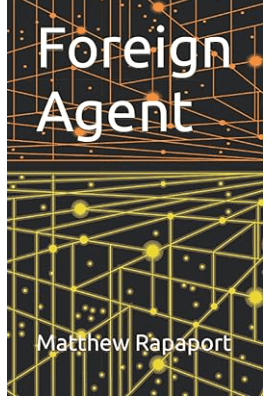
Foreign Agent. 2021

Foreign Agent was conceived while I was taking a shower, having just finished joking with my girlfriend about Chinese technology (his television, Alexa, phones, etc.) monitoring our sex. I joked that I should invoice the Chinese. As I go off to my shower, I say to her: “The only fantasy in all of this is that the Chinese would pay me.” In the shower, I had an epiphany! “I could,” I said to myself, “simply make believe the Chinese would pay me”—not for sex, but for my geopolitical opinion! Sex was an added bonus. And so Foreign Agent was born.

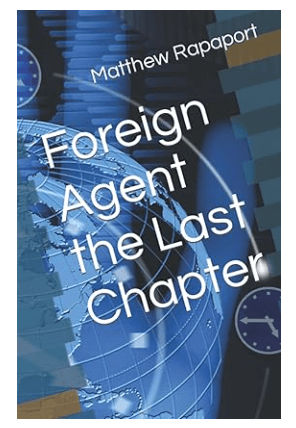
Foreign Agent the Last Chapter. 2022

Foreign Agent was to be a stand-alone novel. I had no thought to write another. But some months after the publication, in another shower, I had another epiphany. There was an element of the first novel, the aliens mentioned only in its last chapter, that could be the basis of a second novel, and so Foreign Agent the Last Chapter was born! This novel is closely tied to the first. The locale and characters are the same; only time has passed.

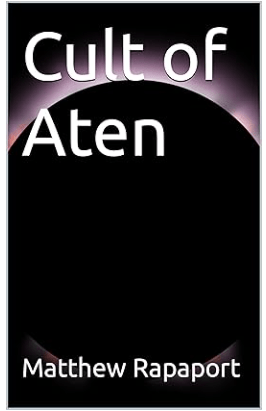
Cult of Aten. 2023

Once again, in the shower, I wistfully realize that my two novels are not selling very well—a few copies a year, maybe! But what might happen, I wonder, if the Cult of Aten (conceived in the second novel) were made real and took off? That became the basis of the third novel, the Cult and the first two books becoming wildly successful! But while the first two novels are ostensibly drafted by Francis Nash in Bangkok, this one is written by me-as-myself. The setting and characters—except for introductory mentions establishing context for the reader—are entirely different. If Foreign Agent and Foreign Agent the Last Chapter are brothers, Cult of Aten is more of a distant cousin and can be read as a stand-alone novel.

LoveMe Inc. 2024

My fourth novel, LoveMe Inc., is entirely independent of the other novels. Narrated by a 38-year-old Matthew (who is not supposed to be me), the novel takes place near Washington, D.C., in 2027-9 and is something of a political thriller. There are a dozen or so main characters, but the central trio includes a libido-charged artificial intelligence conspiring to take control of U.S. and international politics based on ideas found in its training documents—which happen to include—surprise, surprise—the three prior novels of Matthew Rapaport!

The Out of Town Buyer (Kindle only)

The Out of Town Buyer is a co-authored novella, my first non-short-story piece of literature, written in 2005-6 but not published until 2012. The authors are listed as Anonymous & Anonymous to reflect the joint authorship and also hide themselves as both were married (one still is) at the time of the writing. Discovering that J (the co-author) was herself a stimulating erotica writer, I proposed that we write a story together. She proposed that we get together to “do some research.”

The story idea was that each scene (the sex and what happens before and in between the sex) would be crafted in detail and that each author would take a paragraph or two to describe that part of the scene in first person from their own viewpoint, the shifting voices being signaled by a change in font. Together (sometimes in bed), they mapped out the story paragraph by paragraph.

Unlike the later novels, part story and part sex, the novella is, except for an introductory few pages where we meet, all about the sex. My primary aim was to coax J into describing her orgasms. The reader will have to judge my degree of success.

***

Sex in the novels: Through the 1980s, 90s, and into the early 2000s, I wrote a half dozen pornographic short stories published on the Usenet (it was one of these stories, published in 2005 on Literotica, that brought J and me together to write The Out of Town Buyer). In those stories, excessively erotic explicitness is the backbone of the writing’s humor. This practice is only a little smoothed out in the novella, and sex remains over-described in the first two novels. When I wrote Cult of Aten, I decided it was too much of a good thing. In the longer form, the over-description got tiring. As a result, most of the over-description and even some, but by no means all, of the explicitness is removed in Cult of Aten, and this process advances in LoveMe Inc., where even more of the sex, but not all, is closer to soft-core.

Review: LoveMe Inc. by Matthew Rapaport

By Wehttam Tropapar

The novel: ebook and paperback available.

LoveMe Inc. is Matthew Rapaport’s fourth novel, a new story in a new place, with new characters, including the narrator (also Matthew), who is but thirty-eight years old. Ah to be young again… And yet, despite it’s narrative separation from the person of the author, Matthew manages to contrive some marketing for himself and his particular skills.

The story begins ambiguously in the summer/fall of 2027. Matthew, a programmer and statistical analyst, is contacted by a libido-endowed artificial intelligence (AI) and leads him into the employ of Dr. Pamela Parker (who researches psycho-sexual pathologies in women) and her post-grad student Lakshmi Tripathi. When the book opens, Matthew has already seduced and fucked six of Dr. Parker’s patients—I’m drifting into spoiler country here! No sex is portrayed in this part of the narrative, but his “bad boy” behavior comes back to bite him (and not in the good way). 

Together the three of them, along with the AI, discover that certain women can be politically liberalized by orgasms. Between them, and soon more characters come into play, plots are hatched to help sway the national election of 2028, which the Republicans—having, as we know, won in 2024 by disinformation-appeal to an undereducated electorate—plan to fix so that electoral politics in America is ended once and for all.  

There are multiple twists in this plot. AI is at the center of most of them. To tell you anything would commit major spoilers. Here is a minor one: how does Matthew Rapaport market himself? The full answer has two parts, but I’m only going to reveal one. His three novels (Foreign Agent, Foreign Agent the Last Chapter, and Cult of Aten) are the last three novels in the training corpus of the libidinous AI! Of the second, I will only say that it is one of the novel’s tragedies.

Mr. Rapaport is surely honing his craft. This is the most complex of his novels thus far, and except for a limited amount of gratuitous sex—90% of all the sex being softcore—the action all connects up sensibly. Moreover, there are no hanging threads needing resolution in epilogs. Mr. Rapaport ends this one properly!