Review: Alec Bradley “The Burner” Table Top Lighter

tabletoplighter

A quick applause to Alec Bradley for this delightful table top lighter. This is the coolest lighter I have ever owned. It looks cool and works great!

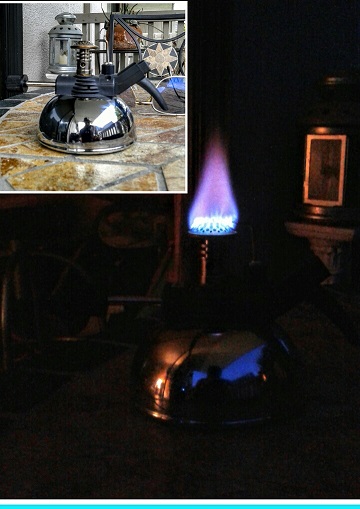
Look at the picture! The gas tank is the base of the lighter and it is a whopper holding several ounces of propane. I use it every day and fill it once a month. The burner head looks like a mushroom sprouting from the base, with slanted sides and a small flat top. From one side comes the handle with an easily accessed button you push in to light. Coming off the handle is the spark wire, nice and thick, very rugged it hangs over the burner head sparking between its point and the head to light the gas. Opposite the handle is the gas valve. One full turn is usually good to light. As the lighter burns the head warms up and the flame grows in size. You merely adjust the valve a bit to get the flame you want. All in all it has a great techie look 3.5 inches tall and 6 inches from end to end it doesn’t take up much room on the table. It’s pretty rugged too. I dropped it on a wood floor once. Landed on the burner but no damage occurred.

Notice the large soft flame, one of the best things about this lighter. A soft blue gas flame (like an old fashioned gas stove) is hotter than the yellow flame of most soft-flame style propane lighters and the flame’s area toasts and lights any cigar very quickly. Its advantages are many, but it does have a few disadvantages..

If you are like me and like to make small corrections to a cigar’s burn line it’s a bit difficult to do with this lighter. All the other disadvantages have to do with using the lighter outdoors. I smoke on a porch so I use it outside. First it is very sensitive to wind. It resists being blown out pretty well, but even a small breeze will cause the flame to dance all over the place making it difficult to find the heat. Second, the flame is pretty much invisible in daylight. Not just direct sun, but any normal daylight. Dim light before dawn or just after sunset is ok, but the lighter is at its best in the dark.

Price around $50 retail “the Burner” is available from most of the online shops that sell Alec Bradley cigars. I’ve had mine for a couple of years now. I enjoy using it very much!

Smoke hardy BOTL & SOTL

Physics and the Evidence for Non-Material Consciousness

selfie

There is an old story of the net and the fishermen. A net having a weave that lets any object smaller than 10 inches long slip through it. Fishermen cast the net in the lake and harvest fish always ten inches long or longer. The fishermen mistakenly conclude that there are no fish in the lake smaller than 10 inches. Philosophy 101 students easily recognize the fishermen’s mistake. If there were fish in the lake smaller than 10 inches they would slip through the net.

Now imagine that there is some constraint on these fishermen that prevents them from weaving nets any more finely than they have. Is there any other means by which they might acquire evidence of fish smaller than ten inches long? As it happens there is. They can take some of the larger fish, keep them alive in captivity, and mate them. If successful, they would see that fish lay eggs, eggs hatch into little fish, and little fish, properly fed, grow into fish ten or more inches long! Having done this sort of thing many times, our fishermen can correctly induct, from many particular observations, that there are indeed fish in the lake smaller than ten inches because those smaller fish are the descendants of the bigger fish and one day will become bigger fish themselves.

Although the analogy is imperfect, physics, that is the present state of our body of science, has something in common with that net. Our senses and all the instruments and physics we can derive from them are physical. No matter how refined we make our instruments they are physical things and cannot measure or detect anything that isn’t also a physical thing. Quantum mechanics doesn’t help here. Ruth Kastner (“The Transactional Interpretation of Quantum Mechanics”) goes so far as to conclude that the solution to various quantum puzzles is to locate quantum phenomena outside of spacetime. But they remain very much physical nevertheless. As indeterminate quantum phenomena emerge into spacetime they become deterministic, fully participating in the time-bound causal web, subject to causal closure.

No one, even died-in-the-wool physicalists, deny that there is any logical proof of the absence of anything real that isn’t physical, but nevertheless most commit themselves to the proposition that no non-physical entity can be real based on the capacity of physics to be self-explanatory. There are also those who simply define ‘reality’ in such a way as to preclude anything that isn’t physical from being real, and therefore chalk up anything historically adduced for such reality to utter illusion, a mirage.

As with the problem of the net, we ask if there is any possible evidence for there being something real in the universe that isn’t physical? Unlike with the fish, we cannot merely encompass some part of the physical and watch it to see if it produces something non-physical. We can try of course. Experiments and observations have been going on since Newton, some would say since Galileo, without such a transformation ever being witnessed. Scientists and philosophers have long conceded that the non-physical, should it exist, cannot in principle be detected and measured with physical instruments, the only kind we can build. They further concede that it is, technically, an inductive error to conclude there is nothing other than the physical in the universe based on this incapacity alone.

What warrants that further conclusion is the observation that physics is causally closed on itself. It is one thing to concede that we could not in principle measure anything non-physical. But when we measure that which is physical, we discover that these measurements alone fulfill all explanatory requirements for the present state-of-the-universe. Physical causes and nothing but physical causes result in all the effects we can measure throughout the cosmos. Physical causes result only in physical effects and physical effects spring from nothing more than physical causes.

For my purposes, as with physics, ‘reality’ is associated with causal efficacy in the physical. Anything that is or can become a cause in the physical is real. Cause is to be taken to mean “contributing cause”. It need not be the sole cause, nor the physically proximate cause. To be a cause it is only required that some physical effect is the ultimate result. The causal closure hypothesis is related to the observation that physical effects have, at least, physical proximate causes. All measurable physical effects seem to have, immediate antecedents that are also physical. But this does not preclude the existence of non-physical causes. For a non-physical cause to be real, it is only necessary that an observer be able to connect up a purported cause and an effect measurable in the world. I will have more to say about this “connecting up”.

Among modern philosophers there are some (Chalmer’s, Nagel, Lowe, Haskers, Foster, O’Connor, and others) who push back on the physicalist claim. They argue that there is reason to believe that there is something both real and non-physical in the universe, specifically consciousness, that is a subjective through which we experience anything at all including our observation of the physical. Physicalists rejoin that this phenomenon, consciousness, is not a “non-material reality”. It is merely a way of viewing the material itself. A rain cloud looks very different from above and below, but both views are merely different perspectives of the same single thing. We confirm this assertion by tracing, physically, from the top to the bottom of the cloud and determine that it is the same entity viewed two different ways.

This does not appear to be possible as concerns consciousness. No physics has ever traced, physically, all the way from subjective experience to the physics (technically biology — brain states) that purportedly underlies it. Many (mostly scientists) argue that we just haven’t got there yet and we will someday make that tracing. Others, many more of them philosophers, argue that the physicalist rejoinder is more hubris than reality. That it might turn out impossible, in principle, to ever make that mapping. Of course this doesn’t mean brain states have nothing to do with consciousness for obviously they do. What it means is that consciousness is not (or may not be) merely “another view” of brain states.

I am not going to address those arguments here but I am going to explore the question whether or not this phenomenon we call consciousness is in fact evidence and in what way it is evidence for the existence of something real that is beyond the reach of physics because it is non-physical.

For any evidence to be evidence, the phenomenon for which it is adduced has to be real. There cannot be evidence for anything that is by definition unreal. At the same time any evidence, if it is evidence of anything at all, has to emerge from, or become available to, our subjective experience as observers. The evidence must appear in consciousness. From our own subjective points of view there is no evidence of anything in the universe, physical or otherwise, that doesn’t emerge in or through our experience — aided or unaided by instruments or quintessentially mental formalism like logic.

How do we fare here as concerns consciousness? Its reality is one of the matters in question. The independent reality of consciousness is controversial. We cannot demonstrate, physically, that it is real. On the other hand, as all evidence of any kind emerges through experience it seems strange to insist that our experience is nothing but illusion. What happens to the evidential status of physics itself if the consciousness that interprets physical evidence as such is only an illusion? Can evidence be real if the status of the “evidence interpreter” is not? What happens to the truth status of the proposition “physics is causally closed” if the subjective arena asserting that proposition is an illusion?

This threat to the veracity of physics is a real problem for physicalists who insist that consciousness cannot be real. It at least suggests that it might be real, that its reality cannot be ruled out by fiat and might have to be accepted for the sake of our seeming capacity to comprehend the world.

The evidence for the non-material character of consciousness also emerges in consciousness! An idea cannot be weighed but it nevertheless appears that ideas are instrumental in the process of moving our bodies and thus our capacity to control aspects of the world confirming the correspondence between experience and physics. All of human society, our technological infrastructure, political institutions, and history are a function of this relation between quintessentially non-material ideas and the physical world. Somewhere in the distant past lies an ancestor, a hunter-gatherer who carried a club and a piece of chipped flint. Having both of these objects and a knowledge of making rope or twine from plant stems, this ancestor thought to attempt tying the flint and the club together producing something novel and more utilitarian than either the flint or club alone. An idea became a physical thing, an ax, through the controlled (purposeful) movement of a body that tied the flint and club together.

Many of the actions we take appear, to experience, related to the ideas we have. Using our bodies, we can pattern the physical by mapping ideas onto it. This is what I spoke of above as a “connecting up”. That I use an idea, a mental picture perhaps of some intended physical end-product, along with appropriate motions of my body, to produce that end product. The connection between the idea and the end product is obvious and immediate to us. It is not a connection between the physical and something non-physical outside of ourselves (magic unicorns perhaps), but between ourselves (subjective experience), our bodies, and the final physical output. We understand that our physical hands fashioned the physical end-product and that our hands moved in response to physical nerve impulses. The connection backs up to what it was that set those nerve impulses in action; a non-physical idea coupled with a non-physical intent to attempt its implementation (a mapping) in the physical.

We take this relation so “for granted” that mostly we do not even notice it. The productive conjunction between ideas and objects, mediated by bodies, means that ideas are real. Through the mediating influence of the controlled body ideas are causally efficacious. This could not be so if ideas were nothing more than illusions. True ideas have correlative brain states that are physical, but we do not subjectively manipulate brain states. We juggle ideational contents of subjective consciousness directly and these have a quintessentially non-material character.

The non-material quality of ideas is not of course proven by their association with physical actions whose consequences are also manifest in consciousness. Deterministic brain states not manipulated in consciousness might result in both ideas (and all of consciousness) and movement thus explaining their apparent connection. If this were true however it would have to be true about every product of humanity from the first struck flint to the space station and for that matter all the institutions and historical contingencies resulting in the present state-of-the-world. A staggering set of deterministic coincidences for which we, that is subjective experience, can take no credit whatsoever.

One cannot have this both ways. Either the subjective arena has no causal efficacy whatsoever or there is here a genuine connection between non-material cause and physical effect. If we wish to suspend judgement on this dilemma we yet must acknowledge that subjective experience does at least rule out physicalist declarations of its impossibility. Our experience counts as enough evidence for the reality of the non-material to question the physicalist assertion that there cannot possibly be anything other than the physical in the universe. Subjective experience seems to be telling us that the non-material is real and the entire history of human civilization at least warrants our concession to the possibility.

The evidence suggests, if it does not formally demonstrate, that something real and non-material is possible and obtains inside the otherwise physical universe. Consciousness (broadly speaking) is that reality. All of the philosophers cited above are materialists but not physicalists. They share with the physicalists a conviction that everything inside the material universe, including consciousness, takes origin in nothing more than the physical. They break with the physicalists in asserting the non-physical can, in fact, emerge from the purely physical and that in this universe, consciousness is that non-physical emergent entity.

Once emerged, they assert, the non-material cannot be fully traced-back to the physical. Subjective experience is not merely another viewpoint, another way of “looking at” something physical, but a novel thing in itself. Once it comes to be, from out of the physical, it can no longer be fully reduced to the physical. This view is called “property dualism”. Two phenomenon, mind and physics, but ultimately a single source, physics. But this view has its own problem with the contents and qualities of experience. Even if the non-material cannot be reduced in any logical way to the physical (more or less the position of all the philosophers cited above) it must, nevertheless originate from nothing more than the physical and this means that some evidence of the transformation from physical to non-physical should lie in the physical past, in the history of the universe. That no such evidence has ever been observed is not proof that non-material origins are not purely physical.

To date no mechanism has been discovered in physics that would plausibly result in such a transformation. If it is true that no such mechanism exists, physics is really causally closed, then the emergence of the non-physical from the physical alone is not possible and no historical marks are there to be found!

Every one of these property dualist theories of the non-material amounts to presupposing either an opening in causal closure or an invisible (to physics) set of causal laws or properties in the physical that add the qualities (to physics) required to produce the non-material. The first approach implies some evidence of itself within physics as noted in the previous paragraph. None has been found, and none of our present theories of the world require any provision for it.

Metaphysically speaking, the second approach is no less supernatural than the hypothesis of a divine being. It may lack the being’s anthropomorphic qualities but its presence and interaction with the physical are no less inexplicable. The “coming to be” of these psycho-physical laws (Chalmers’ term) wants explaining, and their interaction with the physical is no less a mystery than the interaction problem posed by a substance-dualism of mind or for that matter God. For a more detailed treatment of this issue specifically see my “Fantasy Physics and the Genesis of Mind”

To wrap up I summarize what I hope I have accomplished.

1. Physics can measure only the physical.

2. Physics leaves in abeyance the question of some non-material reality inside the physical universe. It remains logically possible. Physics has no evidence for it, but all physics can assert with authority is that explanations of indisputably physical phenomena require no reference to it.

3. There are subjective observers inside the physical universe. These observers all have bodies made of matter and subject to measurement by physics. But they also have “subjective experience” whose qualities are not subject to physical measurement.

4. Either the qualities of subjective experience are not real or they are real and can make some contribution to physical cause; they can configure physical cause (movement of a body) to produce physical effects patterned by a non-material idea. The non-material idea can be mapped to physical reality or put conversely physical reality can be patterned, configured, by non-material ideas.

5. Either the whole of human history and achievement is a blind accident or non-material ideas are causally efficacious and therefore must be real.

In “An Epistemological Argument for Free Will” I argue that free will is real and our experience warrants that belief. None of what is discussed above impinges directly on free will. Our ideas might be both real and non-material without our having free will. The connection between ideas and the physical might, after all, be fully determined even if ideas are in fact the initial patterns of the physical result. But the subsequent free will argument does rest, metaphysically, on the reality and non-materiality of consciousness.

Rum Review: Pusser’s Navy Rum

PussersPic

This rum has a real history. The British navy used to issue a “rum ration” to all its sailors starting way back in 1655. Before this the navy issued beer rations and also tried wine and even brandy, but none of these spirits fared well exposed to the temperature variations experienced in different parts of the world. Rum, by contrast, just seemed to get better with time. The ration ended in 1970 (and British sailors held many a mock funeral for it) , but the formula for the rum was preserved and the makers of Pusser’s bought it from the British Admiralty on promise of never disclosing it. There are (I believe) some 7 different Caribbean rums in this blend making it one of the more complexly blended rums around. What the sailors actually drank, at least in the early days of the ration, was distributed at a higher ABV (56%) and tested by pouring a bit on some gunpowder. If the alcohol content of the rum is less than 56% the gunpowder will not ignite, but at 56% and above, the gunpowder burns.

In the glass: Medium amber about half way between my lightest and darkest rums. Nice color. Swirled makes fat legs that start slowly and then speed up as they drift down the glass.

On the nose: If you take a deep whiff when first poured you get a tremendous hit of a sort of vegetal funk that some have called putrid. I am not a scotch drinker, but the aroma suggests to me what a heavily peated scotch smells like, though scotch drinkers tell me its not. But it does smell a bit like old socks or the moldy undergrowth of a wet forest. There is also fruit, apricot, orange and rich caramel, a lot of complexity on the nose. As the rum breaths the funk drops off a bit but it remains the dominant aroma throughout.

In the mouth: One of my creamier rums, but the cream comes along with some fire. At 42% ABV this rum has a little more alcohol than the others I’ve been drinking (although the Pusser’s “Gunpowder” rum at 54.5% ABV is supposed to be available in the U.S. sometime this year and I will certainly try it). It has a little fire going down, but just enough to remind you it’s an alcoholic drink. Sugar content is low, 6g/l according to the measurements.  Note that the rum is listed at 40% ABV on that list, but that is not correct. Overall the rum is thick feeling, perhaps more so than any of my other rums except for the El Dorado  which has a lot more sugar.

Flavor: Funk! Yes that aroma of old socks or wet mold comes through loud and clear in the flavor. I am told by another rum aficionado that this vegetal taste comes from the distillate of a very old fashioned wooden pot-still used in the blend. This flavor rides on top of everything else. The rum is sweet but not very sweet and the funk cuts it anyway. There is molasses in there and brown sugar, caramel, and raisin, maybe some banana too. There are a lot of flavors to tease apart here, but everything starts with the funk.

Pusser’s is one of the world’s great rums thanks to its history and staying power. It is not a rum every rum drinker likes. Either you like the funk or develop a taste for it, or you just won’t like this rum. One reviewer who didn’t like it called it “putrid”. I’ve noticed this same funky note in two other rums, Appleton 12 year and El Dorado 15. It is pretty up-front in the Appleton though not as strong as the Pusser’s while it presents as a background note in the El Dorado. I’m sure there are many other rums, any that have a wooden pot-still component in the blend, that have it too, but I haven’t found them yet or they are too expensive for me to try. That’s the other amazing thing about Pusser’s. At $25 for a 750ml bottle in California it is among the least expensive rums I have, the Barbancourt 5 star and Gosling’s Black Seal being the other two that are really good. Will I buy this rum again? I’m on my 4th bottle now and I’m sure there will be more to come!

Drink hardy my sailor and land lubber friends!


An Epistemological Argument for Free Will

philmobster1small

Epistemology is that branch of philosophy that has as its subject the various concepts we label ‘knowledge’, ‘truth’, ‘belief’, and also about how we come to “know something”. I begin with a phenomenological observation:  I believe I have free will. I appear to exercise it, to manifest my will by controlling my body.  Throughout my lifetime my experience suggests to me that I have exercised choice that was not coerced upon me nor determined in the same way that physical events are determined, but instead were determined by my-self, metaphorically an entity that sits about 2 inches behind my eyes.

This is a phenomenological observation. The epistemological issue is: do I have knowledge of freedom or is it a phenomenal illusion?  Is my belief in the ontological genuineness of free will justified? Is that belief knowledge? If the proposition “free will is real” is true, any freely made choice would constitute its truth maker. But surely this begs the question because the free-ness of the act is the very matter at issue.

The knowledge of which I speak above cannot be analytic. It isn’t the same sort of thing as my knowing that two plus two must equal four. Rather, it seems to me that my life’s experience, for example my decision to compose this essay, has been a series of choices from an often broad set of alternatives of which I was aware and the the particular choices I made resulted in a history that might easily have been different. Not only my own choices, but those of my fellows near and far, proceeding back into the early reaches of human society could, had they been made differently, resulted in various possible worlds, contingent histories some only moderately different and others vastly different from the history of the world as it has unfolded.

I write here about what philosophers call “libertarian free will” and not merely compatibilism, a doctrine that seeks to establish something to call “free will” even in the face of determinism (and micro-indeterminism) . In that case, we are free when we seem (illusion?) to be able to do “what we want” even if that desire too is determined (or random) and not freely chosen in the libertarian sense. This is not what most of us mean when we speak of free will. We speak of being direct and original causes, volition-directed causes that are not merely the appearance of “bringing into existence” by our agency, but actually are brought about by that volition. If such a thing is real, then determinism must break down in one place.

If free will is genuine, there must be some phenomena with which causal chains begin without having been determined by some physically prior state of the universe, but only by the choice of a volitional agent. Causal chains are what drives event-unfolding. We identify joints in the history of unfolding events. Places where a particular cause directed the unfolding such that in the absence of that cause things would have turned out differently. If free will is real, there should be joints that have no sufficient deterministic causes and simultaneously are not merely indetermined. They would be sufficiently determined by a volitional purpose originating in an agent. Can we identify such joints?

Of course not every joint in the course of history can be related to free will. Natural processes also influence history. In fact some of the characteristic differences between natural processes and human action seem further to support a judgement for the genuineness of free will. The causal chains that yield up a particular volcanic eruption can easily be traced back thousands, even millions of years. But the causal chains that result in a particular human choice, say to pull a trigger and kill someone in cold blood, cannot be indisputably traced back farther than the decision itself. Yes we speak of reasons, individual history, desires, etc, but even these cannot be definitively connected to the choice to shoot or refrain from shooting in the same way that a “hot spot” under the pacific ocean can be definitively connected to the formation of an volcanic island a million years later. When the hot spot formed the volcano became inevitable unless the Earth was destroyed in the intervening years.

As concerns the trigger, our intuition, based on years of having made and unmade (changed our minds) decisions ourselves, it seems that the inevitability of its being pulled was not determined until the instant in time at which it was pulled. This does not imply that the decision is not associated with a physical correlate, a brain state.  The ubiquity of this association is the crux of our problem from a third party perspective.

Note that to deny even the possibility of free will and to assert that what we think are genuine choices are only pseudo-choices because what we actually choose is determined by what amount to a natural process (whether a just antecedent brain state or going all the way back to the big bang), requires a metaphysical assumption not required by advocates of free will’s genuineness (though they too have assumptions that come in at a later point). It requires one to assume that there is nothing more than a deterministic physics in the universe. Making a case for illusion demands a prior commitment to free will’s impossibility. By contrast accepting the possibility of free will based on the phenomenal appearance of it  requires only that we not accept the prior commitment.

Setting the Problem

If I step to the edge of a cliff to admire the view, I am aware that I can take another step in the same direction and fall off the edge plummeting to my death. Alternatively, I can step backwards away from the cliff, or turn around and walk away from it. Each of these choices makes a difference in the world. Stepping off the cliff will initiate causal chains having many consequences for my family, friends, and people who do not know me, but must become involved in the outworkings of my death: police, funeral directors, etc. If I walk away from the cliff other causal chains will begin. I will go back to my work and discover something that makes my employer millions of dollars they would never have otherwise had.

I am certainly not coerced by any external force.  No one has a gun to my head. Yes at this time I have a desire to remain alive and engaged with the world, and this desire is one of perhaps many reasons for my stepping back from the cliff, but a reason is not a cause. I am fully aware of this and other reasons for choices I make every day, but at the same time I am aware that I can (and have in my life) choose in opposition to reasons. My reasons clearly justify (or not) my choice after the fact but they do not determine, that is compel me, to make that choice.

All the same many philosophers (and scientists writing as philosophers) deny that free will is real. They base this denial on observations (measurements) of the phenomena of the physical universe. They discover all these phenomena to be “causally closed” meaning that physical effects come only from physical causes and physical causes have only physical effects. A third quality associated with causal closure is reciprocity: an effect has a reciprocal impact on its cause. If a moving billiard ball strikes a stationary one momentum is exchanged and the direction and speed of both balls is changed. Reciprocity is important because it is often the quality actually measured by science. There are often cases where we can observe (measure) a cause but not detect some effect — perhaps our instruments are not sensitive enough. But we do measure some change in the causal agent and from that change we can infer the effect that could not be measured directly.

The “free will” business, if it truly existed in the full libertarian sense violates these three principles. If I make a choice, and nothing prior in the physical universe determined that choice, then something to which I refer as a self must exist and have to power to initiate physical chains of causation without there having been any prior determining physical cause of that chain (see note on the self at the end of the essay), the ubiquitous presence of correlative brain states notwithstanding. That the history of the cosmos leading to us and our particular lives at this time is the result of chains of physical cause and effect is not particularly controversial. Whether we speak of gravity, colliding masses, electromagnetic energy, or the actions of human agents, the forces that propel history forward are all physical.

To initiate either of the causal chains envisioned from my position on the cliff’s edge I must move my body. It is my body, a physical thing, whose interaction with the rest of the physical world engages with the causal web. I don’t know anyone who disputes this. Free will, if it exists, is antecedent (metaphysically) to such motion even if the choice is simultaneous with it physically. The issue is not that my body isn’t the physical agent of potentially alternative causal change but that there is something else that is the agent of that body’s action, something not physical, a self with the power of volition, initiating novel causal chains by moving a body! Not only is the exercise of volition undetermined it is fundamentally uncaused by any antecedent physical cause or effect. The cause originates in the agent.

The “not physical” part is the crux of the problem. We certainly find physical bodies and in this respect our causal powers are much like those of any inanimate object in the universe. If I throw a rock that breaks a window, the rock is the agent of the window’s breaking, and my arm is the agent of the rock’s movement. Momentum was imparted to that rock by my arm, both physical and no different than two rocks colliding in outer space exchanging momentum and thus velocity in precisely predictable ways. So as we trace back physical effects in the universe, we find only physical causes including the movement of arms. In this tracing, we account for everything that happens since the big bang. There is nothing left over for free will to explain. Quantum mechanics does not help us either. It is true that quantum phenomena introduce indeterminism into the causal web, but while quantum phenomena might provide some metaphysical space for a hypothetical free will to operate, they are not characterized by any volitional purpose. If there is such a thing as free will, volitional agency, the agent must be non-physical because we cannot find it in any catalog of physical cause-effect relations going all the way back to the big bang.

Why don’t we find the agent? Because its presence and power violates the principles of causal closure. Being “original cause” of a physical effect (movement of the body) there is no prior cause of which it, the choice, is an effect. Significantly, from an epistemological viewpoint, there is no reciprocity. When my arm moves with the rock in my hand I am imparting momentum to the rock and there is a reciprocal resistance from the rock. I can feel the rock pushing back (as it were) on my arm as the rock gains momentum. But I have said that the “original cause” of the arm’s movement was an uncaused choice. The movement of my arm has no reciprocal effect on the choice to move it, a choice which is immediately past and unaffected. This is the evidence that the original cause, the choice, is not physical. Physics doesn’t find such causes in the catalog of the physical because there is no reciprocity to measure.

Free Will is Impossible (supposedly)!

I am familiar with three general arguments as concerns the illusory nature of free will, one logical, one epistemological, and one empirical. The logical argument is simply that free will is impossible thanks to causal closure and that is the end of the matter. That we appear to be free willed must be illusion because there is no logical way for a causally closed universe to produce it. This argument entails of course that it is not physically possible for a causally closed physics to produce a non-physical thing, but it is more. It notes there is no connection by which the doings of the physical can be mapped to the non-physical because the physical’s closure is axiomatic. This argument ignores question of what it is that is having this illusion and by implication extends to consciousness in general and self-consciousness in particular. Everything that we take to be our inner lives is illusion. None of the other arguments even matter as they can pertain to nothing other than a fantasy.

The empirical argument revolves around the experiments of Benjamin Libet in the 1970s. Libet found that a detectable brain state preceded a subject’s report of having made a decision. But the subjects in Libet’s experiments were very constrained as concerns their decisions. Even under natural circumstances it is common to find a decision associated with a just prior qualia or a mental event such as the emergence into consciousness of a reason. But that we act because of a reason does not mean the reason causes in any physical sense the motion of a body. How could a reason, a mental thing if ever there was one cause a physical thing anyway? We understand pretty much what reasons are. They have no magical property of initiating causal chains in the physical. But some entity appears to have that power and to choose a particular act from among alternatives whether for reasons or not. It still should not be surprising that there is some “set up”, some change in the content of consciousness, detectable in a brain state, just prior to many of our decisions. The decisions themselves remain free willed.

The epistemological argument begins by noting that naive human experience proves unreliable as concerns the “true workings” of the world. This argument relies on a duplicitous maneuver, deliberately conflating perceptual reliability at every size level (graining) of the cosmos. It is true that our naive senses are not reliable as concerns the workings of the very large: the cosmos, galaxies, the physics of stars. Even the sun seems, after all, to go around Earth! Likewise with the very small. The sub-atomic and atomic worlds, even up to the realm of simple life like bacteria which are made of many atoms, are all beyond our ability to explain given only our unaided senses. But there is a middle range on which our sensory systems are focused and about which it conveys remarkably reliable information. If you make a turn on a trail and come upon a lion, your next decision, for good or ill, had better assume that there is indeed a lion in front of you. Even primitive man knew what substance composed a sand storm. Even believing some god caused the wind, they knew that the wind was blowing sand!

This is a range of sizes, from roughly mountains to grains of dust at which our sensory experiences, the content of consciousness that emerges from our perception of these things, can be taken to be reliable under normal circumstances. As it happens, our own recognition and implicit reliance on the freedom of our will occurs at exactly this level. As concerns the freedom to initiate original causal chains in the physical we are strictly limited to our bodies and these uncontroversially occupy the middle ground of reliable perception and inference. Although we cannot rule out the possibility that our seeming to have free will is not a reliable indicator of its reality, there is nothing about the nature of our experience of it, the experiential world of our bodies which it seems to control, that suggests that it is anything other than free.

The Theistic Alternative

How has philosophy dealt with this issue? One way is to posit something in the vicinity of God who is, like the volitional agent not physical but nevertheless both the source of the physical and the volitional power of a causal agent. Theism puts everything together. There is a physical universe whose mechanisms are purely physical, and there are free-will-endowed agents who can initiate uncaused causal chains. Both are real and their combination in the physical universe is made possible and takes origin (directly or indirectly) in God. But this option leaves something to be explained.

How does God, who is presumptively non-physical, have the power to “make the physical” and further make a non-physical entity, the conscious agent, with the power to interact with the physical and originate uncaused causal chains within it? What is the mechanism of this creation? We notice that the interacting physical and non-physical have, under this metaphysical alternative, a common origin. This at least grounds the possibility of interaction even if it doesn’t explain either how it works or how the two sides were made to begin with. As concerns mind and free will, the theistic alternative is associated with what is called “substance dualism” because mind has qualities that do not emerge from the physical alone.

Philosophers who believe that there are meaningful questions that are in principle unanswerable often have this sort of question in mind. We become self-conscious as non-material agent-observers constrained to physical bodies in a physical universe. Our phenomenological universe lies within the physical universe whose only mechanisms we can sense (often aided by instruments) are the physical ones set in motion by the fact (or the act) of creation. God, should he exist, is not measurable, not detectable physically. Even hypothetically speaking we should expect this to be so. To understand how, by what mechanism, God interacts with the physical we would have, ourselves, to transcend the physical, to be able to examine it as it were from the outside.

Intellectually, God’s reality is an inference based on our observation of causal closure in the physical when coupled with an acceptance at face value of the reality of free will. We are able, at least in principle, to grasp the possibility of original creation (of the universe) because we know ourselves to be “original creators”. In our case the power of uncaused cause is limited to the movement of a body while in God’s case (we suppose) there are no limits other than the consistency of logic, but we do not know this. If we wish to take the theistic route, we only know that whatever the limits of God’s powers, they are at least sufficient to generate the physical universe and self-conscious observers with a limited free will. In the final analysis, as concerns the mechanism of both creation and interaction between the physical and non-physical once created, no answer from our perspective is possible. God presumably knows the trick or we wouldn’t be here, but that is as much as we can say about it (see note on God at the end of the essay).

Naturalism, Physicalism, Materialism, and Property Dualism

Philosophers (not to mention scientists) generally do not like the theistic alternative. Often they cite “occam’s razor” and a somewhat more modern expression in a famous statement by Albert Einstein that “A theory should be as simple as possible but no simpler”. By this Einstein meant to call attention to the requirement that a theory actually explain the phenomena it covers. If it fails that requirement its simplicity is irrelevant! But the aim of the philosophical objection to theism is to remove the theistic demand for an entity that is in principle beyond detection by science. Not only does assuming this entity raise the “interaction problem” (the matter of just how the physical and non-physical interact), but also other metaphysical, epistemological, and ethical questions none of which can be verified or falsified by any physical measurement (see note at end of essay). If the free will that seems justified to our experience could be explained (and not merely explained-away) without reference to a non-material agent with the capacity to produce that power in, or in some sense grant it to, an otherwise physical agent that would be a simpler theory.

But the presently popular non-theistic alternatives also fail to fully explain the seemingly strong epistemological warrant for free will. I review these in the context of a useful distinction between physicalism, naturalism, and materialism. A very good and in depth review of these doctrines can be found in an excellent book by John Foster “The Immaterial Self: A Defense of Cartesian Dualism” (1991) and another, “The Emergent Self” by William Hasker (2001). Also see my essay expanding further on this: “Fantasy Physics and the Genesis of Mind”

Physicalism is a metaphysical doctrine. It states basically the real physical, the stuff that can be measured with physical instruments (including the quantum background which cannot strictly be measured but is presumptively physical all the same), is all there is. Further there is no such thing as evidence for any real non-physical thing because, by fiat, there is no such a thing as a non-physical thing! As one might imagine, physicalists are often associated with the “consciousness and free will are an illusion” position. A few have struggled to find some way to warrant the reality of consciousness (failing other than to say “we just don’t know how it works yet”) but free will is even more difficult because it would so obviously, being “uncaused cause” represent a violation of physicalism!

Naturalism is an epistemological doctrine related to physicalism. It says that there is nothing, no phenomenon in the universe (including consciousness and free will if either should exist) that cannot be explained by reference to physical mechanism. Naturalism is related to physicalism in that if physicalism is true, it would follow that anything that is real in the universe has to come from nothing more than (and thus be explained by) the physical. If naturalists do not deny the reality of consciousness or free will (they frequently do however), then the burden on them is to explain these things in purely physical terms. In this, they have not succeeded.

Materialism takes another path. Like physicalism it is a metaphysical doctrine and it shares with physicalism the assertion that all the phenomena of the universe must begin from nothing more than the physical. But it denies that everything the physical can produce is subsequently explainable in purely physical terms. What materialism does is deny that physical causes can have only physical effects. It opens causal closure asserting that complex physical processes can result in emergent phenomena that, once emerged, cannot be explained in physical terms. It is significant that the only phenomena that count here, the emergence of which materialists speak, happens to be consciousness and phenomena associated with consciousness including free will! Such emergence from the physical is called “property dualism” because while the mind emerges from the physical it exhibits properties that are not physical and cannot be explained (reduced) to purely physical terms.

Materialists are fond of citing other emergent phenomena in the universe. A common example is water. Liquid water has properties that are not to be found in oxygen or hydrogen alone. Water’s special properties only emerge from a set of conditions involving water molecules, pressure, and temperature. But it is significant that liquid water and its properties remain incontrovertibly physical as are the water molecules, hydrogen, and oxygen that compose it. In fact, the properties of liquid water are the outcome of the special shape of the water molecule, and that shape, in turn, is indeed the result of the properties of hydrogen and oxygen. In theory then it is possible to predict the properties of liquid water from the properties of hydrogen and oxygen alone if we understood them well enough. This is even more obvious as concerns the water molecule. Understanding the implications of its physical chemistry would tell us what liquid water was like, and under what conditions it would form, even if we had not encountered it before.

This is the problem with all the examples of emergence cited by physicists or philosophers. All of them are physical with the exception of the one that wants explaining here, consciousness and free will. That these things are an example of just another emergence like water is part of what is at issue. In 300+ years of physics since Newton no physicist has ever observed physical causes resulting in non-physical effects. If materialism is true then this must be possible but that it is possible and that it has actually happened in the case of consciousness (and free will) is an assumption not grounded by the slightest physical evidence. As a metaphysical inference, it has no more empirical standing than God and it suffers from an analogous set of problems.

Property dualism has an interaction problem! How the physical results in the non-physical is the inverse of the problem of how a non-physical God can create the physical. Similarly, the reverse holds in that the question of how it is that non-physical mind can control the physical is the same problem from either the theistic or the property-dualistic direction. It is not controversial that a brain state is the proximate cause of my moving my body. At issue is what causes (if it is a freely willed movement) that brain state! Property dualism explains this no better than substance dualism. In both cases something quintessentially non-material becomes a cause in the material universe.

The philosophical issues with theism stem from having to suppose there is a supernatural being. The philosophical issues with materialism stem from the absence of any observable power in physics to produce anything non-physical let alone a non-physical uncaused cause! Property dualists can only assume that this must be possible just as theists, in the final analysis, can only suppose that God must be real. Theists can only wave their hands and say “God must know how to do it because we experience it.” Materialists can only wave their hands and say “physics must be able to do it because we experience it.”

The epistemological problems are identical in substance and property dualisms. The nature of the subject and the relation between what seems to manifest as a “willful agent” and consciousness is identical. There are even parallel ethical issues. In the case of theism the ethical issue revolves around what responsibility we have to God should he exist. In the case of property dualism there is a question of whether we can be held responsible for anything as there is no guarantee under property dualism that free will is genuine even if consciousness is!

So the theistic alternative posits a “magical being” while the materialist alternative posits either “magical properties of the physical” or special relations between physical particulars that have a magical (non-material) effect. Neither explains how, that is the mechanics of the mechanism, by or through which free will, uncaused cause, comes about in a physical universe governed by the strict causal closure we observe in physics. The theistic alternative at least posits a being with the power to perform the trick, but we are no closer to knowing how the trick is performed either way.

We are back, therefore, where we began. Free will seems real enough in our experience and beginning by rejecting its possibility renders experience meaningless. But we cannot empirically identify causes that could not have been purely physical thanks to those always present correlative brain states!  Either we accept by assumption that it is real (restoring sensibility to experience), or we deny that free will is real and live with the fact that we cannot explain either how or why it seems to be. For my two cents a belief that “free will is real” is true, is justified by the absence of reciprocity in our experience of its exercise, and this despite the fact that, other theism, no adequate metaphysical ground for it has yet been articulated. To my mind the task of philosophy is to explain what grounds our experience. We can explain why the sun seems to go around the Earth even though it doesn’t. But we have not yet explained why we seem to have free will if in fact we do not.
————-
NOTES

The many issues raised by the theistic alternative are discussed at some length in my two books (Amazon Kindle Books) “Why This Universe: God, Cosmology, Consciousness, and Free-Will” (2014) and “God, Causal Closure, and Free Will” (2016).

The SELF: The idea of “a self” is highly controversial in philosophy. There are many explanations advanced for what appears to be a self. Even more than as concerns free will, philosophers almost universely accept that a self is an illusion. I cannot get into this argument in the space of this essay, but I note that almost every philosopher, even categorically denying that a self exists, continues to use language implying a self when discussing free will, consciousness, and any other subject having a subjective aspect. I deal with the nature and reality of the self, personality, extensively in the two books noted above.

GOD: Actually we can infer much more as concerns the nature of God because human consciousness has access to values: truth, beauty, and goodness. I have no time to cover this ground here and it has little direct bearing on the epistemological evidence for free will. Again I refer the reader to my two books listed in the first note above.


Rum Review: Dictador 12 year

dictador12pic

In the glass: Color is a medium amber maybe barely lighter in shade than the Santa Teresa 1796. Indeed there are a lot of comparisons to be made between these two rums. Swirling it generates thin medium fast legs.

Aroma: Only a little alcohol. Lots of caramel, brown sugar, something like a little varnish, but something older there too like some mold or vegetal aroma. If there is fruit in there it is old fruit. After sitting in the glass a few minutes the aroma dies back more fully than the Santa Teresa, but otherwise they are very similar.

In the mouth: Nice and smooth, a medium finish, not bitter. A little heat going down the throat just the way I like it. The rum is a little creamy again very close to the Santa Teresa.

Flavor: This is really why I’m comparing the Dictador 12 to Santa Teresa 1796. They are so similar here! When I first opened the Dictador rum my impression was that of pure milk-caramel, toffee, and brown sugar. But as sweetness goes, even fresh it is not very sweet despite the caramel and sugar flavors. As the bottle breaths a bit these dominant caramel notes settle down and the rum tastes remarkably like the Santa Teresa but a bit less sweet. Sugar tests confirm that this is a very low-sugar rum. Like that other rum, the flavors here seemed squashed together. There is an overall impression but I can’t tease individual flavors out of it.

Cigar Pairing: Interestingly the comparison between Dictador 12 and Santa Teresa 1796 breaks down here. The rum doesn’t seem to do much for the cigars I’ve tried with it so far. I’ve only tried a half dozen at this point, but most were cigars on which the Santa Teresa has some enhancing effect. I didn’t really notice much in any of these pairings, but I will update this if I come across something that connects for me.

All in all I would have to say that this is a good rum as rums go even if it doesn’t seem to suit my palate as a cigar compliment. But good is not great. Dictador 12 year is about $45 around me as compared to an un-discounted $50 or so for the Santa Teresa. If I find this rum discounted below $40 I might get it again, but otherwise, there are too many other rums that are less expensive and do more for the cigars!

Cigar Review: Room 101 Ichiban Maduro Corona

ichibanscrapbook

Appearance: 6.25×44 Corona. Medium brown color on the wrapper, slight sheen, a few veins. Evenly packed, medium dense. The wrapper has a sweet aroma, I’m reminded of fresh popcorn. Taste is salt and pepper. Looks good.

Smoking: Lots of smoke, good burn line all the way down, draw perfect for me — I like it on the light side with only a slight resistance. Enough to remind you you’re not just breathing through a wide straw. Smoke time was 90 minutes, this is a slow smoking cigar.

Flavors: Light cedar, some pepper. I taste significant sweetness here, balsa incense, some sweet wood or leather, some warm cinnamon-like spice, brown sugar. I should note here that I am pairing this cigar with Mocambo 20, reviewed here, a rich rum with a lot of effect on a cigar. There is also some burnt vegetal flavor in there one of the things that makes this smoke different from my Room 101 favorite the Namakubi. In the second half, the leather comes forward while the brown sugar and pepper dial back. Some minty hint comes and goes. As the cigar gets to the nub the pepper comes forward again but everything else, a little muted, is still there!

These are good, highly recommended. I think the Namakubi is a little less expensive, around $8 compared to near $9 for the Ichiban but these prices vary a bit by vendor and more by vitola so look around. I think the Namakubi is sweeter and richer in flavor, but the Ichiban has those complex roasted vegetable and char flavors that the Namakubi lacks. Your palate might easily favor the Ichiban! Either choice will be a good cigar experience.

Rum Review: Mocambo 20 year Aged

Mocambo bottle picture
Mocambo 20 year aged

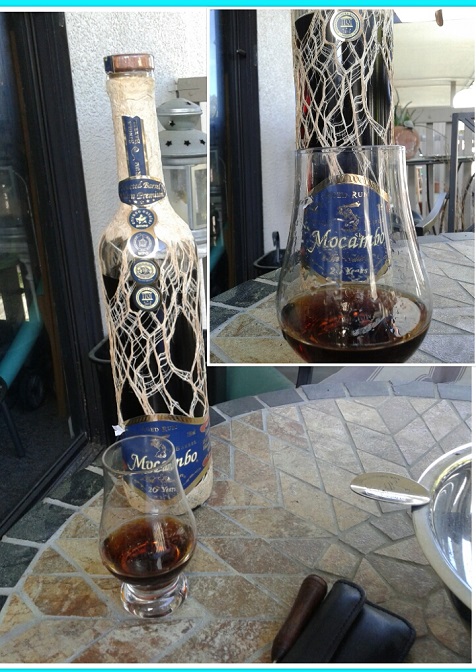
In the glass: Very dark, rich burnt mahogany red perhaps the darkest single rum I have, a little darker even than the Gosling’s Black Seal! Swirled it produces thin fast legs.

On the nose: A little alcohol at first and acetone but minimal and disappear quickly letting the rum breath for a while. There is also dark molasses, burnt caramel (treacle), raisin and a rich clove-like spice, some chocolate, in rich combination that varies as the rum is rested and then sipped.

Mouth feel: Creamy but not overmuch. Smooth with but a little fire going down in a medium long sweet finish that keeps the cream.

Flavor: Wow, a burst of flavors in many dimensions but hitting high notes in molasses, treacle, dark brown sugar, tobacco, coffee liqueur, and milk chocolate. What I really like about this rum is that the flavors aren’t all squished together, you can taste everything and something different seems to pop out with every sip. There is oak in there underlying it all, and a lighter caramel seems to float in there too. The rum is sweet but only enough to be pleasant. I cannot find a sugar test for this rum, but I’m going to guess it will fall in the lower to mid range for added sugar. It is distinctly sweet, more than some, but nearly as much as other rums in my collection.

Cigar pairing potential: Superb! Goes with everything with the possible exception of very mild and lightly flavored cigars. I don’t think this would pair well with a “yard gar”. But do check this one out with a good medium strong and full flavored cigar. Brings out a lot of sugar, roastings, and leather in the smoke.

I think this is a very under appreciated rum. There are few reviews and no results in the sugar test lists that I have found. The bottle says “20 years aged” but I don’t know what that really means. The rum is only $35 at my retailer which puts it into the low-middle price bracket for me and I doubt it is all aged 20 years for that price. It is likely a solera style rum and so perhaps has some 20 year in it.

This was one of the first rums I really got into. My retailer eventually ran out and I was without it for a couple of years when I found it again. I wondered if I would still like it as much and I do! The one independent review I’ve found claimed the rum was “unbalanced”. Perhaps the reviewer did not appreciate the heavy notes in the flavor profile but I think they are great flavors and make the rum stand out. Especially as you can taste them all! It reminds me of the more expensive Dos Maderas 5+5 without the sherry notes. As usual I liked the rum originally because it went well with cigars I like and that continues to be the case. Among my less expensive bottles I will definitely keep this one around!

Highly recommended for cigar pairing!


Rum Review: Santa Teresa 1796

Rum Review: Santa Teresa 1796

Color: Medium amber, about half way between my lightest and darkest rums
In the glass: Thin fast running legs when swirled
Aroma: Mild, little alcohol, fruit like banana, apricot, brown sugar, caramel, tiny bit of acetone.
Mouth: Short finish, smooth with little fire, noticeably creamy.
Flavor: Compressed. There is brown sugar, some caramel, some other notes, perhaps oak, that all seem to be compressed together into a flat meld. The flavor is pleasant but doesn’t seem to have much depth and richness. Sweet, but not very sweet. Added sugar is low, between 0-7g/l so the rum’s sweetness is obtained legitimately.
Cigar pairing potential: Excellent! Goes with everything from light to dark, nutty and leather sweet, roasted vegetables, and flowers to darker chocolate notes. Does not go very well with extremely dark cigars like the Asylum Nyctophilia which gains nothing from it. Doesn’t work with very grassy or vegetal cigars either, but otherwise works with almost everything that has a little sweetness to it.

1796bottleSanta Teresa 1796 was the third rum I picked up some years back when my retailer ran out of Mocambo 20 and Pamparo Aniversario R.E. It was the same price as the second of these and I went through three or four bottles when the price went up and I stopped buying it. By that time, I had sampled and bought a dozen other rums.

At some point later on I found it on sale at another retailer at 20% discount so I bought a few bottles. I was surprised when I didn’t like it nearly as much as I had before. Perhaps the other rums had spoiled me even though they were, with a few exceptions, much less expensive! As described above it isn’t bad, just seems flat and one dimensional compared to other rums in the same and even lower price ranges. I wondered what would happen if I ever found the Mocambo or Pampero Aniversario again, and eventually I did. They both remained delicious to my palate so it was definitely the Santa Teresa. Still good, but not great.

But having gone through a third of this bottle now I remember why I liked this rum. It pairs superbly with most of the cigars I like. Anything with a little sweetness, nut, leather, or brown sugar goes great. I’m sampling it now with a L’Atelier La Mission 1959 and the result is very good! Will I pick it up again? At $55/bottle around here no, but if I see it for $42 again I will!

Cigar Review: Asylum Lobotomy

scrapbook Asylum Lobotomy Petit-corona (4.25″x44) seems to be a Famous Smoke exclusive. There are a few vitolas, but these little babies are by far the smallest and they are tiny indeed, like my present favorite the Room 101 Ecuador petit-corona (see picture)! But it’s a very different cigar!

A Nicaraguan puro with Habano Maduro wrapper and Nicaraguan binder and fillers (otherwise unspecified). It looks real nice. Smooth dark wrapper, slightly oily, not densely packed but not loose either. Feels good with no aparent soft spots. The wrapper aroma is manure and barnyard, very rich. On the cold draw, I got little, but the wrapper is noticibly salty.

Smoking was good. Lots of smoke, perfect draw all the way along. I had to correct the burn a few times, but then I am a “serial corrector”. Oddly though, it did go out a couple of times and I didn’t think I was smoking too slowly. This being the first of these I’ve smoked, and they are fresh having only just been released in February 2016, I’ll see how others go in this.

lobotomynoruler Flavors… Well, if you like pepper bombs, you will love this cigar. From first to last, there is lots of pepper on the tongue and retrohale. It can get so bright that it sometimes tastes like there is a little lemmon peel in there once in a while. Otherwise the first half of the cigar has vegetal, barnyard notes, burnt wood, maybe cedar. As the cigar slips into the second half some sweetness comes in. Sometimes I sense nut, or flowers, roasted vegetables and maybe something like hops. One of the nice things this cigar does is transition from more burnt to sweet, but all sorts of flavor notes come and go adding to the layers here. Throughout it all there is the pepper. Every flavor seems to dance on the pepper but the pepper doesn’t mask the other flavors, instead I think it pushes everything else along. A very interesting blend!

Prices on these are very reasonable especially for the quality of the cigars. These petit-corona bundles of 20 come out to only $3.90/stick. Amazing!

Some Thoughts on Aging Cigars

Some Thoughts on Aging Cigars

When talking to people about aging cigars, and for that matter smoking cigars, I often find it useful to relate the process and experience to wine. There are a lot of parallels. Grapes and tobacco are agriculture products. From one year to the next grapes grown from the same vines have different qualities and so do tobacco leaves coming from the same field and seed-stock. This all makes sense right? Each year the amount of sun, shade, rain, average temperature, and other daily variations affects how the plant grows.

WineFermentationOnce harvested, grapes are crushed and put into tanks where, adding a little yeast, sugar is fermented into alcohol. Tobacco leaves are dried (cured) by hanging in warm airy barns, then fermented by being pressed together into “pilons” roughly 8’x8′ pallets stacked from a few inches off the floor to about 5′ in height. The pressure, heat (135F) and reduced oxygen environments in these dense stacks causes chemical changes in the tobacco that produce all the different molecules (and the carcinogens by the way) that we sense as aromas and flavors in the tobacco when we smoke it. These include esters, aldehydes, alcohols, ketones, lactones, and so many others I’ll just call them “aromatic molecules”. The process also produces huge amounts of ammonia, something you notice immediately when you step into a tobacco fermentation room. Grape fermentation takes a few days. Tobacco fermentation takes some (sometimes many) months while each pilon is regularly rotated (inner leaves going to the outside and outer leaves to the middle) to insure that all the tobacco gets an equal amount of pressure and heat during the whole process.

PilonPictureAfter fermentation, alcoholic grape juice is typically put into oak barrels and left in a controlled temperature and moisture environment for one to two years, sometimes more. Here the parallel between wine and cigars breaks down a bit. Few cigar manufacturers age their fermented tobacco before sorting the leaves and rolling cigars. Padron is the only manufacturer I know (there are perhaps others) who age their fermented tobacco for two or more years prior to rolling from it.

Once wine has aged for a few years it is bottled. Often bottles are made from a single type of grape. Such wines are called varietals. In California (for example) a wine must be at least 75% from one grape type and one year (it might be a blend of the same grape variety from different parts of the field) to be called a varietal, sirrah for example. But many wines are also blends of several different grapes quite possibly from barrels of different ages. Cigars are almost always like these blended wines. Any number of leaves from different tobacco plants are used in the manufacture of cigars, and the presence of some leaf from long-aged tobacco is common in limited-release blends. Usually the limitation is the amount of aged leaf available to the manufacturer!

Once wine is bottled it is shipped. When cigars are rolled they are rested for two to three months (and sometimes more) in slightly drying conditions. This allows them to shed any remaining ammonia and let the hundreds of different flavor and aroma molecules meld. At the end of this process, the cigar should smoke (burn, draw, smoke-output) and taste more or less as the blender intended. Following this rest, cigars are boxed, shrink-wrapped, and shipped. It’s at this point that we pick up the wine parallel again.

Some time is consumed shipping wine and cigars from manufacturer through distributor to retailer and finally to our hands. Wine is very vulnerable at this stage. Heat a bottle of good wine to 100F in a hot warehouse or truck for a day and the wine will most likely be ruined. The whole wine supply chain normally stays climate controlled. Cigars are a bit more rugged. A few days too hot, cold, moist, or dry doesn’t seem to bother them much. I do not know if cigars are climate controlled in the journey from factory to retailer (for economic reasons I would tend to doubt it) where we hope they are kept properly! I routinely have cigars ground shipped from the U.S. East to West coast in all seasons, a 5-7 day trip. I doubt they are climate controlled anywhere in this journey, although many retailers do put little Bovida packets in their shipments for just this reason. Out of hundreds of boxes a few arrive a little dry or moist, but most are just fine.

So open a bottle of new (say 2 year aged) wine and a cigar ROTT (that’s “right off the truck” if you don’t know that one yet). The wine tastes good, and the cigar likewise. Of course we don’t know how long the wine or the cigar has been with the retailer. With wine this can be a big problem and many aficionados buy their wine directly from the winery — wine clubs are hugely popular in California for this reason. This can be a problem with cigars too, but we rely on our retailers to hold the cigars in a reasonable environment. I’ve received boxes of cigars with two year-old dates stamped into them. All of these cigars were fine, and delicious, but of course I don’t know what they would have tasted like two years prior.

Let’s make believe that our bottle of wine left is barrel and our cigar its factory a few months ago for the sake of comparison. What happens when we leave the bottle and the cigar to sit for a while in conditions appropriate to each? Sometimes some magic happens.

After say a month the wine should not have changed much at all. Wine flavors evolve because hundreds of flavor molecules interact within the wine. The water and alcohol make chemical reactions possible between these molecules and new molecules are produced. This process happens more quickly in the barrel but it continues in the bottle although of course without the barrel’s influence. Cigars are a different story. The cigar’s environment isn’t liquid. Chemical reactions (and molecule formation) in fermentation are a product of heat, pressure and reduced oxygen. Although different tobacco leaves (and combinations of flavor molecules) are brought into contact when a cigar is rolled, there isn’t any heat or pressure to induce further chemical changes that form new molecules except by the break-down of existing molecules.

Cigars flavors don’t evolve so much because molecules are being combined, but because existing molecules break down and/or evaporate! Some of the break-down products of aromatic molecules are also aromatic with completely different contributions to the overall flavor of the smoke. Most importantly, these volatile molecules break down and evaporate at different rates. Resting the cigar causes a slight re-adjustment of proportions in its flavor molecules. In some cases (although this shouldn’t happen) a manufacturer releases a cigar a little too early and there is still some ammonia evaporating from its leaves. It might also arrive a little dry or moist. A few weeks to a month in our humidors will acclimate the cigar to our preferred smoking environment. Often the most pungent and sharp (ammonia being a serious offender here) molecules evaporate the fastest leaving a cigar noticeably more balanced after a few months rest, perhaps something the blender intended.

As rest extends from a few months to a year and more it becomes aging. Wines age slowly protected as they are by thick glass bottles and corks that let, at most, a few air molecules in or out of the bottle. Cigars continue their evaporation/break-down progression. As cigars age over a few years, the proportions of aromatic molecules remaining in them change dramatically and as one would expect this has a great impact on their flavor. Relatively speaking, a wine changes as much in ten years as a cigar does in two. In the wine’s case, some molecules have broken down, while various new ones might be built up but none of these molecules gets out of the bottle! In the cigar’s case, everything is about molecular proportions changing as volatile molecules break-down or evaporate from the cigar.

After two years, a cigar having relatively few aromatic molecules when it was young has almost nothing of them even if the cigar is kept in good condition. The leaf might be perfectly smoke-able, it just won’t have much flavor in it. By contrast a full flavored cigar with relatively many volatile molecules in its youth might still have quite a few left after two years but their proportions will have changed dramatically. Molecules that contributed little to the cigar’s flavor years before might now dominate. After a while most of what is left in old cigar leaf is sugar and amino acids that are too big to evaporate. When burned together they form pyridines and pyrazines which are responsible for the dominant note in cigar smoke (fresh or aged), but do not by themselves have much nuance in aroma or flavor. It’s all the other extras, if any, that add the flavors and aromas we look for in cigar smoke.

Here’s where things get interesting and the cigar-wine parallel comes back full force. Sometimes a good young wine is even better in five years, and sometimes not. If good after five years it might be bad (or even better) after ten. There are wines that are characteristically better or worse aging performers, but that is only broadly true and bottling (different years) of the same grape blend can vary here. In the end, when sampling a ten or twenty year old wine (even kept in perfect conditions) you just have to see how it comes out. The same thing happens to cigars. As the proportions of flavorful molecules change the cigar’s taste profile changes and much of the time for the better up to a point. Most smokers agree that cigar flavors are a bit less sharp, more rounded, balanced, and even a little sweeter after a few months rest. This seems even to happen with cigars whose tobaccos are considerably aged prior to rolling. Sometimes (and much here depends on the individual palate) this improvement continues up to a few years, but sometimes it doesn’t and the cigar becomes hot, flat, and uninteresting.

As with wine there are characteristic tobaccos that age well as compared to those that do not, and at the same time there is a lot of individual variation from year to year and manufacturer to manufacturer. I mentioned palate above. Wine experts tend to agree about a given wine. Most will agree about flavor improvement or lack of improvement and in what way the flavor changes with age. There is much less agreement among cigar smokers. There are cigars I believe taste better fresh and are less flavorful after a year or more. Others will feel just the opposite about the same cigars made about the same time from the same crop! I’ve also had cigars that were, to me, mediocre when fresh (other smokers loved them) that were far tastier after two years forgotten at the bottom of my humidor.

Do I age my cigars? Well I buy cigars by the box and I have many different cigars so even when I’m smoking through a box “quickly” it takes about six months. A box of more expensive cigars goes more slowly and I will always have one or two cigars remaining after a year or more. Finally I have deliberately set cigars aside for two years just to see how they evolved. In some cases the results were excellent, in others, not so much. What about the plastic wrapper on many cigars; on or off for aging? I happen to like the plastic, it protects the cigar, but I often cut the foot off of it to let the cigar breath a little more. I do this when transferring cigars from box to humidor so it just remains that way if the cigar ends up aging. I have however also aged cigars that had no plastic wrap to begin with. If your humidor is properly maintained you shouldn’t have any problem with or without the plastic.

I do urge you to give cigar aging a try if you can, another dimension to the hobby. At the same time I don’t sweat it too much. Most of the time my cigars taste fine ROTT and a couple months rest never hurts them. As I’m smoking mostly less expensive cigars these days the more expensive sticks I yet have are going slowly, but I still smoke them now and then. I probably have a dozen cigars over two years old, but that seems to be the limit to improvement for most and some are past their peak at that point. I recently had a four year old cigar and it was delicious with a rich brown sugar flavor. But it was a one-of-a-kind gift and so I have no idea what it might have tasted like when younger.

This link will take you to a good technical paper on the chemistry of cigar tobacco in particular with comparison to cigarette tobacco preparation. It is heavy on the anti-cancer angle concerning tobacco, but the list of chemicals and other components of fermented tobacco is really good.

Giving credit where credit is due, the pictures above of fermentation tanks come from the Hoga Company and pilons came from Google photos via RobostoJoe.

Here is a link to another aging essay by RobustoJoe who gets the credit for the pilon picture. On the whole he and I agree, but he claims that fermentation continues as cigars age, something I think is not correct.

Smoke ’em up BOTL and SOTL. Have fun!