Fantasy Physics and the Genesis of Mind

selfie

Physics rests on the “causal closure principle” (CCP). The CCP has three legs:

CCP(1): Physics comes only from physics.
CCP(2): Physics produces only physics.

Together these say the physical effects we observe come only from prior physics, and physical causes (using cause in its common language sense) produce only physical effects.

CCP(3): There is no teleology in physical mechanism, no goal-directedness. CCP(3) is something of a corrollary of the first two legs. Physical relations and interactions are either determinate or indeterminate, but either way they are not “before the fact” directed at particular outcomes.

If God does not exist, the only philosophy of mind (PoM) consistent with all three legs of the CCP is eliminative materialism. Every other nontheistic PoM that rejects eliminative materialism and accepts that mind cannot be logically reduced to physics, violates the CCP in one or more ways.

PoM theories that claim mind exists in some sense of that word, that mind is real and emerges from ordinary physics without anything “in principle undetectable” (QM aside) added to physics to make it happen violate CCP(2) but not CCP(3).  They assert, plainly enough, that physics results in something that is in some sense non-physical, but mind’s emergence is just as accidental (contingent) as all other [physical] emergent phenomena (from stars to liquid water to life).

PoMs claiming that physics is incomplete, that something else must be added to ordinary (measurable) physics to make mind emerge (dual-aspect monism and panpsychism of various sorts) violate both CCP(2) and CCP(3).

Only theism can both accept all the CCP while accommodating mind’s reality (and for that matter libertarian free will). Theism also grounds our conviction of agency which nontheistic theories universally deride. I write about theism extensively but my purpose in this essay is to show that the [supposed] problems with theism for physics and PoM are no worse than those of nontheistic PoMs. This is to say both suffer from equally serious metaphysical and epistemological problems.

Being inaccessible to empirical (or for that matter logical) demonstration (or falsification), a “God hypothesis” is a speculative solution, a curve drawn arbitrarily to fit points (mechanistic nature of the universe joined with free will for example). Other speculative solutions, so it is claimed, are equally possible and equally impossible to confirm or deny. In fact however it is more difficult than it seems to come up with these alternative solutions. Speculative solutions that fit all the points (the mind-independent world and everything in experience) and remain logically coherent are difficult to invent. Many have tried. Like theism, atheistic attempts at solving the mind problem are also data-free speculative solutions because the data, mind emerging from brains, cannot be observed!

Physicists are often eliminative materialists (nothing emerges strictly speaking) or reductive-materialists (only an epiphenomenon emerges).  Only eliminative materialism is fully compliant with the CCP and logically coherent, but it is also the solution that is most prima fascia absurd from the subjective viewpoint it denies exists! Reductive-materialism either violates CCP(2) if epiphenomenal-mind is taken to be something real or it is logically incoherent! Physics causes the external conditions of a mirage, but the illusion that is the mirage happens only in a mind. An illusion presumes a subjective experience in which the illusion occurs.

The view that a non-material mind emerges from ordinary physics violates CCP(2)! The idea is coherent because mind is not taken to be an illusion. The problem is that no physicist has ever seen a physical phenomenon emerging into (or as) a nonphysical one. We see physics emerging from physics all over the universe from galaxies and stars to liquid water to life, but all of what comes of these events (causes and effects) is physical! The retort from physics is that we do not see any other non-physical emergence because the one such thing that has happened in the universe is the very mind we are trying to explain. Mind is the evidence that physics can produce mind. Surely this argument is circular? It plainly begs the question to say that the evidence physics alone can explain the appearance of mind is mind!

There are a few philosophers who follow the physicists here (John Searle, Bob Dole among others), but many philosophers see problems in this approach. First there is the circularity already mentioned, but in addition, this solution (whether it includes a role for quantum mechanics commonly cited by both physicists and philosophers) entails that mind’s appearance is contingent. Not only might it not have appeared in the universe, something every materialist accepts, but its appearance is mysterious. The mystery applies to mind in general, and individual minds in particular. Why is consciousness ubiquitous in animals with complex nervous systems?

Troubled by these problems, materialist philosophers seek solutions that remain [purportedly] physical while, at the same time, channeling universe evolution towards consciousness and by doing so taking its mystery away. But every one of these solutions violates CCP(2) and CCP(3)! The idea that universe evolution is directed is plainly teleological! This is what prompts philosophers (and some physicists) to grasp the straw of quantum mechanics,  but this (I will argue) doesn’t help them.

To explain genuine mind in a Godless universe there are dual-aspect monisms (Henry Stapp, Donald Davidson, Thomas Nagel) and panpsychisms (David Chalmers, Philip Goff, John Leslie). Under normal circumstances both of these theories would count as metaphysical, that is not physical theories at all! They are physical not logically, but merely by ancestry. Purportedly they remain physical (or physics grounded) because their novel (never specified) qualities can only have originated in the big bang!

Dual-aspect monisms make the claim that physics is incomplete in the sense that there are additional fundamental properties in micro-physics not yet (and perhaps never to be) discovered. The physical in this view includes the mental in a proto-property form. This undiscovered addition is not conscious; atoms are not aware. Nevertheless the qualities of this extra-physics direct event unfolding towards that which yields consciousness. Working backwards from consciousness, this channeling must also encompass the preconscious stages of life’s evolution and the origin life throughout the universe. To our empirical experience, only life, some life, becomes conscious, and that only as it gains the right sort of complexity following millions of years of evolution.

If dual-aspect monism of any sort was true however, we would expect its effect to show up in the equations describing the regularity of physical evolution. There is no such term in the equations of macro physics so to say that this extra aspect of the physical is a part of physics surely begs the question.

This is why I think so many philosophers grasp at quantum dynamics to locate proto-mental qualities. We cannot directly measure quantum phenomena until they interact with the macro physical world, and quantum phenomena, technically, are not random but indetermined. Perhaps (so they speculate) we can locate the proto-mental in the difference between ‘random’ and ‘indeterminate’, in effect shielding teleology from possible detection? But surely a proto-mental is not the only possibility accounting for the restriction from random to indeterminate (see note on this distinction at end of essay).

Furthermore no one (physicist or philosopher) has been able to say what properties the proto-mental has, how they restrict random to indeterminate, or how the indeterminateness of the quantum phenomena we know push the macro universe towards consciousness. Even Henry Stapp’s “Quantum Zeno Effect” addresses only the narrow interface between brain and the human type of consciousness. Even if this speculative connection turns out to be a measurable phenomenon, no one has suggested how the physical world accommodates it. They all seem to agree that the proto-mental cannot be conscious in the sense that we experience it, but that tells us nothing of what properties it does, or even might, have and how they work!

What all of these theories entail however is that the mental (the proto-mental at least) must be antecedent to the physical! If it has a downward influence on the physical, which these views entail, it has to be ontologically real! Where does it come from? If the foundation of the universe is physical, what is it in or of the physical that grounds the proto-mental? The idea of a proto-mental here is not incoherent by any means. But it’s coherence largely depends on there being something about the fundamental ontology of the universe that isn’t physical! Moreover something that directs with intention!  Teleology is here introduced something the more honest of the philosophers admit they cannot seem to avoid.

For these reasons, dual-aspect monisms violate CCP(2) but they also violate CCP(3) because whatever else the extra might be it is clearly teleological. Instead of the universe ending in one state or another driven only by contingent process, the extra-physics channels evolution toward a specific outcome! It is therefore purposeful in the sense of being goal-directed.

Panpsychism is the converse of dual-aspect monism. It isn’t that mind builds up particle by particle thanks to some undiscovered property of particle physics, but rather it is the universe taken as a whole that comes to embody the extra physical qualities. Philip Goff (in a paper) neatly distinguishes two forms of panpsychism, micro and cosmo versions. Micropanpsychism is much like dual-aspect monism. The mental is attached to physics at the particle level but it isn’t effective except as contributor to a totalizing affect of the cosmos. Micropanpsychism has dual-aspect monism as a foundation but asserts that its impact is felt only in relation to the whole universe. You might think of this like neurons and brains. Every neuron in your brain is a foundation of brain functionality. But mind doesn’t show itself other than at the level of the whole brain, or at least large parts of it. In Micropanpsychism, the properties of the whole emerge from properties of the parts.

Cosmopanpychism abandons the dual-aspect foundation and asserts it is only the universe as a whole that reveals proto-mental properties. This view needs no micro-alteration to physics. Mind emerges from brains the way stars emerge from gas clouds because special properties of the totality, properties described by laws parallel to those of physics, are able to invoke it. Somehow, the entire universe acquires properties (usually not taken to be conscious as such) that come to direct physical evolution, and then biological evolution, towards consciousness.

This idea clearly violates CCP(3) (it is teleological) but is precisely an attempt to avoid violating CCP(2).  It is unsuccessful because the panpsychist claim is essentially that from the total state of the universe there emerges a parallel collection of qualities (properties and laws) that evoke mind from brains!  At one level or another, physics results in non-physics and so violates CCP(2). Besides Goff, David Chalmers is a proponent of this view.

For the cosmopanpsychists the “mental qualities” do not (typically) amount to the emergence of a literal Cosmic Mind, a “thinking universe”. Such a view would amount to substance dualism at the level of biological mind! But the philosophers who assert this do not, with one exception that I know of, specify what any of these properties are. As is the case with all the other theories, none of the qualities that supposedly effect the transformation nor any part of the mechanics of their interaction with the other-than-mental are anywhere given.

The exception here is John Leslie who asserts the property or quality characterizing this emergence is goodness. We normally think of goodness as a quality of the character of persons and so, by extension, of their minds. Emerging with the big bang is not only purposeless physical mechanism, but a parallel quality of goodness. A universe pushed in that direction is so pushed because goodness is a quality of it from the beginning, and mind is good!

To get the job done, any of these extras must, necessarily, be effective. It does no good to say that something besides the physics we know, something that is nevertheless physical (or quasi-physical), might or might not push cosmological evolution towards life and life towards consciousness. If the operation of these extras is itself contingent then what would be their point? To do the job they must not only have the necessary power, but that power must result in their goal-directed effect. The extra-in-physics, its goal-directedness, must be logically antecedent to the physics we measure that does not, in any aspect, appear goal-directed.

Where does antecedence come from? Since all of these philosophers are materialists, it must originate, with everything else, in the big bang. But there is nothing in the physics of the big bang that contains anything of the mental, anything of this extra there, and certainly nothing to which we can point that bears value; goodness. The big bang is a quintessentially physical event. What is  the proto-mental property in physics? How does it arise from within an other-than-mental physics and yet be logically antecedent to physics?

The extra-in-physics, under any of these approaches, hangs, metaphysically, on literally nothing! In John Leslie’s view, not only is universal mechanism goal directed, it is also moral! For him, morality happens to pop into the universe with the big bang and it is this quality that underlies drift towards the mental. How, presumably in the absence of any mind, has this direction become good? Even if it is, how does goodness effect the direction of physical contingency?

Does physics itself have an analogous problem with this last point? Where does the physical universe come from? Why is there any physics at all? Physicists have an out. They have the quantum vacuum which, while purportedly physical, cannot in principle be directly probed. This boundary layer between physics and nothing insulates physics. As concerns physics itself, and anything it gleans of quantum phenomena, the CCP is not violated. It is for this reason, I think, that so many philosophers reach for the quantum straw. We have already seen that this move is ad hoc. Moreover it goes against that which we have discovered about quantum behavior. No “mental term” is needed in the equations of quantum mechanics any more than in macrophysical equations, and goal-directedness is not implied by any of our multiple quantum interpretations.

To be fair, many of the philosophers who propose the solutions outlined above recognize that these suggestions violate the CCP. All claim (often citing Occam’s Razor) that violating the CCP is less onerous than supposing there is, for example, a God who knows the trick of making all of this work out the way it has. Working out a way, that is, for purposeless physical mechanism, mind, and even libertarian free will, to coexist in the universe. What troubles me about these philosophers is their refusal to admit that these problems (what brings about cosmological mental properties. How precisely do they interact with physics) are in some respects more mysterious than God! At least God can be supposed to “know the trick”.

Perhaps in the greatest twist of irony,  many of these minds have thrown up their hands and returned to idealism, abandoning the CCP entirely! Not only is the mental logically antecedent to physics, it is ontologically prior! The above mysteries are resolved because mind causes physics and not the other way around! The irony is that, in essence, this is what theism has claimed all along! I should not need to point out that in God’s absence, the metaphysical ground, prior to physics, of the mental is unfathomably mysterious!

How does a “God hypothesis” avoid violating CCP(1) with particular regard to free will? Doesn’t a genuinely (libertarian) free will entail (as Sean Carroll has put it in “The Big Picture”) that “mind causes physics”? In a narrow sense yes, theism violates CCP(1) but theism has an out. Mind is presupposed after all and constitutes the one exception to CCP(1) in the universe! The Theist is free to change CCP(1) to read: “physics comes only from physics and mind”. This move doesn’t help the physicalist because for her, the issue is the emergence of mind from physics without presupposing mind. They can, of course, say that mind is the only exception to CCP(1), but that surely begs the question, there not being any other evidence that physics can do this.

The change to CCP(1) is not circular in Theism. Yes mind is an exception. It is in truth a cause of physics. But here mind is presupposed. CCP(1) is not violated because mind doesn’t emerge only from physics. The exception, that part that evokes subjective experience from brain activity, comes not from physics but by some indirect route from God. It must be indirect (I do not believe God personally manages emerging individual minds) because God is changeless while mind, individual mind, changes with time. Mind’s direct source (besides brains) must be inside time.

Theism does not violate CCP(2) because physical mechanism still produces only physics. The result of mind-producing-physics, say the movement of my arm, remains physical. Theism does not violate CCP(3) because physical mechanism remains perfectly purposeless. Purpose as such remains entirely in mind. Notice that CCP(3) does not say that the physical universe has no purpose, only that the local operation of its mechanism (macro and micro)  is purposeless.

The goal of this essay has been to argue that nontheistic notions of mind’s emergence (or lack of existence) have problems equal to or exceeding the problematic aspects of theism. Let’s review.

God is a fantastical being. Positing his existence demands at the least an addition to what physicists take to be the only ontology of the universe; the physical. A God hypothesis demands that this entity has the power and knows the trick to producing the physical as well as causing minds to arise from the physical work of brains and interact downward with the material world. This mystery cries out for a physical explanation; at least a suggestion of what it is about the physical that makes that connection. Theism does not supply this physical answer, but nor does physicalism or any of the extra-physical theories covered above.

On first blush, the extra-physical ideas demand less addition to our fundamental ontology. The physicalist theories demand, if not technically an addition to ontology, at least that the physical can do that which no observation, no experiment, has seen it do; bring about something nonphysical. The extra-physical theories do demand a new, non-material addition to ontology. It isn’t God, but yet it must have the power to bring life and then mind about. Not only must it have this power, it must surely succeed. If the emergence of consciousness remained contingent and might not have happened the extra-physical qualities of the universe would be redundant. Further, any direction, anything other than absolute contingency, implies a teleology that has to be antecedent to the physics it influences!

The atheist philosophers who hold such theories recognize that they do move partway towards God (at least a Deistic version of him). In effect they are a “functional God”. But if there is no real God, then in what, metaphysically speaking, do any of these properties cohere? If you add to this stand-in the property of “having purpose”, and to backstop an infinite chain of prior cause, being first (and so uncaused) cause, you pretty much have gone all the way to God. In the end, the purely physicalist theories are nonsensical because mind is both prima facia obvious and non-physical. The extra-physical theories, if they do not need all the qualities of an “Abrahamic God”, require enough of these properties (non-materiality, purpose, antecedent cause) to be equally fantastical! When, in addition, you accommodate the problem of these mysterious properties emerging, literally from nothing, you end at a full-blown God concept that is at least deistic if not fully theistic.

Updated Dec. 2018


Note on the distinction between ‘random’ and ‘indeterminate’

The distinction is important in quantum mechanics (I believe) because quantum phenomena come out in a well known and repeatable probability distribution even though there is no reason, no cause that we know of, why they should not be actually random. An electron could, theoretically be anywhere in the universe but there is a 99.9% probability that it will be found in bounded range of locations.

Here is a mundane macrophysical example I hope captures the idea. Imagine a fair six-sided die. Any face from 1 to 6 can come up with equal probability. The die is random within the confines of possibility (even an electron cannot be outside the universe). Now suppose you have a heavily-loaded die in which two sides, 1 or 6 are likely (and repeatedly) to come up on 90% of the throws, but within that 90% a 1 or a 6 are equally likely. That die is no longer random, but it is indeterminate.


Review: The Order of Time by Carlo Rovelli

By sheer coincidence I published the essay, “What is Time”, shortly before reading Carlo Rovelli’s book. Rather than writing additional commentary here, I put a pointer to that essay. While it does not address Rovelli directly (I hadn’t read him yet) it covers the points made in the review included below. But I do not want to discourage people from reading this excellent book. It is always good to understand the arguments of authors with which you (in this case I) happen to disagree. One cannot claim to be a well rounded philosopher without understanding what it is that those you disagree with are saying.

The Order of Time by Carlo Rovelli (2018) Amazon review

Like consciousness, time is a subject that no philosopher or physicist has ever managed to nail down completely. Thanks to their slippery character, being so close to us (the first one IS us) they are endless sources for fountains of speculation. In this book, Rovelli’s subject is time, but consciousness comes into this narrative as well.

Rovelli is a “time denier”. OK, that’s being a little unfair but not by much. What he denies is that there exists an independent, fundamental property or quality of the universe that is time. Of course the universe is full of movement and change, events unfolding into other events. His basic position is that time emerges into our perspective, our viewpoint, from these phenomena, but it is merely an illusion. The movement is real, the changing is real, but the time in which all of this seems to occur is nothing more than a manifestation of human (possibly animal) mind and the illusion, in turn, is supported by the entropy generated in the functioning of our brains.

The book (not long read) is divided into three parts. In the first Rovelli covers the various sub-disciplines of physics and their temporal implications (or lack thereof). He begins with classical physics (the equations work backwards in time), and moves on to General and Special Relativity, and quantum mechanics. Here he demonstrates that our simple intuition of a universal time flowing from past to future is untenable. Time, mind-independent time, if it exists at all, cannot be like that. In part two he further demolishes time. Not only is it not what we think, in and for physics, it doesn’t really exist at all; even the present is an illusion! In part three, he puts time back together for and in the perspective of an subjective viewpoint.

He argues it is the fact that we view the world from a perspective, that when we perceive the world we inevitably blur the details into a sort of summary or gestalt for our perspective, that causes time to appear to mind, The physics supporting that appearance comes down to thermodynamics. Human time, brain time, is “thermal time”. Certainly Rovelli thinks thermodynamics (in particular the 2nd law) is real, but while responsible for what consciousness perceives of time and so a real enough subjective experience, from the 3rd party perspective of physics, change is real, but time is a mirage.

This book is written for a lay audience. There is almost no math in it (what there is appears in footnotes), and it defends a view common to much of the physics and philosophy community. To be sure Rovelli differs a bit from some of his peers. He argues that relativistic “block time” is no more a “true portrait of objective time” than any other theory. In Rovelli’s view remember there is no such thing as “objective time”.

In 2015 a philosopher (Roberto Unger) and a physicist (Lee Smolin) wrote “The Singular Universe and the Reality of Time”. This book (reviewed by me on Amazon) makes precisely the opposite case from that of Rovelli. Of course they recognize what Relativity and quantum mechanics imply about time, but they maintain, nevertheless, that a notion (and reality) of objective, “universal time”, is more fundamental than any other phenomena of the universe, even more than space! Rovelli mentions this book in a footnote and admits that Unger and Smolin’s view “is defensible”, but he leaves it there and never addresses what is defensible about it.

The Unger/Smolin book goes against the grain of 95% of today’s physicists. Personally I agree with Smolin and Unger. The fact (thanks to limiting effect of the speed of light) that we cannot map our present to any present in a remote galaxy, or even the nearest star does not mean there is no present there, in fact everywhere. Something is happening, NOW, everywhere in the universe. We do not know what it is, but that does not mean the present isn’t real as Rovelli believes. Had Rovelli directly addressed Unger and Smolin I would have given this book another star. Had he not mentioned them at all, I would have taken another away.

In summary this is a decent and well written book advocating for a particular view of time (or no time) that I happen to think is wrong, but what do I know? It happens to be the dominant view in physics today. Rovelli is a well respected physicist and a good writer. Those of you interested in the subject will find this book valuable whether you agree with the author or not.

Review: The T by Three Masters of the Cigar Blending Art

Review: The T by Three Masters of the Cigar Blending Art

Robert Caldwell, A. J. Fernandez, Matt Booth: Three well recognized names in our favorite industry. This is their second release together, this one produced at the Fernandez factory in Nicaragua. The cigar was to be named “The Truth” but Tatuaje seems to own that name. Really? You can own the word “Truth”?

I’ve been over a half dozen other reviews of this stick and the principals are not revealing much about the blend except that it is Nicaraguan puro.

Wrapper: Ecuador Habano (grown in Nicaragua)
Binder: Nicaragua
Filler: Nicaragua

There are five different vitolas, all box pressed. The one I’m smoking is the Lonsdale, 6.5″ x 44.

Cold Aroma: Black tea, manure, barnyard are the aromas I get, especially the tea. Some other reviews have been all over the place with this.

Pre-light construction: Dark brown wrapper, slightly toothy. No veins, almost invisible seams. Box pressed, firm, no soft or hard spots. Looks fabulous.
Draw: Just about a perfect medium here that stays consistent throughout the smoke.

I have seen this cigar reviewed everywhere and everyone loves it. Alas is too expensive for me usually $12/stick at the box level. So when Cigars & Pipes recently had a fire sale and I saw these for $8.50/stick (still a full $2 above my present budget cap) I had to grab a box. Might be the only box I ever have, but I am glad I went for it.

When you light this up you get a little pepper that rapidly dials back and stays in the background. I get sweet wood, nuts, coffee, and lots of leather in the flavors, even sometimes a hint of fruit in the retrohale! Smoke output is great, and the cigar wants to smoke slowly. What strikes me most though is the cigar’s smoothness. All the flavors come out as a marvelous sweet meld. I cannot think of its like in any other cigar except maybe the 1924 Anniversary Padron, a cigar I have not smoked now in a few years as their price just went too high. Back to the T, as the cigar smokes down it gets a little less sweet while pepper and barn yard flavors come forward. The burn line stays straight throughout. This is a very well constructed cigar!

Flavors here are so well blended that none of them come out and really strike you, instead shifting back and forth with every puff. And this is a kick ass cigar, very full strength, or perhaps it is just the length of the stick. I’ve been through four of them now. The first two made me dizzy. I tried to let one go at the 3″ mark and come back to it, but even after a few hours when I pick it up the pepper comes way up and the other flavors have disappeared. I have to smoke this stick very slowly. Total smoke time ends up being about 90 minutes!

The ash does not hold very long, dropping at about 1/2″ but that might have something to do with how slowly I am able to smoke it. This is truly a cigar to savor. The subtle flavors here seem to go best with a subtle rum. The 40% ABV Real McCoy pictured is perfect. I reviewed this rum’s stronger brother a while back before I tasted this version. Turns out they are exactly the same rum (I believe) with this one watered down to the 40% level while the more limited edition version stands at 47%.

Over all, a great stick from three great masters of the cigar blending art. Given today’s cigar prices these are worth their $12/stick sticker even if I can’t afford them. If you find them at any price substantially under that, don’t miss out!

Cigar Review: Room 101 Serie HN Papi Chulo

Cigar Review: Room 101 Serie HN Papi Chulo

Released in June 2013, this must be one of the Room 101 sticks prior to Matt Booth retiring from the business. I gather he is back now, but will not be re-releasing old blends. So this is one of those rare deals (the only kind I can afford these days). Famous Smoke dumping odds and ends for steeply discounted prices. This 50 count box came out to $3/stick including shipping! The cigar is a cousin of the Namakubi and Daruma also released in limited numbers with a Papi Chulo vitola. I think this is a less “dry chocolate” (Namakubi) and “vegetal wood” (Daruma) and more light brown sugar sweetness. In any case all three are delicious and I am happy to have this deal. Let’s get to the cigar.

Wrapper: Honduran Criollo 98
Binder: Brazillian Mata Fina
Filler: Honduran Criollo Ligero and Dominican Navarette

Vitola: 4″ x 42 “Papi Chulo”

Open the box and what hits you is strongly aromatic black tea along with barnyard, manure, and leather. Wrapper color is medium brown, the pack is even all the way around and medium. The stick is not as firmly packed and dense as the Namakubi. The wrapper has a few fine veins, but everything looks very well made. I did a straight cut, draw is superb for me (I like it on the light side) and stays that way throughout the smoke.

Burn line stays pretty straight. I made minor corrections on one of three sticks I’ve smoked so far. The other two required none. Smoke output is very good, and stays steady throughout the smoke. Smoke time for me about 50 minutes. These smoke a bit faster than the Namakubi or Daruma which are more densely packed.

Flavors: Light on pepper until the final inch when it comes up considerably. Much of it is a charred sweet woodiness or toast and nuttiness combined with leather, brown sugar, and warm baking spices. I didn’t notice a lot of transition. Various flavors came up and dialed back, but all stayed present until the very end when pepper dominated. This is one hell of a great cigar! Buy them if you see them! Another review linked HERE is from Halfwheel.

Strength: A solid medium all the way along

I’ve paired this smoke with coffee (great) and two rums, both having an effect on the cigar. A sweet rum brought out some coffee flavor, and the less sweet rum emphasized the brown sugar notes of the cigar.

What is Time?

selfiemin

Philosophers and physicists have developed conventions for speaking of time, but none of these ever say precisely what time is, or even if it is mind-independent. Space-talk is vague also, but not as vague as time talk. We can conceptualize space as a container in which objects exist in various relations of distance and direction. This may not be a complete physical description, but it describes space’s functional role. The structure of space is controversial, but there isn’t much disagreement about its mind-independent existence (Kantians and idealists excepted). This is not the case with time.

We say that time is a one-dimensional container along which we can place not objects, but events. Events can have various temporal distances from one another, but only one direction; from past through present to future. Once an event is fixed in time, past, no “new event” can be placed at an earlier time. This fixity on one side of the present, contrasted with a converse openness to contingency on the other is a central property of time. But it is because this quality is so ridged, and so universal, that it seems to disappear into the phenomena that occur within it.

In examining this hypothetical container we discover that from the present we can only discern evidence of what came before, in the past. We can project certain regularities into the future, but unlike the past for which records or markers exist in the present, there are no records or markers visible for the future. We also notice that from the viewpoint of our experience it is always “the present”. Unlike space within which we are patently able to move to different locations subjectively (in our experience) and objectively (from the viewpoint of third parties) we are not able to experience, or directly observe, anything other than a present moment in which movement and change is the only constant.

Change always occurs in the present which never moves off the unfolding flux of events. Put another way, where that flux is, is the present. This leads a large coterie of philosophers and physicists to say time isn’t an identifiable property of our universe. The causal net, process, is real, but time is nothing but a mirage in subjective mind, a way to interpret the net’s unfolding. That net is, after all, unfolding as patterns of brain states simultaneous with its evolution everywhere else. Consciousness rests on this same causal link.

Philosophers talk about time in tensed (A-series) and non-tensed (B-series) language, the ‘A’, ‘B’ business made up by a Scottish philosopher named McTaggart back in 1908 who argued that time didn’t exist because all talk about it was circular or inconsistent. “Tensed time” means there is a reference, an index, which is always our own subjective experience now. Events will happen in the future, happen in the present, and having happened are now past. Subjectively there is a “flow of time” from future through present to past. A-series talk focuses on subjectivity; a description of how we sense time.

Tenseless time talk is discrete. Event ‘X’ happens earlier or later or simultaneous with event ‘Y’. When speaking in these terms, it doesn’t matter where we are among the event relations. X can be earlier than Y whether our now succeeds Y or is somewhere between X and Y. If our now precedes both X and Y we can project their temporal relation without indexing it to our present temporal position. B-series talk is objectively focused on temporal relations independent of mind. Neither “A” nor “B” talk commits one to a particular view of time (existing or not) as such.

PRESENTISM

Most physicists (and philosophers) are either ‘presentists’, ‘eternalists’, or a particular combination of the two. Neither view commits one time’s mind-independent existence. Presentism relies on a certain idea about what “is real”. A real is something that you can “go to”. You can go to Mars, Mars is real. But you cannot go to the past or the future.

Time, whatever else it is, is not something you can “move around in”. only the present is therefore real. Presentism makes unsurprising our plain inability to move around in time. It accounts for our always-in-the present experience, but it remains non-committal about the physical reality of time as distinguishable quality of the universe.

Presentists have no problem talking about the past. There are plenty of markers or records in the present that signal past events. Importantly the events signaled are not occurring now, but their records, evidence of their happening, persist into, and become a part of, our present. That the intervals between past events and their present records seem to be real gives Presentism most of its philosophical trouble.

Marks or records relate time to truth and facts (see “Truth and Truthmaking”). The proposition “Julius Caesar died on March 15, 44 BC” is true because he did in fact die on that day. But is it the fact of his death in the past that makes the proposition true, or is it the record of that death persisting into the present to which the truth is connected? If we had no record of his death today (as is true of so many nameless historical passings) we would not be able to say that any fact (past event or present record) anchored the truth of the proposition.

Yet we also want to say there were events in the past, for which we have no records, whose facticity would make propositions about them true if records of them persisted to the present time. We discover new facts about the past precisely when we discover that certain present “states of affairs” are records of those events.

Facts are immutable. Time is so universal that immutability alone is sufficient to assign the event to the past. Part of what we mean by past is that some “state of affairs” came to be in just the way it did when that time was the present, and by so coming to be, became a fixed actual while before its occurrence it was only potential. Caesar’s murder was contingent, not necessary. It might have been that all the perpetrators and Caesar were present at the time and place, but some other event took place “there and then” that thwarted the planned deed.

Events happened as they did, but might have happened otherwise. Happening fixes their being, their facticity. Once they have happened, they cannot have happened any other way. This “locking into place” of what were, until now, only potentials, fixing events, is one of time’s salient properties.

Presentism’s recognition of records or markers in the present as evidence of events or states of affairs no longer real, must then connect these markers with the events they purportedly represent. It is something of a paradox to say the vibrant life and events of ancient Rome on the day of Caesar’s death, a present undoubtedly real to them at the time, has become unreal in our time while all the same, some part of the events of that day have perdured through the interval between that day and now. That perdurance is, after all, how we come to connect them up, to assert that they are evidence of past events. These markers have remained real, although often changed, in the interval since they came to exist. Such changes as they undergo (for example the gradual degradation of a ruin), have a continuity traceable to a prior present. Does it matter then if we say the past is also real but fixed?

Since unicorns are not real, saying “this unicorn is bigger than that unicorn” makes no sense. An analogous problem exists for Presentism concerning temporal intervals. If the past is not real what does it mean of two past events that one took place one year (or one minute) before the other or that some other event, a war for example, lasted thirty years? Records of these events are all real at the same time, now, but how can two events no longer real have a real interval between them? We can of course say that this record “came to exist” some years before that record, but is such a statement comprehensible if the past is no longer real?

ETERNALISM

Eternalism asserts that the past, present, and future are real even in and for the present. Eternalism does not commit one to saying that time is real, but rather measuring temporal intervals is never absolute and what looks future to our perspective might be past in another. Eternalism has swayed physics since Einstein’s publication of his theory of Relativity which has some strange and counterintuitive implications for our measurement of time. From within a reference frame (a physical system moving broadly together) time measurement by the speed of light seems identical. But when we look from one frame to another, frames moving faster than our own have slower moving time and vice versa.

This observation means that between frames it is impossible in an absolute sense to say that one event occurred earlier, later, or simultaneously, with another event in a different frame. Fixing a “time line” for events is possible only relative to the observing frame, not over all. Years of experimental work have indeed proved that a clock ticks more slowly in a frame that moves faster (relative to the speed of light) through space than in one that moves slower. Clocks also tick more slowly more deeply in a gravity well. There cannot now be any doubt about these observational results. This has led many philosophers and physicists to conclude there can be no such thing as time in an over-arching sense, only relative times specific to individual frames of reference.

Eternalists do not believe they can “go to” the past or the future in their own frame except for the trick of leaving their frame and going to another where time is slower then returning to the original frame. It would seem as though you have gone to the future (of the frame to which you have returned). In reality, this amounts to waiting out a certain number of clock ticks in the original (temporally faster) frame by spending time in a temporally slower frame.

Eternalism avoids committing itself to the present being in some sense special over-all. Of course it is special to us, and everyone agrees that psychologically it IS special because our subjectivity is limited to it. We are conscious only and always “in the present”. The “reality of the future” in Eternalism is a matter of some faith. It falls out of the mathematics of Relativity, but cannot be experienced observationally other than the trick of “waiting out” another frame’s clock ticks while in a temporally slower frame.

While there are events already past in some other frame that appear to lay in the future of our frame (and vice versa), those events are never observed until their light reaches the observing frame. It is an axiom of our space-time geometry that when the record of an event reaches us through space, our recording temporally succeeds its occurrence. No matter how the “pace of time” varies between any two frames, one frame cannot view an event in any frame before the event happens.

All of these considerations (a much oversimplified sketch) have led many philosophers and physicists to infer there is nothing to time at all, nothing other than a psychological response to motion (and cause) in space. One state of affairs unfolding into another needs some interval and we can assemble that unfolding  (within a frame) into a “time line” of “earlier” and “later” states of affairs. Julian Barbour in “The End of Time” (1999) accepts as an axiom of his faith that the future is real and already populated with “states of affairs” presently invisible to us. This leads him to advance a theory in which events of the present not only rest on a past and present foundation but are pulled into their new arrangements by the already settled reality of the future.

For Barbour, time simpliciter is not real, but there is a present everywhere. There is a fixed landscape of future events towards which the present, everywhere, unfolds. His landscape is filled with peaks and valleys the depth of which represent the probability of a given event or state of affairs unfolding in just that way and not another. Barbour does not deny that to us, it appears as though events flow onto this future landscape, but he insists that this is merely appearance, psychological time. Instead, the landscape fixes the distribution of “future states of affairs”.

STANDING NO-TIME ON ITS HEAD

What is it that we suppose time does for us? It allows for motion of course, and therefore cause. To cause requires time. Yet as in Barbour’s theory, we need not, as a result, think that time is a mind-independent property of the universe. In “Time, Tense, and Causation” (1997), Michael Tooley asserts that time is nothing more than a psychological expression of cause. He believes the present and past are real (though not the future) because causal unfolding happened in the past and is happening now, in the present. But like Barbour he believes that time, as such, does not exist. The present is real to experience, and the past is real because events, now fixed, happened, but time is real only to mind.

For Tooley, time is not a property of our universe, but motion and cause are properties of our universe and creatures such as ourselves report this unfolding of the causal web as time. Tooley rejects the physical reality of block time because in his view, the future is not real. There are no events there (yet). But his view does not escape the problem of simultaneity. He concedes that it is not possible, in principle, to place every event in the universe on a single time line. It makes no sense, for example, to say that “the universe is 13.8 billion years old”, something that can only be true (made true by our temporal relation to the big bang) from our specific frame of reference.

In a recent book, “The Order of Time” (2018) Carlo Rovelli more or less agrees with Michael Tooley about causal process, in Rovelli’s description “change and event unfolding” being the real phenomena that manifests in human psychology as a passing of time. Rovelli concedes that this experience is real enough and founded on thermodynamics, but outside of it, there isn’t any time at all, not even a present!

In “The Singular Universe and the Reality of Time” (2014) Roberto Unger and Lee Smolin take the opposite tack. Their claim is that time is not only mind-independently real, but the most fundamental and over-arching property of our universe. Space can literally come and go in cycles of gravitational collapse and big-bang creation. These cycles are possible because time goes backwards and forwards indefinitely.

Precisely because time is the universe’s fundamental property and, as Unger puts it, “drenches everything” it is a property that cannot be isolated, but is implied by its effect: Motion and cause occur in our universe and history is a particular path taken from the big bang to now, through time. The present universe is a combination of all the space-time paths taken in its history. These paths are real from their beginning notwithstanding they are forever fixed behind their leading edges. Time is not a phenomenon in the universe, but rather the environment in which the universe and its properties cohere. Time is real, because it is the stage on which cause, event unfolding, forms our totality.

It is a truism that the physical sciences can only measure phenomena of the physical world. All our instruments, and the means by which instruments report what they detect, are physical! It is a theorem of causal closure that physical phenomena result always and only in physical effects, and that those effects therefore arise from physical phenomena alone. Instruments and the phenomena they measure both conform to the same physical law. It is precisely the nature of measurement to convert or map one phenomenon (form of energy) that we cannot measure directly into another which we can. Laws remain the same, but phenomena become distinguishable because their interaction energy is convertible.

All of these variously converted phenomena are inside the universe. But time is not inside the universe, it is a fundamental quality of the universe. Everything we know, the instruments and the phenomena they measure are drenched with the same time. We can measure intervals of time by counting harmonic oscillations (from orbits of planets to vibration in atoms), but cannot map time the way we map energy conversions because all of those maps occur within a common ocean of time.

Since cause and time are so closely associated does it make any difference to say that time emerges from cause (Tooley) or that cause is possible thanks to time? Functionally, perhaps not, but each view has philosophical consequences. Assuming time is an ocean embedding everything else (including space) allows Unger & Smolin to reject an unverifiable multiverse.

If time is the universal ocean of the physical then our universe and its special properties is the present variation of a succession of universes each of which inherits characteristics from its prior ancestor. Present characteristics are traced from former characteristics through a temporal interval of extreme (but not infinite) pressure and heat (the big bang). This lets Unger & Smolin imagine that characteristics of the ancestral universe might one day be recognisable in this one. The transformation from one universe to another, unlike the multiverse, is hypothetically, a testable hypothesis.

Global time is yet another outcome of the Unger & Smolin thesis. The universe has the same age in every frame because different time measurements, intervals, can be mapped to one another. Clocks in our frame say the universe is 14 billion years old. This might be 10 billion years in a faster (through space) moving frame as measured from our own, and 15 billion in a slower moving frame. Yet from within all frames the recombination event (in our frame 380,000 years after the big bang) occurs at 0.00275% of the temporal distance between the big bang and that frame’s present.

From the viewpoint of any frame then, all the events of the universe can be fit, proportionally speaking, in the same order in every frame! We can, in other words, map our 14 billion years into the measurements in the other frames while keeping the same order of events. In the Unger and Smolin view, it is conceptually possible to place every event in the universe on a single time line. That the universe has a certain “global age” that is the same in all frames becomes meaningful.

THE THEOLOGOCAL VIEW of TIME

Imagine an alternate possible universe that, at first glance, looks much like our own in that all the stars, galaxies, and planets are distributed in space exactly like they are for us in the real world. But in this alternate universe, there is no time and so no change. Everything is static, nothing moves. Of course this isn’t physically possible, a star could not be a star if in stasis. We are imagining here. In our imaginary universe there is no such thing as a light-year because there are no years, or for that matter hours or any other interval of time.

In our universe we can measure distance by time because we know of a phenomenon, light, that never varies in its speed through the vacuum of space. But we cannot do this in the imaginary universe because nothing moves, there is no change. There can be no speed which always involves distance and time. But there can be a concept of miles, or feet, or meters because defining those magnitudes need not involve time.

Now suppose you live in this universe (again, you cannot, but let’s imagine that a subjective view exists and has experience) on the planet Earth. Suppose you have the means to visit another star, say Arcturus. For simplicity let’s call a light-year 6×10^12 miles (it’s a bit fewer than that but I want to keep the math simple). Arcturus is 37 light-years (again the real figure is a bit less) from Sol. That comes out to 2×10^14 miles. In our imaginary universe Arcturus is that distance, in miles, from Sol even though light-years do not exist. But if you had the means to transport your consciousness to Arcturus, you would, in our timeless universe, cross the distance instantaneously. No time can elapse because there is no time. Want to go from Arcturus to Antares? Another instantaneous transition in space. Why stop at stars in our own galaxy? Visit Andromeda or any other galaxy in the universe, all instantly. Notice the jump from Sol to Arcturus to Antares, to any galaxy all, takes place timelessly. No time elapses in the entire multi-jump transaction.

Here is the point of the thought experiment. You could visit every star and galaxy in the universe instantaneously and that amounts to saying “at the same time”. This makes you omnipresent. You can literally be everywhere in space simultaneously. Supposing you could have experiences (yes, real experience demands time, but again we’re imagining) in all of these places. Not only could you visit everywhere simultaneously, you could remain in all places indefinitely! You would have the experience of everything everywhere simultaneously. You would be omniscient. By extirpating time from our universe creatures like ourselves gain two of the three infinite powers normally ascribed only to God.

God being infinite and eternal is “outside time”. Eternity is not merely “endless time” it is, as with my thought experiment above, something entirely different. In the Unger & Smolin view there is no eternity but time does go backwards and forwards indefinitely (not infinitely, leaving a hanging ontological question addressed only by a “God hypothesis”). But the story of a universe created by God, as near as our metaphysics can put it together puts time in exactly this same role. It is the ocean that governs our universe over-all.

We live in a “time governed universe”, meaning exactly what Unger & Smolin mean by time, an over-arching environment in which the objects, processes, and notional regularities that describe them, are all time-dependent. The mathematics of basic physics works both forwards and backwards in time, but our actual physics, the macrophysics of our universe, does not. God may be “outside time”, but we live in a “time drenched” creation.

Nor should we assume from this theological view that time and eternity are, necessarily, the only two facets of the universe. Besides eternity and time it is possible there are other creations, ontologies that are other-than-eternal, yet not time-bound. But while this is a metaphysical possibility thanks to God’s infinity, there is nothing more we can say about such regimes should they exist. We are stuck in time and cannot detect, that is measure, anything other than time-bound phenomena as Unger & Smolin claim. Even to say “God is eternal” is only a placeholder (We have no sense of what eternity is really like) albeit one made reasonable by the philosophical demands of infinity (see my “Prolegomena to a Future Theology); a causeless, eternal, starting point grounding rational thought.

Yet there is something more here, something ignored by physics and philosophy, for which theology accounts. In both the “time does not exist” and the “time is the ocean” views, we should not expect to be sensitive to time simpliciter. A fish is, presumably, not aware of the ocean in which it swims. How are we aware of time? The philosophical community universally credits our time sense to consciousness in general. Brain processes occur on the leading edge of the causal web with all other process. It makes sense that our experience takes place with time always in the background, and this for animals as well as humans. But for human beings, time is more than background.

Animals live in the present and have memories but these are not connected to abstract ideas of past, present, and future. Human beings not only live in time like the animals but we are abstractly aware of time. Given that everything in the physical universe of our experience is “drenched in global time”, how is it that we are able to distinguish or identify time as a distinct quality of our experience at all?

What theology gives us is personality (see my books and the essay “Why Personality”). Human consciousness is able to distinguish time because human mind amalgamates a changeless pattern. Mind, consciousness is drenched in time and so constantly changing like everything else in the universe, but personality (not our identity but the temporally fixed facet of it), remains fixed. Personality provides the contrast (changeless in the presence of otherwise ubiquitous change) by which we distinguish time itself.

Just about every philosopher disagrees with me and insists that personality (agency being merely another affect of consciousness) changes with everything else. All of these thinkers universally fail to distinguish personality from character, personality’s expression in consciousness and behavior. Character changes, but the personality centered in that character does not. This is how I know that I, the same person, persist (or perdure) through all the character and bodily changes I’ve experienced throughout my life. My body changes, my mind changes, my character changes, but I, the person, have not changed. I am the same person experiencing all of these changes throughout my lifetime.

How is it possible that this miracle of changeless pattern exists in a universe in which all else changes in the ocean of time? It exists and can exist because it comes direct from God who is infinite and changeless and is therefore the only possible source of it. Indeed it is the only phenomenon in the universe of our experience created directly by God and is the real meaning of the phrase “in God’s image”, that is, our being personal. All else, all the rest of the finite creation, including life and consciousness, arises indirectly. God remains the ultimate cause of everything, but the physics we experience, including its embedding in time, has come about indirectly, beginning at some fundamental level through a chains of physical cause.

I go into this subject in much more detail in my books and linked essays, but it is worth pointing out here that the higher animals, while conscious and sensitive to environmental clues occurring in time do not separate time from the other dimensions of their experience. Animals experience time in the same way that they experience values (see again the Prolegomena linked above). They are immersed in them (and it), but because animals are not persons they cannot distinguish time (or values) from their unified experience. A lion is not abstractly aware of being the same lion today as she was yesterday. Animal mind, like human mind apart from the personality pattern, changes along with everything else.

Personality may be the changeless benchmark by which we recognize time as such, but theology gives us something else with regard to mind-independent time. It entails the reality of the future! For Unger, Smolin, and Tooley, the future is not real because there are no events there; the causal nexus is, by definition and experience, the present. But theology fixes one event in the future. It is necessary, if there is a God who is God, that the time-universe has some purpose, some end state that must, also necessarily, come about. This would not be the end of time, but rather the achievement of some intended state of affairs in time.

From the principles of God’s infinity and human sensitivity to values, we can infer that this end must ultimately involve goodness, love, between all persons and become the best possible universe! We do not know what the physical state of the universe will be then, nor do we know by what contingent path it will arrive at that state. But that it must arrive eventually is certain and that fixes an event, the achievement of God’s purpose for time, in the future. If that is the case, the future must be real.

CONCLUSION

Everything in our physical universe, including the physics itself must have a causal beginning. Physicists point to the quantum vacuum, but if Unger & Smolin are right, time itself conditions or constrains this regimen. Physics cannot cause time, rather time is the environment in which physics takes place. But something must then ground time itself, something Unger & Smolin lay aside as brute and un-analyzable. They are correct. Without a “God hypothesis” we cannot make sense of a “beginning of time” even while making sense (the quantum vacuum) of a “beginning of space”.

I am happy with a theological underpinning that makes time real, an ocean that characterizes our universe. Most philosophers and physicists are happy to assume, from our inability to observe any but time-bound phenomena, that time is an illusion arising from motion which underlies cause. It was satisfying to discover a philosopher (Unger) and physicist (Smolin) who are not so flip and recognize that time is the real foundation of our universe. But even, assuming they are correct, to identify time with the over-arching environment within which the system that is our physical universe works, is only a metaphor. It is not to say anything about of what, exactly, time consists.

Time isn’t a substance any more than cause is a substance, but it isn’t a process either. To say it is the foundation on which cause, process, rests is only a metaphor though apt. The exchange of conserved quantities that underlies physical cause is properly a mechanism, and time plays an enabling role. But physical cause is effected by exchange of various conserved quantities and often the transformation of one such quantity into another. By contrast time enables all these uni-vocally. To “exchange conserved qualities”, whether charge, momentum, or energy demands time. Time mediates all of these exchanges, but that is to say nothing more than that they all occur in or through time.

Thanks to time’s global character, physics can safely ignore it. The “time factor” appearing in equations is a stand-in taking duration into account. But as far as concerns physics nothing more needs to be said about “global time”. It is nothing more than a manner of speaking. But if Unger, Smolin, and indeed Theism are correct, such a view, while enough to support calculation, misses an important characteristic of the reality of our physical universe. While it is possible to understand phenomena within the universe without supposing global time is real, it is not possible to understand the universe as a whole. Of course theology enriches this insight, but even without it, Unger & Smolin are, I believe, correct in that we cannot understand the facts of our cosmological history unless time is real.

Rum Review: Hamilton Demerara River

Rum Review: Hamilton Demerara River

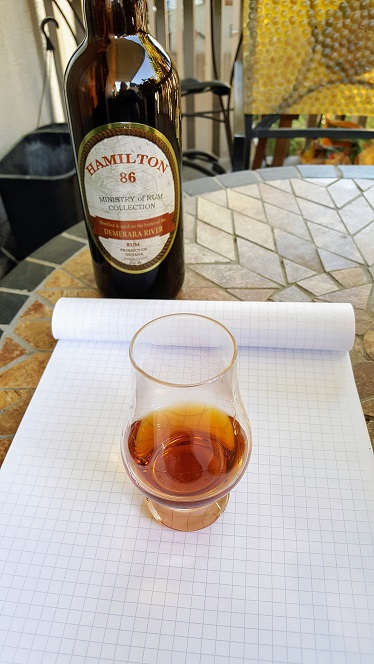
The label on the back of this bottle says: “The bottle of rum in your hand was blended from carefully selected rums distilled and aged up to five years in Guyana then bottled in the U.S. without adding any sugar or other sweetener. The rich dark fruit, spice, smoky wood, and tobacco notes in this rum add a unique flavor to cocktails and Tiki drinks…”

Looking this up on the web it turns out that this rum is bottled from the same blend as the Hamilton Overproof 151 rum but dialled back to a less eye watering 86 proof (43% ABV). It is, presumably, made from molasses extracted from Demerara River (in Guyana) sugar plantations. Why Demerara sugar is so highly prized for rum I do not know, but it is true that all the “Demerara rums” I’ve tried (like El Dorado) are pretty darn good. As it turns out, according to this interesting essay on Demerara rums there is only ONE DISTILLERY (Diamond) in Guyana now and all Demerara-based rums start there. How do they do this? The key (from the linked article above) is: “The challenge for the Diamond Distillery is to maintain the distinctiveness of the many different brands while having them all under one roof. One way they do this is by using a variety of different stills including the only wood stills left in the world.” Here is a link to the Diamond distillery’s page.

So now you know… Let’s get on to the tasting

Color: medium-dark amber, red, orange. Not the darkest rum but on the dark side
Legs: tiny beads coalesce to thick tear drops and run slowly
Aroma: Heavy hit of prune and raisin, slight alcohol, caramel and treacle, apricot, sweet smoke. Very rich aroma, I could delight in this sensory experience a long time.

Flavor: Mixed-up. Light touches of tobacco, light brown sugar, a little oak, dark fruit. Sweet and rich without a lot of flavor separation. Reminds me of a creamier, sweeter version of English Harbour. Flavors are amalgamated and come forward as one delicious offering. Smooth, long sweet finish, a bit of heat rises slowly after the swallow, and sustains itself quite long, the prune-raisin and tobacco in the aroma coming up at the end on the nose and back of the throat. Nice experience!

It is hard to believe that nothing is added to this rum to smooth it. If the oldest rum in the blend is 5 years this seems rather dark in color and the smoothness in it can only come from the blend . Yes, English Harbour is smooth and only 5 years old, but it does have a little sugar in it. This rum is distinctly richer than English Harbour but reminiscent of it. At $24 at my supplier it also competes with English Harbour on price, and while I love that rum and always have some around, I will be adding this Hamilton to my permanent collection as well.

Highly recommended if you are looking for a smooth and easy-going rum to enjoy neat or in cocktails. For your interest here is a link to Hamilton’s Ministry of Rum

For those living in or around the San Francisco Bay Area, here is a link to Bitters & Bottles, my local (South San Francisco) retailer maintaining a superb rum collection!

Cigar Review: Warped Lirio Rojo Corona

Cigar Review: Warped Lirio Rojo Corona

This unbanded beauty is a puro in two ways… The wrapper, binder, and filler are all Nicaraguan, and they are also all Aganorsa tobacco. Lirio Rojo means “red lilly” and apparently only 2000 were made in 2015. How did I manage to get 3 5 packs in 2017 then? Not sure, but I believe there were other production runs in later years.

Binder/wrapper/filler: Nicaraguan Aganorsa
Size: All reviews say 5.5″ x 44 but I measure it out at 5.75″ x 46.
Rolled at the TABSA factory (Tabacos Valle de jalapa S.A.)
Cost: Usually around $10, I got them on a discount for $7.50 from rodrigocigars.com. If you are not on his mailing list, you should be. George comes up with discounts on good cigars every couple of months and will email you when he does.

Wrapper & Color: Medium brown, smooth, no veins, slightly grainy to the tongue.
Cold smell: very light barnyard, black tea
Cold draw: Draw itself is a medium, flavor reminiscent of black tea and wood.
Strength: Medium throughout

Construction: Smooth wrapper, no veins, evenly packed but not dense. Looks good. Draw is medium and stays medium throughout the stick. Does not plug behind the coal. Burns straight. Only minor corrections once or twice per stick. Have smoked 8 of these now and it took a few of them to learn how to smoke them. Smoked at my usual pace, the smoke gets a little thin and they tend to go out somewhere around the middle of the stick. I’ve learned to smoke these a little faster than I normally do, but they did not get hot as a result. Flavor stayed with the stick throughout and smoke output remained strong.

Now to the smoke.

First third: A little pepper, but only a little. The cigar starts out with cedar and other wood, tobacco. A little sweet mint on the retrohale, dry toast, black tea, grass, and maybe a little leather. Not at all a sweet stick, but no sourness either. I like the smoke, but is not nearly as sweet as I expected from a Warped cigar.

Second third: The toast becomes a little sweeter, like melba-toast. Grass and tea still present. The [barely-mint] remains, leather disappears. Pepper stays in the background. Not a sweet cigar, but I’m still enjoying the experience.

Last third: Not much transition here but some. Pepper comes forward a bit, but still not a lot of it. Sweetness drops off and the cedar and black tea comes up. Able to smoke it down to the nub. Flavors never get harsh. Smoke time 1 hour.

Over all I like this stick. I can’t say it was sweet but it is a good offering from Warped, something different. I have smoked these with various rums, but no pairing stands out. What does stand out is coffee! This is a great cigar for a coffee pairing.

Here are two other reviews for your reference. The Katman review is a bit mixed but ultimately he likes the cigar. I like Developing Palates reviews, they use two reviewers and print both reviews in parallel. All three of these reviewers, and especially the last two list many flavors, lots of pepper, and the team review basically raves about the stick. I liked it, but did not find it so rich and varied as the other reviews. They smoke well once you have the pace down right.

Review: Fire and Fury by Michael Wolff

Another diversion here into pop culture, this time the more strictly political. We live in dangerous times and there is no better symbol of them than this book. I did note in the review a single philosophical issue I had with the book. I will spend my time here in these comments elaborating a bit on it. As usual, the original Amazon review is included in full following these comments.

The matter concerns the accuracy of the portrait Wolff paints of both President Trump and the Whitehouse West Wing organization with particular focus on Steve Bannon, and the duo Bannon began to call Jarvanka, Trump’s daughter Ivanka and her husband Jared. In a way, the story is told from their viewpoint while pulling together observations and comments of other parties both a direct part of the Trump organization (however temporarily) and those on the wider periphery.

According to the story various cabals formed and evaporated over the course of Trump’s pre-inaugural period and in the first 200 days or so of the administration. It seems like the only constant was the antipathy between Bannon (painted as an essentially driven fanatic with the old fashioned instincts of a bomb throwing anarchist), and Jarvanka a pair of rich and spoiled children whose politics were liberal leaning but who hadn’t the slightest idea of how to really accomplish anything (or what could be accomplished) aside from protecting their riches and their relation to Trump. Nobody had the slightest real political experience.

Wolff gives us no reason to believe that in talking to any of these people (both the narrow and wider set of players) he was getting an unvarnished truth uncolored by their desire to use Wolff himself to “get at” any of the opposing cabals. If what he tells us is true, it would have been almost impossible for these players to relate to Wolff with the unbiased truth. Wolff became (or it was hoped he would become) one of the arrows in each cabal’s quiver. It is therefore impossible to tell if the emerging picture is a caricature or faithful photographic image. That question, I believe, will remain unanswered until further journalistic accounts of Trump’s first year (or tenure however long it goes) are written.

But all the same, and this is the scary part, the answer to the question doesn’t much matter here as concerns the relation between the Trump administration and the world (including ourselves in the U.S.). Whether caricature or photograph, the image is that of a very disturbed and dangerous situation, an American administration that not only does not know what it is doing broadly speaking, but whose ostensible leader appears pathologically unfit to serve in this office. Worse, he is surrounded by other pathologies of various kinds all of which overlap with at least two of his; great wealth taken for granted, and an unswerving belief in their judgments about matters with which their lives have prepared them in not the slightest way.

That, my friends, is frightening to me. But it gets even worse. Not only do they not understand the consequences of their actions as concerns the world at large, they do not really care so long as their wealth is preserved. That is only a little unfair because Wolff does paint Jarvanka as caring, they just don’t know what or how to do anything about it so their focus remains, as with the others, on their wealth, power, and even (especially in Bannon’s case as he was not rich) in the appearance of power.

The story continues to take bizarre twists. Today, January 16 2018, results of the President’s medical examination, including investigation of degenerative cognitive decline, were effusively described. The doctor, a military man with rows of campaign ribbons on his breast told us that this 71 year old (and obviously overweight) man was in perfect health physically and mentally. One wants to believe the doctor and perhaps it is so that there is no disease process detectable in the President’s brain. But perfect health is a bit hard to believe and would be of anyone who looked like Donald Trump does today. The doctor attributed it to “good genes”. Based on what Michael Wolff has told us, this could only be a signal that the news conference was a put on, a show. Or am I being paranoid?

Now September 2018 and Bob Woodward has released his book “Fear: Trump in the White House” which I have reviewed. More good journalism.

That’s all I’ll say for now. Happy to discuss in comments.

Fire and Fury Michael Wolff

This must have been a difficult book to write. There is so much story to be told and the principle threads so entangled that it must have been very difficult to tie them together in a coherent story. Wolff mostly succeeds, but not entirely. Then again that is an important part of the very story Wolff is trying to tell, the story itself is about an incoherent presidential administration.

Told in broadly chronological order of the presidential election of 2016 and the roughly first 200 days of the administration up to the middle of August 2017. At the end an epilogue focused on Steve Bannon, who has a claim to being the book’s main character, brings the story up to roughly October 2017, but the pace of news has hardly stopped there. As I write this in January 2018 I can only be sure that much more will happen. Within its chronology, there are frequent steps backwards as Wolff brings in the various characters and their varying alliances coloring-in their relation to the then forward moving part of the story. Of all the characters brought to the fore, at least among the dozen or more who are in direct proximity to the president by living or working in the West Wing, only a single pair (Ivanka and husband Jared Kushner) keep the same relationship relative to one another throughout. Every other person or cabal-like group changes relationships often multiple times as most of the individuals involved come into the story and then go out!

I do have one philosophical matter to bring up. Let’s grant that Wolff reported accurately on everything he was told by everybody. He presents a fair picture of that to which he was a party either first, or at most second (and occasionally third) hand. At the same time that which he is reporting is, he points out, the back stabbing testimony of each cabal out to paint the others in the worst light possible. Even if those to whom he spoke were not outright lying to him, at the least they were telling highly selective truths almost surely leaving much out. Our only hope in this mess is that from the back stabbing of all sides towards one another and the occasional more neutral voice (though nobody was entirely neutral) from the periphery, Wolff has put together if not a true portrait, then at least a portrait true to the Kafka-esque nature of the administration! If that is a horrible thought, it is what makes this an important book.

This is high class journalism first and foremost, but it reads at the same time like an Elmore Leonard novel! As Sean Spicer began to say “you can’t make this shit up!”. Frankly this book would be hysterically funny if it was not so downright dangerous and disturbing.

Book Review: Assholes A Theory

My only additional comment here is that Amazon rejected my review (below) because it contains the word ‘asshole’. This is political correctness gone crazy. They asked me to delete the word or perhaps change it to something like ‘A******’ but I refused. Considering that the title of the book appears at the top of every review I cannot comprehend how Amazon algorithms would permit the publication of any review of this book. Be that as it may, I am not politically correct and I publish my review of this excellent book here on the blog for your edification.

Assholes, A Theory

Bravo for a brilliant book. Dr. James takes what appears at first to be a trivial notion, “the asshole” as a metaphor for a particular sort of human
behavior and uses it to illustrate how philosophy is done, what it must consider, and the directions in which it can be applied.

He begins by defining the term and then comparing it to other “terms of derision” like ‘jerk’ exploring various examples both hypothetical and drawn from the headlines so that after the first few chapters we are comfortable understanding what an asshole is as compared to other kinds of behavior worthy of opprobrium. Following this set up he moves on to social philosophy; why this behavior exists, how it comes about, various possibilities concerning its root cause (or causes) and why most (but not all) assholes are men. He next discusses what people who are not assholes can do about those who are, both on the individual level and in small or large social systems. In the closing chapters he moves further into the realm of the political and economic. He argues for a refreshing view of what might be called “the problems of capitalism”. Far from the Marxist idea that capitalism is inherently and necessarily unstable, James argues that modern (State regulated) capitalism can be perfectly stable and what makes it unstable are the presence of, you guessed it, assholes, whose behavior distorts the system rendering it less and less stable over time.

Does James make his case here for this final claim? I think he does, and it puts a nice capstone on an all around excellent book in the philosophical arena of ethics. An easy read. If you are looking for an example of good philosophical technique applied to a trivial notion that turns out to have world shattering consequences, this would be a good read.

Where Jacob Needleman Goes Wrong in “Why Can’t we be Good”

Jacob Needleman wrote “Why Can’t we be Good?” in 2007. I read it in 2017. He was a professor of mine at San Francisco State in the late 1970s. The only philosopher of religion at SFSU I took a few classes of his. Only a few. Despite a shared belief in the existence of God we disagreed about almost everything else. I see that this has not changed between then and 2007. Some of this disagreement figures in my formal review (for Amazon) of the book included below. Here in my philosophical commentary, I want to say more about it, and in particular some of that which stems from my personal experience with Jacob Needleman.

First to set some context. Needleman believes God exists. So far so good. In “Why Can’t we be Good?” he is a little vague about his concept of God vascilating between the transcent “Abrahamic God” of the world’s three major monotheisms, and something else, a “God in us”, a thread present in many religions (including the monotheisms) and emphasized in more recent movements characterized as “New Age”. I think Needleman believes that both views of God can be real at the same time which is fine by me, but in this book he is very unclear about distinguishing between the two concepts.

As is true of virtually all of today’s philosophers of religion and theologians terms like ‘person’, ‘spirit’, ‘soul’, and [less often] ‘mind’ can be used interchangeably. I am not concerned with these indistinctions here except to mention them because their blurring together does happen in this book. I am concerned rather with a problem specific to Needleman’s thought, something I came up against almost from the moment I met him and is very clearly stated in this book. One could even say it was the central point of the book. At root, the first and fundamental problem for me is that Needleman believes a genuine relationship with God (and recall he is vague about what or more precisely with whom such a relationship occurs) is a difficult achievement demanding, among other things, much study, perhaps years, and more than this, it requires the competent help of a guide, a genuinely enlightened person who can guide you through your studies. Needleman is quite clear that whatever else is necessary to successful achievement of that genuine connection, a guide, is also necessary.

How Needleman arrived at such a position I can only speculate. Having known him, my speculations might be very close to the mark. But whatever it was that brought him to this position (he does leave hints to it in the book), Needleman grew up into young adulthood and an advanced education in philosophy at a time in which the mystical and New Age ideas that fuel his viewpoint had gained a popularity in the culture of this time, something they still maintain today though far less frenetically. I think Needleman had the good fortune to seek his fortune in somewhat New Age philosophy at a time when this came to be much in demand.

In Needleman’s view, without the guide (and a guide is not the only requirement) we are literally incapable of a “genuine, deep, moral decision and action”. With the possible exception of moments of great crisis (that even this is a problem for the whole idea he just does not see) we have no real free will in the moral domain because we are all asleep, disconnected from the god within (and without). This is why we “cannot be good”. Everything we do (morally) we do out of habit or culture accretion. No moral decision really belongs to us. Needleman simply discounts what it is moral free will really represents. Not some phenomenon that requires study, but opportunity to improve the very connection Needleman asserts we don’t have by what we decide to do! Needleman does point out that one who seeks to strengthen the connection to spirit must be sincere about it, and that sincerity must lead to some action. That is all well and good except that for Needleman, any action we take that seems good is merely the outcome of our life’s moral accretions that do not by themselves get us to where we must be although such action is nevertheless (like sincerety and the guide) a necessary part of the process.

If Needleman discounts free will on the good side, he must also discount it on the bad and he does, declaring unhesitatingly that all evil in the world is the result of our disconnection from spirit. From deliberately sending tourists who ask for help in the wrong direction to ordering the construction of death camps and murdering entire communities, all of this merely a consequence of being unaware of our “true selves”. I find this notion both absurd and obscene. Needleman’s mistake also causes him to blur the distinction between error and evil. If I work in a chemical plant and accidentally open the wrong valve, perhaps I cause an explosion somewhere in the plant, a mistake, error. If on the other hand I freely open that same valve knowing it will cause that explosion, that act is not an error but evil! The difference is plain, but Needleman cannot get to it because he discounts moral free will in all but enlightened persons.

Needleman is correct about sincerity and doing something, that is acting to (freely) do the best good you can (even if it is only a small good) when a situation to do good presents itself and even if much of what you actually do is done out of habit or cultural accretion. Sincerity entails a willingness to try taking action when you can. When you do this, three things happen: (1) you become incrementally more sensitive to such opportunities for action, (2) acting becomes a little easier, and (3) your action becomes incrementally more adroit and fully free. You can call this progressive development “the working of the spirit” or just chalk it up to “practice makes perfect”. Either way, if you persist, eventually the process itself will awaken you. See my “Why Free Will”.

Notice that none of this is particularly intellectual. It is spiritual and not intellectual development. Needleman would be right to assert that the intellectual can support the spiritual. Once you are sincere and acting, study and guidance can reinforce the process, but they cannot be necessary to it.

“Why Can’t we be Good” Jacob Needleman 2007

In the interest of full disclosure, Jacob Needleman was a professor of mine at San Francisco State University where I did my philosophy MA in the late 1970s. I had a few classes from him and found we disagreed about almost everything. I will try not to get into all of that in this review, but some of it cannot, perhaps, be helped. I see the basis of our disagreements in 1979 are very much in evidence here in this book written in 2007.

In “Why Can’t we be Good?” Dr. Needleman takes stock of the evil in the world, much of it obviously the result of human behavior both now and for thousands of years past. He certainly notes that humans do also behave in what passes for goodness in their daily lives. Many of us love our children and do our best to raise them lovingly and there are instances of human action, tens of millions every day all over the world that pass for civil and often “beyond the requirements” of civil behavior. So why he asks are we not doing even better? Why does the world appear steeped in evil?

His argument is that we are not better because we have lost sight of what “real goodness” means because we have forgotten our fundamental connection to the spirit forces (God transcendent, God embodied in “our self” [often blurring these ideas]). He admits that sometimes, in crisis, we act on a “higher, genuine, moral level” but most of the time, the best we can do is merely acting our of reasonably good habits we’ve acquired from our culture, and just as often (perhaps more) we act in downright evil ways. His central claim is that we cannot find (re-discover) this connection by our-self. To re-acquire our consciousness of the fundamental connection demands a teacher, a guide, which always takes the form of some already enlightened person who can both point us to the various holy-literature (be they Christian, Jewish, Buddhist, etc) traditions where the connection is revealed but also help us to understand and interpret what exactly the traditions are trying to tell us. Without this guidance, we are, Needleman tells us, ultimately helpless. Putting it bluntly, we must study what it means to be good and appropriate these teachings into our inner being to even begin approaching genuine moral action.

If this all sounds a bit new agey “I can’t help the world without first helping myself” it is, but Needleman is more sophisticated than that. Besides a “teacher”, the student seeker must sincerely want this for him or herself. We are not in the realm of magic incantations that make us over in one fell swoop. Of course even the new age teachings also note this. What Needleman adds is his recognition that no matter how lacking we are in genuine morality, we must nevertheless try, that is act, in the world of our daily existence. We must act to do the “best we can” as we travel about our daily lives interacting with others however weak and habitual those actions might be. We must practice, not only in our studies, but in life. Only by these things, sincerity, study, and action, can we re-awaken our consciousness of the connection between ourselves and that relationship to the cosmos that results in genuinely deep, and not superficial, moral behavior.

But while Needleman is correct about the need for action, I do not believe he grasps its overriding significance. Because we (most of us) do not know who we really are our “moral free will” is minimal to non-existent. We are hemmed about by habits and cultural acquisitions, social accretions that render us incapable of genuinely free moral choices (except possibly in times of crisis). For Needleman this applies as much to evil as good. He twice quotes Socrates declaring “No man does evil intentionally”. All evil in the world (he says) stems from our disconnection (culturally induced) from the reality we are meant to know. Socrates (at least as quoted here) and Needleman fail to distinguish between error (the truly inevitable outcome of our limited perspective and cognitive abilities including all that we cannot know lying above our intellectual pay grade) and evil. The latter is precisely “error deliberately (that is freely) chosen”! It might be true that “no man does error intentionally”, but evil is evil because it is intentional!

The same must be true of “the good”. Certainly there is a continuum of moral choice from the trivial to the profound. But even our “good habits” were not always habits, we had to allow them to become habits at some time in our earlier life. The same holds for the accretions of our culture. Some of these are certainly harmful and others good. If, on balance, we have adopted (for ourselves) more good ones than bad, this too must be the result of genuinely moral choices all along the trajectory of our lives. The sincerity of the seeker, something Needleman notes is necessary for any sort of success, must already have been a freely made moral decision or it wouldn’t be “sincere”!

A better choice for a title for this book might have been “Why Can’t we be Better”, but that’s less dramatic and would put Needleman in the position of admitting that, provided we are sincere and we do the good that we are able to do now, we will grow incrementally better — practice makes perfect. A guide, should you be lucky enough to find a real one, can be helpful, but cannot be necessary. My applause here goes to Needleman’s emphasis on action, something he talks about more than either of the other two “necessities”, the guide and the sincerity of the seeker. Forty years ago I don’t remember this much recognition of the importance of acting, but then my memory certainly deceives me. In any case he has it here. Included in early chapters are some nice exercises people can actually do together that simulate “the ethical” in the “theater of the mind” as Needleman puts it. Easy to read, not technical. Will it help you along your “quest to be good”? Well it can’t hurt!