As with most of the philosophy I review there are matters, lines of inquiry, alternate points of view, that illuminate more to be done, or resolve issues raised, that are not appropriate in the context of a book review. A review should focus on what the author says and perhaps how (s)he gets to what is said, not on differences of opinion between author and reviewer. And so I publish book reviews on Amazon, and then republish them here along with a link to the book for my reader’s convenience, and commentary whose purpose is dredging up those differences of opinion.
The first question that comes to my mind is the relation between metaphysics and ontology. The authors do not address this very much other than to say that the latter is usually considered to be a sub-discipline of the former, but no relation is clearly delineated. As a result an issue I noted in the review is the authors attribution to ontology (an alternative “fundamental question”) of a question I normally associate with metaphysics; the “fundamental ground” of what is real. If ontology is about “what is real” or “what exists” independent of mind (including such mind-managed entities as propositions, numbers, and sets), it only gets to be about the fundamental ground of what is real if, as some ontological systems do claim, that fundamental ground is the sole existent entity, everything else being nothing more than various assemblies of it and “are real” only in a derivative sense.
But while trying to understand what might be real even of the assemblies (natural and artifactual kinds for example) surely mind itself is among the [presumably] “natural kinds” for which we must account. Drs. Berto and Plebani ignore this singular question choosing instead to narrow their survey to a few well-worked channels of thought about reality “besides mind”. Idealism (everything is mind) is ignored because their focus is on what can be said of “mind independent” reality. Taking for granted that there is such a thing, we can characterize it in variously useful ways, and thus reject idealism. But even if idealism itself is false, the question of what exactly mind is matters a great deal.
Natural kinds like stars and animals, and artifactual kinds like chairs and statues are, after all, physical particulars while propositions and numbers clearly are abstractions and the mind-independent status of abstractions surely depends on the status of mind itself? If mind “substantively exists” then we can argue about the ontological status of abstractions. If mind does not exist (eliminative materialism) or is merely epiphenomenal illusion, then abstractions cannot in principle have any “mind independent” status.
On the matter of “fundamental ground” there is no explicit discussion of the distinction between substance and process ontology. The authors come at their subject mostly from a “substance viewpoint” but they do also address the ontological status of events which are processes. They address the causal status of agency versus process in events, but the chicken and egg problem (are all substances process or is process merely the causal interaction of substances) is not specifically covered.
I have another small issue with this book. When reading books on ontology written in the last few years (this one in 2015) I look for references to E. J. Lowe who, in my opinion, was among the best thinkers on this subject (he passed away quite young in 2014 or so). I rarely find him, but these authors do cite him (from a 1989 book) in their examination of particulars. But the authors discuss not only particulars, but kinds (classes), tropes (or modes), and global universals (all are after all well-worn ontological subjects). Yet they make no mention of Lowe’s “Four Category Ontology” (2006) in which he brings each of these four elements into harmonious and logically consistent relation. Of course Lowe’s is but one idea among many, but it is the only recent treatment (and I have looked having read many of the authors they cite in the text) that so neatly ties them all together. There should have been at least some mention of Lowe’s book.
Meanwhile, despite these shortcomings, this is a good read. The authors address only a tiny slice of the whole ontological field, but they do a good job with that slice, broadly illustrating how ontology is done and the salient factors that enter into it.
I’m not much for reading “overview books” in philosophy, they tend to be over simplistic and misrepresent as much as they enlighten. Once in a while a title appeals to me and this one looked rich enough to be worth a read. It was.
Dr.’s Berto and Plebani (“the authors” from here on) begin very deliberately setting out the distinction between ontology from metaontology. The former (covered last in the book) is about answering the question: what things are there in the universe, or what kinds of things are there, and are “kinds” (for example) among the things there are? As it turns out trying to answer such questions, since they are so fundamental to what we take our experience to be about, raises many questions of procedure. From what set of assumptions do we begin to address such issues and by what methodology? These latter questions are the subject of metaontology.
In a moderate length book covering a 2500 year-old field, the authors cannot possibly address all the viable proposals for answering these questions. They choose several lines of thought taken to be the dominant contemporary themes of the field in the analytic tradition and follows them out. Beginning with what they entail for the procedural questions, and then using each of the various meta-positions to address the main questions of ontology proper: material things (natural and artifactual), abstract things (propositions, numbers, sets and classes, fictional characters), and events. They do a superb job tying the procedural approaches covered in the first half of the book to the meat of the subject in the second. They never answer the question “what is there” but then they are not advocating a particular ontology, rather showing how the possible set of answers follow from different approaches to the subject. The book illustrates how different meta-approaches affect the possible range of answers to the ontological questions themselves. He is successful here, but the reader does have to pay attention.
There are a few holes (and yes the ontological status of holes is addressed) in the presentation. Ontology is a sub-discipline of metaphysics and the authors do not ever clearly distinguish between them; not that this is easy to do in any case. For example, they present “grounding theories”, as the idea that the big question of ontology is not “what there is” but what is the “fundamental ground”, the “basic stuff” of “what there is”? As I understand it, the matter of grounding is the core of metaphysics and not ontology per se, though to be sure the line between them is very ill defined. They also note from the beginning that matters of mind are not at issue. Propositions and the quality of redness are mental phenomena. The ontological question is would we still, hypothetically, count them as entities in the universe if minds did not exist? Fair enough, but the ontological status of mind itself is controversial in philosophy. Some discussion of this question from the viewpoint the metaontologies he covers would have been interesting.
In the telling of all this, the authors include many dozens of references from philosophers of the 19th and (mostly) 20th Century. The book’s bibliography is a who’s who of metaphysical and ontological thought, and yet there is far more left out (God theories, ontological commitments in Continental philosophy, or Eastern philosophies are ignored) than included. Again I do not fault the authors for this. They had to find a way to narrow the material or the book would be a thousand pages long. This is a superb book for philosophy students at the undergraduate level who have an interest in these questions. It can be read by anyone however and does not presuppose any familiarity with the presented material.
If before discovering these cigars you asked me for my pick of the “best cigar for the money” I would have said the Drew Estate Papa’s Fritas. True their price has gone up by about 30% in the years since they first appeared, but they are still a great stick for the money. Having encountered these Cracker Crumbs, retailing at only $2.90/stick (I found them for $2.45) I might have to change my mind…
Surrogates are one of L’Atelier’s brands and rolled at the My Father factory in Esteli Nicaragua. My Father knows how to roll a cigar and L’Atelier is adept at finding delicious blends. So far so good. Surrogates gives each of its vitolas names. The Cracker Crumbs is a 4.5″ x 38 (so petit corona) version of the much larger (6″ x 60) “Animal Crackers”, a cigar I haven’t tried as that vitola is just way to big for me..
Cold Aroma: Very light. Some barnyard, something a little sweet (leather?). Nice but indistinct. Cold Draw: Salt, light grass or hay. Again indistinct
Construction: This cigar is a little rough. a maduro-dark brown, easily visible seams, some prominent veins. Evenly packed though, and a little heavy, a somewhat dense cigar. Interestingly, the cigar is pre-straight-cut almost as though when L’Atelier got their order of paper wrappers (5 cigars to a pack) they were slightly too small and someone came up with the brilliant idea of pre-cutting the stick to fit. Pure speculation on my part. If you look carefully there is clearly a double cap at the head, so these were not made to be open like a cheroot.
Meanwhile, the stick smokes beautifully and very slowly. Lots of creamy smoke, medium draw throughout, and an even burn requiring only occasional touch up. I’ve been through two packs of these and only a couple required any poking with a draw tool to loosen it a bit. Consistently smokes about an hour.
Flavors: This is the best tasting cigar under $3 I have ever had. It begins with a little pepper, sweet woods, graham cracker, and evolves a little more sweetness and leather. On the tongue alone the flavors are muddled, but become distinctively sweet (along with more pepper) on the retrohale. The flavors evolve through the first half of the cigar, more maple wood sweetness and leather come forward, some roasted nut, and a little wintergreen. As the stick smokes down the sweetness fades a bit, the pepper comes forward, but the leather and scent of burning leaves remain. The cigar holds some flavors down to the last 3/4″ so all is good.
Are the Cracker Crumbs as good as the Papa’s Fritas? Well no, not quite. A few of these drew a bit tight and I had to use my draw tool. I never have to do that with the Papa’s Fritas. But the flavors are in the same wheelhouse (the D.E. cigar is a little more flavorful with coco and less pepper) and it is almost $2 less expensive (retail to retail) a 40% reduction! I would say don’t miss these unless you just don’t like L’Atelier or the vitola. Here are a couple of other reviews from HALFWHEEL and LEAF ENTHUSIAST
Wrapper: Jalapa Nicaragua Corojo 99 Aganorsa Binder: Nicaraguan Condega Filler: Criollo 98 and Corojo 99
Rolled at the TABSA (Casa Fernandez) factory in Esteli Nicaragua, the brand (Warped) owner is Kyle Gellis.
I am smoking the production “5205” version a 6.3″ x 42 a longish corona they call a lonsdale.
A little difficult to get the composition straight. Here is what HALFWHEEL and Cigar Dojo say about this stick. But one learns something every time. I did not ever know what AGANORSA means… According to the Cigar Dojo review linked just above: “This acronym represents Agricola Ganadera Norteña S.A., a series of Nicaraguan farms owned by the Fernández family (Casa Fernández) that produce among the largest yields of Nicaraguan tobaccos, as well as some of the most highly acclaimed tobacco in the world.”
So this looks like a great cigar right? Well yes it is, but it isn’t really my cup of tea. Read on..
Cold aroma: Rich manure, barnyard, leather. This is a rich smelling wrapper! Cold taste: salty, grassy, and a little lemon-grass sour.
Construction: The sticks I smoked (five so far) were all pretty good. Light brown smooth wrapper, a few small visible veins. Evenly packed. Not super-dense, but not light either. Draw was medium and mostly stayed that way. Smoke output excellent all along the stick. Burn line required a minor correction from time to time but no big deal. Smoke time almost 90 minutes. Overall an “A” for construction.
Flavors: When first lit I get fresh hay, flowers, brown sugar, nuts, and sweet woods — like burning dry maple leaf. Only a little pepper tingle to speak of. Getting into it a bit there is a hint of candy-like sweetness on the retrohale and a very little bit of white pepper, still a tingle and very rounded. Pairing this stick with a mild rum I also get a hint of spearment in the smoke. As I smoke a little more a mild sourness (some call this an umami-sort of flavor, I like to think of it as cabbage cooked in tomato juice) that reminds me of the twang one often finds in Dominican cigars, something I cannot remember sensing before in a Nicaraguan Puro.
In the middle of the cigar, the nut, sweetness, and woods fade a bit and the grassy vegetal comes up along with that sourness. Pepper goes up a bit on the retrohale, but never dominates. In the last third, the sweet woodiness returns along with some leather. A bit of that sourness remains throughout. The cigar stays pretty much medium in strength, but because it is rather long, it will give you a buzz by the time you finish it.
OK, so far so good… For me, a cigar cannot be a “great cigar” unless it satisfies three criteria:
1. Good if not excellent construction
2. Rich flavors either blended together or distinct
3. Must retain flavors (and not become merely hot smoke) down to the last inch at least — I like to go to the last 3/4″.
This cigar qualifies on all three points, but still of all the Warped cigars I’ve tried I like this one the least and that because of the sour note that gets more noticable through the middle third of the cigar. I have smoked many AGANORSA Nicaraguan Puros and I cannot remember that sourness in any of the others. I can handle a little of it and this stick is fine, the note never dominates the flavor and lots of smokers love it. This will be a great stick for a lot of people.
Cigar aficionado says a re-intro of a blend from 2008. The vitola here is something between a corona and a lancero at 6.25″ x 38.
Wrapper: Ecuadorian Habano Binder: Nicaraguan Filler: Nicaraguan mix of Corojo 99 and Criollo 98
Construction: Smooth wrapper, no visible veins, medium brown, evenly packed. I’ve smoked through five of these now, all very consistent. After cut the draw is medium though a few sticks are a little on the hard side of medium. I had to make a few minor corrections while smoking one or two, but mostly burn stays pretty level all the way down. Smoke output is excellent.
Cold smell: Mild barnyard, some hay.
Strength: medium
Flavors: Lovely wood, caramel, melba toast on rich sweet retrohale, little pepper, heady… Wintergreen/peppermint when paired with rum. Very smooth, light on pepper in the first half. Later, still sweet. Little more pepper, cedar and melba toast on retrohale. There is but a little pepper on these, even the retrohale is smooth. There isn’t a lot of transition in flavors from one part of the cigar to the next, but all along the sweet woods, toast, and sometimes tea and leather all make their presence known. Smoke time goes about an hour and fifteen minutes, a slow and very evenly smoking cigar.
This is a very smooth cigar over all, well constructed and tasty all the way down to the last half inch. I got these with a discount (cigarandpipes.com get on their mailing list) for about $6.25/stick, their retail price is something closer to $8. But even at that this is an excellent cigar. Warped has another winner here.
Usually I begin these book reviews with a little extra commentary; some examination of a philosophical issue I thought inappropriate to go into in the book review itself. I’m sure there are such issues in Sellars’ work for me, but having read these two books I am not confident enough in what Sellars was talking about to say very much. Sellars is certainly no antirealist, but I’m not sure he would call himself a realist (in Searle’s terms) either. He is one of the premier philosophers of logic and language in the thread leading from the Vienna circle through Wittgenstein, and on to Quine, Tarski, and Sellars himself.
Perhaps we could call him a “linguistic realist” as he seems to believe that it is through the acquisition of language that a human child comes to distinguish joints in the world. For Sellars, perception (the five senses) occurs in pre-linguistic children but is at that point inchoate, a jumble of impressions in which nothing is clearly distinguished from anything else. Perhaps the first “joint in the world” the child recognizes as such is its own mother. If my reading of Sellars is correct, the child first distinguishes its mother from the rest of the world when it first connects the word “mom” (even if it cannot yet vocalize it) to that object. In other words, for the child to recognize its own mother, in an intellectual sense, it must be able to “think linguistically”.
I have a big problem with this idea because only humans have such abstract language and yet animals, adult higher animals, clearly have a very sophisticated ability to discriminate “joints in the world”. A dog could not catch a Frisbee if it did not, and even a chicken knows enough to associate dark cool places with the prospect of more juicy insects and so on. Could a philosopher as brilliant as Sellars have missed such an obvious counter example to his connection between language and perception? I wouldn’t think so… It is possible I am interpreting him incorrectly.
I have never before given such a low rating to a book by a professional philosopher of Sellars’ reputation. I also wonder about the value of reviewing a 40 year-old book whose author has long since passed on. But for the sake of my few followers I’ll deliver here, keeping it short.
Sellars says his analysis of language, reference, meaning, and truth (in descending order the main topics of this book) is needed to formulate a consistent (contradiction-free and perspicacious) naturalistic ontology. He takes the truth of naturalism for granted (most philosophers do these days) and while recognizing the term applies mainly to scientific method uses it as a stand-in for “materialism” throughout. I’m being rather loose with the word ‘throughout’ as he barely mentions naturalism or ontology (though repeatedly rejecting anything Platonic) beyond the book’s introduction!
In point of fact, Sellars never directly connects up his theory of reference to ontology, other than insisting that only a nominalism can be right. Sellars’ focus is on the role words (names, descriptions, declarations) play in language. His analysis proceeds through illustrations in formal logic which, while not individually complex, become overwhelming as they go on page after page. I’m guessing a full half the text of the book consists of these formal statements.
Overall the book is based on a series of talks. He says in his introduction that the first three chapters are straight from the talks, while the remainder of the book is more heavily edited to make the whole work come together. Yet the last two chapters of the book are a series of exchanges (unedited correspondence) he had with another philosopher and the book ends following the last of these. He does not ever conclude by summarizing anything. Indeed in the middle of the book there is another page of commentary (from a philosopher not named) criticizing Sellars’ whole approach. He is surely brave to put this in. Nowhere does he respond to this critique, and in point of fact, at least in my opinion, the critic’s approach more sense than Sellars’ view!
I got into this book because Terry Horgan (“Austere Realism” see my review) mentions him a lot and it strikes me that Horgan’s view of how language works, what makes ordinary statements true or meaningful, is derived from Sellars’ work. Horgan however (right or wrong) produces the summary, a synthesis of language’s relation to ontology, with which Sellars should have ended this book. Having read this, do I understand how Sellars links language to meaning and truth? Yes if vaguely. What about ontology as such? No, not at all.
This is my second review of a Sellars book (see “Naturalism and Ontology” also reviewed). I have the same problem here I had with the other. Like that other book, this one is something of a collection of separate essays on the same theme; the relation of language to action, thought, and the correspondence between perception and the mind-independent world.
A carefully crafted collection of related essays on the title’s subject, it is nevertheless very difficult to grasp what Sellars is trying to say overall. To my mind this is a stylistic problem and I imagine that students of Sellars familiar with more of his ideas generally will get much more out of this than did I. We are all used to the mechanism of “flashbacks” in novels. But imagine a novel in which a first level of flashback results in yet another deeper flashback and then one more. When the author returns from the last flashback where is the reader dropped off? One level up? Two? Or back to the original story thread?
In every chapter of this book Sellars begins with a brief statement of his intent and then, before explicating it more fully, informs the reader that certain preliminaries must be taken care of first. Such preliminaries end up nesting to two or more levels and (along with covering various objections and alternatives) occupy 90% of the chapter’s material. By the time Sellars gets back to the main thread, not only am I lost, but I come away with the suspicion that some of those preliminaries are used to introduce definitions and points of view, themselves often controversial, on which his final theses come to hang.
None of this confusion on my part has to do with disagreements in viewpoint. I read a lot of philosophers with whom I disagree but I understand nevertheless what claims they are making and arguments for those claims. From this book, and the other is the same, I come away understanding certain points of detail but not, overall, what Sellars is trying to say about his subject. Yes I get that Sellars believes the correspondence between perception and the mind-independent world, our capacity to discriminate “one something from another” goes through language. Yes I get that our “understanding”, our very ability to have thoughts “about” something, depends on language, but I have yet to figure out what sorts of ontological commitments he draws from this approach.
Sellars is clearly one of the great thinkers in the century-long thread of “linguistic analysis” in philosophy, but while a great thinker, he is not a perspicacious writer.
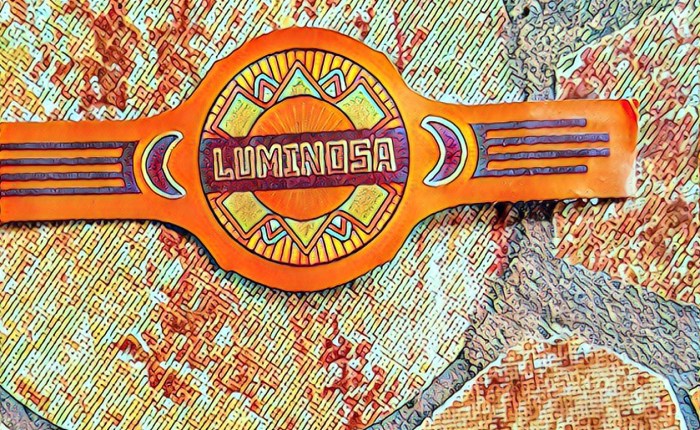
A new (to me) Crowned Heads cigar introduced to the world in 2016. There are reviews to be found but not much about its composition. The cigar is rolled at Tabacalera Alianza S.A. in the Dominican Republic. This is the factory of E.P. Carillo, and he along with Jon Huber are named as the blenders for this one. Another review says the filler and binder are Nicaraguan though they are not specified. The wrapper is given as Ecuadorian Connecticut.
The Luminosa comes in three vitolas: Toro (6×52), Robusto (5×50) and Petit Corona (4×44). I wanted the petit corona but could not find it. I ended up with the robusto normally retailing for $7.75 but they ended up being $6 at the box level to me.
Construction: The wrapper is a medium brown, slightly shiny. There is a small vein or two here and there showing. Nothing impressive or unusual here. The pack is even all the way around on the three I’ve tried so far and somewhat light, not a densely packed cigar, I expect the draw will be superb. The draw is superb, light with only a slight resistance, it remains that way throughout the smoke. Speaking of smoke, the output on this one is also excellent. Nice creamy thick smoke throughout. Burn line also stays good though a few corrections helped from time to time. Construction gets an “A”. All is good so far.
Cold aroma/flavor: Light barnyard, manure, black tea, a little leather. The aroma is not very rich, but all good. The cold draw taste is a little like toast and slightly salty, but there isn’t much to it.
Flavors: I always expect something good from Crowned Heads and the Luminosa delivers. In the first third I sensed browned butter, toast, a little leather and barnyard, hay, and maybe roasted nut. As the cigar progressed its pepper, almost absent at first came up a bit especially on the retrohale. The cigar doesn’t get very peppery making the retrohale easy and very rich. Don’t be afraid with this one. As the cigar smokes on, the nut and butter dial back and some sweet cedar along with the hay comes more forward.
The flavors dial in and out with every puff, but all of them have something to recommend. The cigar starts out pretty mild in strength and gets maybe to a medium when finished. This is a great cigar and remained flavorful down to the last half inch; “A+”. I paired all three of the cigars so far with coffee recommended by most of the reviewers. A really good morning cigar.
Smoke time was a few minutes under an hour. Most robustos go over an hour for me, but being lightly packed this stick smokes a little fast especiall in the first half. Still all and all a satisfying smoke and if I can find another box at $6 I will pick it up. Crowned Heads has another winner here.
In this short paper my purpose is to understand how the word ‘qualia’, plural of ‘quale’, is used and to what exactly it refers. In addition I address the question of the phenomenon’s importance.
Qualia are associated intimately with brain states, and never occur in their absence. It is a fair bet there is some corollary brain state (sets of brain states) associated with every quale and the collection of them. It is also the case that, while normally associated with sensory apparatus, it is possible to invoke qualia, even a specific quale like “a flash of red light”, by “poking the brain” direct. What is mysterious about this is that poking the brain (or stimulating a living organism’s more conventional sensory pathways) does something that poking anything other than brains never does. It invokes, a “subjective experience” qualitatively different from the physical qualities either of the brain or of the source of sensory stimulation.
The sound of a middle-C note from a piano is a quale as is the different sound (thanks to harmonic frequencies) of the same note played on a violin. Each is a particular quale. What seems interesting is producing that note from either instrument, the motion of air molecules set up by the vibrating strings, and everything that happens between the instrument and the middle ear is mechanical. Mechanical energy converts to electrochemical energy in the auditory nerve and spreads in that form through the entire brain. From instrument to brain everything is uncontroversially physical and well understood. But what emerges, what is invoked by all of that physical process, a content of subjective experience, is not uncontroversially physical. It has qualities that none of the physical forerunners have. What is it exactly, and how is this possible in a physical universe of causal closure where physical causes have only physical effects? Those questions make qualia interesting.
In a sense, and this is only metaphor, it is as though a threshold is crossed. On one side a certain combination of purely physical (mechanical [hearing], chemical [taste/smell], electrostatic [touch], or photonic [vision]) energy (yes even the physical poking of a brain) is translated or transformed into a subjective experience whose qualities or properties share nothing in common (other than correlation) with the physical properties of their source. The mystery has nothing to do with the transformation’s necessary dependency on a functioning brain. Rather it is that this sort of transformation happens at all; that physics becomes subjective.
Sound, light, feel, smell, taste are all mind-dependent descriptions of phenomena, that in the mind-independent world are nothing but energy of one kind or another. If I say “I see light” we have always to remember that in mind-independent terms, there isn’t any “light”, only “electromagnetic radiation”. The latter is real and exists in the universe whether there are organisms with apparatus sensitive to it or not. Electromagnetic radiation only “becomes light” to a subject. Information bearing patterns in brain states are translated (mapped), via pathways beginning with sensory apparatus, into an “interior experience”. “The light” is that mapping!
The subjective gestalt is composed of qualia similar to the way particles of the Standard Model comprise the mind-independent world. The particles collect in special ways to form atoms while the atoms (sometimes in special states) aggregate to produce everything else. Some of the phenomena of the mind-independent world impinge on certain “biological sensors” associated with brains. Not all mind-independent phenomena impinge to trigger biological sensors. Neutrinos do not, nor photons outside a limited range of wavelengths.
The subjective arena is broader than qualia alone. Intentions, beliefs, emotions, memories, ideas, and so on are not qualia. Qualia comprise only the sensory modalities of the gestalt (and sometimes the effect of brain pokes). Unlike atoms, there are genuine mereological sums of qualia that is itself a singular quale.
The qualia arising most directly from our physical senses, “atomic qualia” like a particular red experience, sum mereologically to a unified gestalt experience, the sensory ingredients of the subjective arena of which we are conscious at any given moment. Nor at any moment is the arena an equal mix of all sensory impingements of which we are aware. If I am driving I am aware of the feel of the wheel in my hands, the pressure of the gas pedal on my foot, the sounds around me and the aroma of the hot pizza on the seat next to me. But I am, for good reason, focused on the visual scene in front of me. My gestalt includes all the sensory modalities of which I am aware, but as I focus my attention on what I see, qualia arising from sight dominate my arena in that moment.
The relation between separate sensory impingements is constantly changing but the effect, subjectively moment to moment, remains always singular. All this singular arena, taken synchronically, is also properly called a quale. By contrast, the mind independent world is particularized. Yes there are aggregates there, but they too are particular instances of their types. Planets and chairs are aggregates of atoms, but they remain, mind-independently, particular planets and chairs. That they are particular totals is recognized in the subjective interior thanks to the distinguishable qualia they invoke (via brain states) and their summation to the interior gestalt. The mind-independent world is essentially particular, while the subjective arena, under normal circumstances, is intrinsically unified.
None of this usage hangs on any particular theory of or philosophy of mind though it does implicitly reject eliminative materialism. It requires only that the word qualia refers to something, not nothing. That something, that to which we give the label ‘qualia’, is both the individual and totalized sensory modalities of our moment by moment experience. If, apart from qualia and besides intentions, thoughts, and so on, there is a “subconscious mind” and perhaps even an “unconscious mind”, there are no subconscious, let alone unconscious, qualia. A sensory experience isn’t a quale unless one is aware of it!
Qualia are nothing like examples of “emergent phenomena” one meets in the science and philosophy literature, for example the relation between statistical mechanics and thermodynamics. Statistical mechanics is about the motion (and density) of atoms; uncontroversially physical. Thermodynamics, temperature and pressure language, frames “another way” to talk about the same phenomenon. Mathematically, one can demonstrably map one into the other.
Qualia certainly rest on the “motion of atoms” (a synecdoche for simplicity’s sake), not only those that stimulate the sense apparatus, but throughout the brain. There is surely a causal relation here. Yet it is not obvious that “qualia language” is merely another way to talk about brain states. Not only has no one connected them mathematically, no one has suggested what the equivalence conditions might look like. David Chalmers, for example, speaks of “bridge laws”, but in several books on the subject has not suggested just how such laws would be subject to equivalency demonstration on either side of “the gap”.
The brain is a species of portal (a metaphor) made of the same stuff as all the mind-independent world. Some of the phenomena of the mind independent world are able to impinge on the portal in such a way as to invoke, a subjective viewpoint, qualitatively different from the electromagnetic, mass-possessing, stuff underwriting it; something, the subjective experience, that isn’t composed of atoms at all! Consider that my experience of red exhibits no third-party measureable quantity despite being the product, a mapping, of electromagnetic energy!
Of course the brain state correlate grounding the quale exhibits energy, even producing heat. But there is no physically measureable quantity on the subjective side of the portal! Brains translate, map, or convert energy of the mind-independent world into subjective experience which, as such, exhibits no energy utilization over and above that energy accounted for in the activity of brains; activity of atoms that hasn’t the slightest resemblance to its mirror on the other side of the curtain.
So why, as philosophers, should we pay any attention to qualia, brain states being obviously necessary and possibly (less obviously) sufficient for their appearance? Supposing we eventually learn exactly which brain states evoke every specific quale of the subjective gestalt, wouldn’t that constitute “knowing enough”? The problem is two-fold. First qualia do not have any of the measurable properties of brain states. At the same time, they do have properties of their own sort. If I ask a philosopher or physicist “to what does the word ‘qualia’ refer?” few would say “nothing”. But if not nothing, then what? My subjective experience of a color, or of my moment by moment phenomenal arena is not “made of atoms” even if it is a specific material organization, living brains made of atoms, whose activity is responsible for them.
Second, doesn’t this phenomenon smack of mystery “begging for explanation”? Why is the quantum mechanical “measurement problem” interesting? Why do we try so hard to understand what is going on? Something is going on about or in the “quantum world” that becomes counter intuitive when it emerges into the macroscopic. We’d like to explain how this transition works and why it comes out in the particular way it does. But we cannot and the most pedestrian of the fundamental reasons for this is that our instruments cannot get there! We cannot probe the quantum world directly. Why is the proton/electron mass ratio interesting? Why does it beg for explanation? Because it is unique and uniform. Every proton throughout the universe weighs the same as every other proton and mutatis mutandis for the electrons. It is that singular uniformity that makes the phenomenon interesting.
Why are these phenomenon any more interesting than qualia? First there is only one material organization in the universe, brains, that mediate between the impinging mind-independent matter-energy universe and a subjective experience of qualia? Second, like the quantum world, our instruments cannot get there! Even if we knew in every instance what brain states evoke what qualia we would be no closer to answering the question: how does physics become subjective?
Chalmers has pointed out many times that this brain state business might go on, like any other complex matter-energy interaction, without evoking a subjective mirror of itself. Biologists surmise that having a consciousness, and therefore a control (presupposing free-will by the way) over behavior beyond what is possible for non-conscious (automatic and deterministic) neural activity has survival advantage. Ironically, biologists have answered a why question. Physics produces the subjective because it has survival advantage! Surely this is so. But it gets no closer to answering the question how physics evokes a subjective? What makes it possible for physics to have that effect?
Every other matter-energy transformation in the universe, every other emergent phenomenon both begin and end with matter-energy. This includes what goes on in brains! And yet at the same time, and only in brains, there comes to be a “subjective viewpoint”, a phenomenon that begins with matter-energy, but does not end with it. Is that not enough to make it interesting?
I met an agent for Emanuel Cigars online. Her company is HERE. It’s a bit difficult to find your way to the cigar vitola and price list, but if you contact her she will send you a pdf of the list with prices. After looking over their product (see links above), I ended up buying two each of two of their cigars. You will notice two things about their product. First they have a lot of cigars, and second each cigar comes in four or five vitolas! What I purchased was their “Classic Premium” Petit Corona ($8) and the “Hemingway” Petit Corona ($10). These are not inexpensive cigars.
At this link you will find some more information about the company and their tobacco. The owner, Nelson Medina is I presume the blender, and he seems to know what he is doing. Both of these cigars were very flavorful. All Emanuel Cigars seem to be Dominican puros and come exclusively from farms in the North of the Dominican Republic; a place called the Cibao Valley. There is nothing on the website that says anything specific about the wrapper, binder, and filler. It seems not to be written for the aficionado who expects at least that much. So how do they smoke?
Classic Premium
Vitola: Petit Corona 5 x 42 ($8 retail) Wrapper/binder/filler: Dominican
Cold smell: Grass, flowers, faint barnyard, sweet Cold draw/taste: Black tea, some vegetal mushroom combined with a flower sweetness
Construction: Evenly packed if a little light. The wrapper a little rough, medium brown. After cutting draw was excellent throughout. Both of the sample cigars canoe a bit at the beginning, but a single correction takes care of it. Smoke output is nice and thick. Stays that way throughout the smoke. Both samples required a little correction here and there but I give them an “A” for construction on this one.
Strength: Mild to medium all the way through. This would be a good cigar for a casual smoke and for beginners. Will not overwhelm.
Flavor: Leather, flowers, warm sweet woodiness, nutty. No pepper to speak of on the taste until near the end, but there is some on the retrohale. The flavors include a certain meaty sourness that I find a lot in Dominican tobaccos. I don’t like it at all when it dominates the flavor, but here it mingles with enough sweetness, almost raw-sugar like, that it works. All the various flavors, even a cinnamon-like warm spice come and go throughout. The stick keeps its flavors until the nub. All good. Smoke time was about 50 minutes, about right for a small stick.
I think Emanuel has a winner here depending on what you think of that meaty note that pops in on every other puff. I’m not a big fan, but there are smokers who are attracted to that very flavor. There is a reason, after all, the Dominican Republic sells a lot of cigars.
Hemmingway
Vitola: Petit Corona Figurado 4.5 x 42 ($10 retail) Wrapper/binder/filler: Dominican
Cold smell: Manure, black tea, barnyard, grass Cold draw/taste: Pepper on the wrapper, barnyard
Construction: OK, figurados are harder to roll than parejos. This tiny one (both samples I smoked) was way too tight. The first was almost plugged. I had to use a draw tool, something tough to do on such a small cigar. The second had a better draw, but was still pretty tight all the way along by my standards. On both of these I had to cut off the little foot extension to get it lit. For what it’s worth, the wrapper, a dark brown, was smoothly applied, pack was even.
Once it got going I had to fight the first one all the way along. The second smoked better requiring only a little correction here and there. Smoke output was fine once fully lit, but had to pull at these a lot more to get that smoke. I can only give Emanuel a “B” for construction — well wrapped, even pack, way too hard to draw. I like figurados, but if you don’t do them right it doesn’t do any good.
Strength: Medium
Flavor: Again Mr. Medina seems to know what he is doing with tobaccos. There were sweet woods here, brown sugar, roasted nut, and even something like candied fruit in here. There is also that Dominican sourness I don’t particularly like, but as with the other cigar, it melds pretty well with everything else here alternating with sugary sweetness and diminishing toward the end of the cigar. Lots of flavors melding on the retrohale and pepper too. Again a very flavorful cigar if a little bit of a fight to smoke.
The first of these smoked only 37 minutes probably because I had to correct it a lot. The second was better, smoked straighter with but a little correction and lasted 47 minutes. For $10 I think these need a little more work.
—————
All in all, good flavors in both of these smokes especially if you like that “Dominican twang” as some have called it. Use the links above if you want to check out the company and try their smokes.
My interest here in this blog is mostly ontology, epistemology, philosophy of mind, and religion. I’ve paid little attention to how my own views of these philosophical sub-disciplines, particularly the last, impact (or should impact) the social, economic, and political worlds in which we live. In particular what are the social and political consequences in the present-day of the theology sketched here?
We live in topsy-turvy times in which political and social thinking has gravitated to extremes. In particular, among the many seemingly contradictory political and social (not to mention economic) ideas seriously taken by some is the idea that God would support, or can be invoked to justify bigotry and socio-political intolerance. I am careful to say God above because religion as a socio-political institution, physical churches, congregations, and so forth have (though not universally) often advocated political and social ideas that are obviously in opposition to “the will of God”.
There is nothing historically novel in this. The history of religious institutions worldwide is steeped in violence sanctioned by the institution itself. To be sure, in all of this history and within all religious institutions there were other voices, people who stood against institutional intolerance intellectually and in theory, though often having little effect on the social and political course of the institution. But that was then.
Violence remains today. In the Western world this strikes us as obvious about institutional Islam. The Quran is ambiguous as concerns treatment of “apostate Moslems” and non-Moslems. There is no such ambivalence in Christianity portraying as a Father of the individual and all individuals equally. This portrayal is unique in Christianity. Hindu God’s have only occasional and accidental relations to individuals. Buddhism rejects the reality of the individual itself and in its origins was the only one of the world’s presently “great religions” that was strictly speaking Godless. Islam and Judaism, occasionally speaking to the individual, are oriented towards a “God of the tribe”. Christianity (broadly speaking) is the only one of the three monotheisms to teach, without equivocation, that God is the Father of the person.
If God is the Father of the person, he must be the Father of all persons equally. The relationship of Fatherhood is direct and with literally every person on Earth (I think also with people living on planets throughout the universe). If God is infinite and unified his relationship to every personal being in the universe must be the same. The implications of Christian theology lead invariably to this conclusion and even more so the implications of the theology sketched in my Prolegomena linked above. God cannot care about the various political orders that characterize our world (“My Kingdom is not of this world”) though some are more consistent with personal sovereignty (especially as concerns religion itself) than others. Importantly we do not always know, though we always think we know, which are the better ones other than by viewing the life of their citizens over generations of time.
A “true Christian” has to believe that every individual is a “child of God” and should treat them as a sibling. That means Christians should not only be free of hate, but also support an international order promoting life as a brotherhood worldwide. This does not mean we can do away with the present, often hate-inducing political order. Not until everyone (or almost everyone) in the world accepts the truth of universal brotherhood. Today, even those who do accept this truth must sometimes defend, violently, their way of live against threats from those who do not.
The “true Christian” is not like the “true Scotsman”. A Scotsman is one who is born in Scotland. Being born somewhere has no necessary bearing on any other aspect of individual character. This is not the case with a “true Christian”. Being a “true Christian” has nothing to do with national, cultural, or social identity; with where you are born. A person is not born a “true Christian”. A person becomes a “true Christian” by freely accepting and acknowledging, and not merely theoretically, their individual relationship to God the Father through Christ. One cannot be a “true Christian” without accepting, by an act of one’s own will, the actual and not merely theoretical relationship to God, of all persons on Earth. It is not enough merely to be a participant in the institution of the Christian church!
Equality as a person before God does not translate into equality in any other respect. The American declaration of independence’s assertion, that “all people are created equal” is misleading. “Nature and nurture” both ensure that people are not equal in any way other than their relationship to God. But if we are all equal, even in only that one way, we must therefore be related to one another as siblings in a universal family. It is logically inconsistent to assert that you believe in a universal God, and not accept that every person on Earth is a brother or sister. In particular, in the Christian interpretation of this relationship, what is asked of the believer by God, is that they love their siblings! Every person is a person no matter what their race, nationality, sexuality, economic status, and so on. It should therefore be logically impossible to be a xenophobic, homophobic, racist, or nationalist Christian!
Yet if all of this is so, how is it that today, in America, religion is used as a political and social tool in support of a xenophobic, racist, nationalist, and otherwise intolerant right-wing agenda? How do millions of people who declare their belief in a universal God come to support political agendas that are plainly intolerant of individuals for reasons having nothing to do with their personal relationship to God? How do millions of individuals who claim to believe in a “Christian God” come to hate classes of individuals who are obviously persons and so related to God in exactly the way they are?
There are many reasons in the end all resting on the psychology of individuals. Socially, and at its extreme, this psychology can be manipulated to result in a literal depersonalization (open or hidden) of individuals in the despised group; literally coming to believe they are not people. But my focus here is on the role (having an influential bearing on the psychology) of the distinction between religion as that orientation towards one’s individual relationship to God (and by extension all other individuals) and religion conceived as an institution, a church, or as an individual relation to such an institution; being a member of a church. Notice that being born into a Catholic family doesn’t count here. There are many such individuals who are atheists or have elected a religious path other can Catholicism. What counts is what an individual, at sometime in their life (perhaps many times) chooses.
This is not to say the “institutional Church” and the “will of God” cannot be aligned. In “Origins of the Political Order”, Francis Fukuyama credits the Catholic Church with the founding of “rule of law” in Europe. A transcendental God grounded the idea that kings, popes, and peasants, all “equal in the eyes of God”, should be subject to the same rules. That God’s law covered all was accepted in theory beginning in Roman times. God’s law, not its interpretation but the fact of it, aligns the institution of the Church, and the “will of God” as understood by a modern theology. Fukuyama notes that only cultures having a “transcendental religion” (Christian, Hindu, Moslem) ever developed the rule of law idea. China for example, where neither Confucianism nor Buddhism is transcendental, never developed the idea that political elites should be subject to the same rules as everyone else.
The Protestant Reformation changed the view of whom may legitimately interpret Christian (Biblical) teachings, but not the basic insight that all individuals are equally loved by God. Fukuyama again credits the Reformation with the relatively rapid development of democratic accountability in Denmark, Sweden, and Norway. Why? Because the requirement that each individual become his or her own interpreter of the Bible drove the Church to make the entire population literate, peasants included! But Protestantism did reintroduce another idea in conflict with this universality and that became the seed of the present contradictory relation between some Christian institutions and God’s universality. Virtually all the present American “religious right” are Protestant of one sort or another.
Certain Protestant denominations began to connect material (economic and social) success to “being favored by God”. This belief also influenced the Hebrews of Jesus’ time despite the Old Testament’s “Book of Job” explicitly rejecting any such idea. The Hebrews ignored the lesson of Job as do modern Protestants, but the problem goes deeper than the merely economic. The conflation of spirit and economic success leads to the idea that some individuals are favored by God over others and this begins the slippery slope from economics to social intolerance. If God favors certain individuals, he must withdraw favor from others and from this a small step to justified bigotry!
Human emotions and attitudes about the humanity of others (their worthiness as brothers) range from the inclusive to the outright exclusion of everyone not a member of one’s favored group. Of course institutional religion is not the only source of bigorty. There are atheists on both the political left and right. But if, given any leanings to bigotry, one joins in the activities of a physical church whose members are also intolerant, then religion, creedal dogma as taught to, and accepted by, that congregation, can justify bigotry on grounds of Biblical interpretation. Is every such teaching in direct conflict with the universality of God’s love as taught by Jesus? Yes it is, but some Christians (and Protestants are not alone here) become convinced that “universal love” applies only between the members of the “in group”! This is a false teaching but we find it everywhere reinforcing existing prejudice.
What about religious-institutional support of international conflict? How many times do we hear religion invoked in service of “the nation” and in opposition to other nations? Much money flowed from Irish Catholics in the United States to the IRA, overtly supporting Irish terrorism in the 1970s. In the present-day the world is divided into nations some of whom emerged over centuries, while colonial powers, the older nations, cast others together. The problem with the present order is that each nation represents itself to the world as a sovereign entity having rights to global resources. But the world’s resources are limited and if through disproportionate economic or military power one or a few nations act to pull resources towards themselves leaving other nations, their people, with too little.
Part of the problem over all is the number of people trying to live on the world, but this is not a problem any subgroup of nations can solve. More than half the world’s nations are demographically aging. The rest have more youth than can be productively employed at least under present political and socio-economic conditions. In today’s global environment, it is fundamentally bigotry that prevents rational, voluntary redistribution and retraining of excess population from one part of the world to another.
To the bigotry directed at people down the block or in the next town is added the bigotry of nationalism. Nationalism is the idea that not only do the people of my nation deserve a proper share of the world’s resources (morally defensible depending on the share), but it is also a nation’s right to set those standards for itself and to take, or preserve their self-determined share by force of arms if necessary. In today’s world this is nowhere better illustrated than in the South China Sea. A dozen nations should be sharing resources claimed more or less exclusively by China. Modern wars between nations are always about resources in one-way or another even if resources are not always a war’s immediate trigger.
In modern times, nationalism is the disease that leads whole peoples to war. Like bigotry, nationalism need not connect up to religion. But as with bigotry, [some] religious institutions support nationalism on grounds the people of some nations are favored by God while others are, if not condemned, then less worthy. The logical contradiction between nationalism and the demands of religious universalism is identical with that between universalism and bigotry based on ethnicity, sexuality, and so on.
So we find ourselves a culture in which [some] religious institutions come to be in opposition to religion as such. They teach false doctrine, the “white race” or “straight people”, or “Americans”, are the “children of God”. The broader Church should publicly distance itself from intolerant or nationalist congregations unless it too bears false teaching. Too often it does not. Certainly not in Islam, but also within some Protestant communities in the United States and around the world. Those false teachings have come to be widely enough accepted that condemnation by the remaining universalist members of the community would result in serious economic and social dislocation for the wider Church. Here the social and economic realities of a material institution come to conflict directly with its spiritual mission.
I speak here largely of the cultural milieu in the United States. In his recent (September 2018) “Like a Thief in Broad Daylight” Slavoj Zizek notes that in Europe this overt conflict between Christian Universalism and intolerance manifests less in Christian intolerance than in a retreat from Christianity back to paganism! On one level this makes sense. There is no logical contradiction between bigotry (or nationalism) and paganism, but paganism doesn’t help craft solutions to what are very much planet-wide problems. It lacks, among other things, any global value compass.
This then is the negative side of our present. There are religious institutions that falsely link God’s love to a particular subset of individuals whether a race, nation, or other distinction in social identity. What then is the positive side? What politics, what political order should religious institutions support? What political order would be consistent with the universality of God’s love for every individual?
Begin with the sociological end point of such a world. What must God want? Some part of this can be easily drawn from a first principles theology. Every individual on the planet would love and treat like a brother every other individual with whom they interact directly or indirectly. They would do this of their own free will because they know that God loves each of them and that loving one another is what God wants us, freely, to do. When you love someone, you want to do good to them. Loving God is no different, but there isn’t any good we can do to God directly. He is infinite and complete. He needs nothing from us. What he requests, seemingly, what would be “good to him”, is that we freely choose to love his other children, our brothers.
Love here is not some abstract notion, but manifests in well motivated executive administration, economic fairness, and so on. The problem is not Capitalism as the left continues to insist. The problem with Capitalism is the capitalist who is not yet motivated to act fairly and preserve a level field for all. True, today, no one or even a few capitalists can act against the tide without suffering competitive disadvantage, but this will not be the case in the future when capitalists view their mission first as service to the global community and only secondarily in profit terms.
Obviously such a spiritually advanced world would have no bigotry, no crime, and no war. It would not merely suppress their exhibition, there would be none to be exhibited! For this to happen, even to approximate it (for example a war-free world in which not literally every person loved every other, a world in which there might, for example, be some criminal behavior), the peoples of the world would have to view themselves as “people of Earth” as well as members of other subpolities.
The division of executive powers in the United States serves as a good analog. The people of Iowa think of themselves as Iowan, but also as Americans. The Federal government controls the armed forces, and regulates trade between the States. Iowa, despite having a “national guard”, does not scheme to take land from Nebraska. At the same time, the existence of the Federal administration does not obviate State governments any more than State governments obviate county and city governments. All these levels of government are needed for the administration of a large polity like the U.S.
A world without bigotry demands the free-willed transformation of individuals, billions of them. But there are not billions of national governments with armed forces of their own, only a couple of hundred. To achieve a war-free world, even long before individual bigotry, crime, economic unfairness, and other socio-political problems disappear, it is necessary only that armed forces of all nations be given over to the control of some supra-sovereignty that encompasses the planet. In short a world government. Such a supra-sovereignty would not only control all the world’s armed forces, but also, like the U.S. Federal government regulate relations between nations. There would still be need for national and subnational polities, States or provinces, local governments, and so on.
Nations claim a sovereignty that is a fiction. They can be attacked physically, digitally, and economically. Their currencies can be debased not only by bad decisions nationally, but by decisions taken in other nations! By insisting on the national right to sovereignty war between nations is periodically certain. International relations between national States with armies are inherently unstable because no entity exists that can allot resources between them.
If a world government existed, there would be no one left to fight, no “national currency” to devalue. The world-government would be genuinely sovereign. This being the case, why would any need for “armed forces” remain? The reason has to do with the process of getting from where we are now to a fully sovereign world government. There will come a time in which most of the world does vest control of trade relations and armed force in a supra-sovereignty, but there remain nations with their own armed forces who might refuse to join.
This is no different from the early times of evolving national organizations from smaller polities who used force of arms to resist (ultimately unsuccessfully) emerging national polities. Older and less inclusive social organizations, bands to tribes, tribes to limited states, limited states (even cities) to larger states, have always resisted and still resist the evolution of wider polities.
Once the entire world is genuinely on-board, once it becomes unthinkable that a nation, small group of nations, or collections of individuals, would raise their own armies and seek to break away from or resist belonging to the world government, then need for any international armed force fades. Eventually even police forces also fade as individuals of the population advance further towards the social endpoint.
The question posed above was: how is it that today, in America, we have a situation in which employs religion as a political and social tool in support of a xenophobic and otherwise intolerant right-wing agenda? I have not concerned myself with bigots and nationalists who are not also religionists. As with paganism, there is no logical inconsistency between atheism and nationalism even if the latter remains a bad idea and always, eventually, leads to war unless nationalistic leanings are curbed before war grows imminent.
Nor is it necessary for religious institutions to address politics directly. A “religious institution” may abjure politics altogether. Of course the institution’s participating individuals are immerged in the politics of their locale as well as the nation-state. Churches (congregations or taken more broadly) have in theory only a spiritual mission, to help the individual believer to understand and freely choose to do God’s will, which at the cost of repetition can only be to love one another.
Because individuals are political, politics always affects the relationships between individuals in any congregation, and their ministers are no less immune to this effect. If a side must be taken, that side most aligned with God’s equal love for all, the side that most treats everybody involved like a brother in a loving family is the only choice consistent with God’s universality. Any church that, having taken a side, takes the side of intolerance and isolation, of nationalistic “us vs them”, that does not say to its members “go and love them also”, is from the viewpoint of the “spiritual mission”, in contravention of the will of God!
But if Churches can, in theory, ignore politics, if they can ignore nationalism, they cannot ignore individual intolerance. If the institution’s mission is to teach love they cannot support, even covertly, intolerance between any class of individuals. Our present situation regarding institutional religion is ultimately the result of the failure of those institutions to stick to the mission of teaching that God’s love is universal.
So what are we to do about this? From the viewpoint of alignment with Deity, it is never wrong to continue the mission as best can be managed in circumstances. Become an institution or take part in an institution that respects the relationship between man and God and so man and man. Is that going to solve our problem here? Is that going to convince religious institutions now on the wrong road to change their path?
History does not bode well for any such optimistic outlook. Intolerant people who yet think of themselves as religious will gravitate to congregations of like-minded individuals. Values reinforcement is an outgrowth of congregating (religious or not), and not limited to reinforcement of positive values. Any student of history will cite many examples down through the recorded centuries lastly ending in the stance the Hebrew Sanhedrin took on Jesus. With everything else Jesus is the quintessential demonstration to the universe that once history has set a course, once enough men are willfully and in concert arrayed against love, no amount of the Father’s love will prevent the socio-political disaster at that point made certain. Forty years intervened between the death of Jesus on the cross and the Roman destruction of the second temple. Jewish nationalism, already plain in Jesus time and a factor in his persecution, made the event of the final destruction forty years later certain despite the voices of universalism in the expanding Christian message [see note below about Paul].
There are now, in this world, more than enough of the intolerant and hateful, religious or otherwise, to have set the historical course for the next few decades, perhaps a century or more. It might yet be another thousand years, or five thousand, before enough people wake up to the reality of the need to take the compass given by values seriously. But if the message is not carried through that interval, there will be nothing to awaken to. I do not know if the progressively polarizing world will result in another global war, but some global catastrophe, ecological or economic, probably both, is going to sweep over the human race in the next hundred, or maybe only twenty, years.
Will the human race extinguish itself? No, unless possibly the disaster becomes global thermonuclear war. Will the promised land of love manifest after this next global catastrophe? Not likely. There will be yet something else, and then another disaster, and so on, until such time as a true global government evolves. Only then will conditions make the further evolution of universal brotherhood possible. Only one thing can be said with certainty. God’s will, the evolution of universal love on this and every other world, must eventually, in some distant future, come to pass.
Note: If anybody, Paul set the stage for the Western conflict between institution and universal relationship by aligning his version of Jesus’ message with the existent Roman “Cult of Mithras”, the largest institutionalized “Roman Church” of that time. That institution became the Catholic Church and for the sake of secular power, the message altered from the brotherhood of all human beings to the brotherhood of Catholics.
The domains once known as Christendom have long been steeped in civil violence and warfare, and even occasional acts of genocide. The scourge of war also pervades our earliest scripture. One is shocked, for example, to learn that Jahweh calls for ruthless warfare against Israel’s neighbors, epitomized by Joshua’s campaign of virtual genocide against the previous occupants of the Promised Land. Many other stories of armed conflict are found in the Deuteronomistic History. The Hebrews were frequent aggressors, but they just as often were overrun by neighboring empires. The hapless Jews fought internecine battles as well. In Exodus, Moses orders the execution of 3,000 followers because of their idol worship (Ex 32:28). And, during the harsh period described at 1 Kings 15, for example, Judah and Israel engage in an ongoing vicious civil war, with competing religious ideologies at stake.
Pre-modern Christian institutions followed a similar pattern in the name of the Christian God, sometimes called the Prince of Peace. Christian leadership fomented the crusades, the Inquisition, and the witch-burnings. During the Reformation, Catholic fought Protestant in decades of devastating warfare. In modern times, two great world wars were waged by nominal Christian nations against one another. In the U.S., almost all Christian denominations supported the War in Vietnam until Martin Luther King denounced it, and only a few church groups aggressively opposed several dozen other military interventions and the more recent wars in the Middle East.
In many of these cases, points out scholar Robert J. Daly, the combatants exceeded the boundaries of “just war” theory, while still feeling themselves to be acting consistent with Christian belief.[1] Daly suggests, and I agree, that bad theology and mistaken beliefs about God lie behind such violence—at least in part.
If indeed there is such a correlation, one source of this mistaken theology seems fairly obvious. The theological error that offers the most ideological support for structures of violence down through the millennia is Paul’s atonement doctrine, which was in turn a logical extension of the sacrificial and purification rites of the ancient Hebrews.
Here, for example, is a characteristic statement of this teaching [bold emphasis mine]: “[We] are now justified by his grace as a gift, through the redemption that is in Christ Jesus, whom God put forward as a sacrifice of atonement by his blood, effective through faith.” (Rom 3:23–25) Throughout his epistles, Paul points to blood atonement as a core meaning of the cross, offering along the way a wide array of creative metaphors and rhetorical devices to support the idea.
The Pauline idea of blood redemption pervades the Gospels as well, where we read for example that Jesus “gave his life . . . as a ransom for many.” This stark idea can be found at Mark 10:45, who we now know in part based his Gospel after the writings of Paul. Matthew quotes this very same line at Mt 20:28, most likely copying Mark. We find blood atonement ideas in John as well, though much less so in the Gospel of Luke
The general atonement concept, especially as abstracted from Paul’s writings and elaborated by his successors, amounts to the idea that God deliberately intended Jesus’s violent death. In its most extreme form, Jesus’s sacrificial death (and his victory over death by resurrection) was seen as being planned by God from the beginning of time, or at least from the time of Adam’s default. Later theologians extended this idea into a crystallized dogma, especially in the West.
In his masterful book on the atonement idea in Judaism and early Christianity, Stephen Finlan calls the doctrine “crazy-making theology.”[1] For, if your God demands violence—if atGod’s level certain acts of brutality are sometimes necessary—we humans can feel justified in engaging in violence at our level.
“No wonder there seems to be a widespread tendency to take violence for granted in human affairs,” laments Daly.[2] After all, we are to imitate the ways of our God, but must we mimic a God who demands the bloody sacrifice of his only son?
Defining the Doctrine of Atonement Classic atonement theory can be understood as God’s “honor code.” God is in charge of all power transactions with his creatures, governing their behavior as a matter of divine honor. Each time collective human sin or some other offense damages or offends God’s sense of honor, a payment to restore God’s favor must be made through a sacrifice or some form of purification. Otherwise, sinful humanity will be subjected to a divine verdict against it, and must undergo a serious punishment. For example, in Genesis, God had to make humanity as a whole pay for its corruption through a great flood (Gen 6–9). Later in the Hebrew history, sacrifices and purification rites became essential features of cultic practice, and they often entailed extreme violence. In Deuteronomy 3:13-16, God commands that if a town worships idols, “you shall put the inhabitants of that town to the sword, utterly destroying it and everything in it—even putting its livestock to the sword. All of its spoil you shall gather into its public square; then burn the town and all its spoil with fire, as a whole burnt offering to the Lord your God.” [Emphasis mine.] In other words, the destruction of the town is a sacrifice, a burnt offering that honors God and induces him to restore his favor. The payment of the sacrifice also functions like a propitiatory gift to God.
[1] Stephen Finlan, Sacrifice and Atonement: Psychological Motives and Biblical Patterns (Fortress Press, 2016), p. 120.
Other examples of this kind are common in the Old Testament. At Samuel 21, God sends a famine on the land, then tells David that it has occurred because “there is bloodguilt on Saul.” God ends the famine after seven of Saul’s sons are “impaled . . . before the Lord.” Only then does God lift the blight.
According to Finlan, “Costliness was necessary to the sacrificial gift being effective.”[1] Paul grew up amidst the sacrificial cult of Jerusalem as a Pharisee, and he instinctively understood this equation. Paul must have reasoned that, if humankind as a whole was to be saved, a very expensive transaction was needed as a payoff to expiate its sins once and for all. Otherwise, why was an uneducated Galilean—a powerless man who had been crucified like a common criminal—appear to him as a risen savior? Why else would this marginal person have to die such a cruel death, only to be resurrected?
The most effective payment Paul could imagine would be for God to offer up, as a sacrifice, his only Son. Jesus, as God incarnate, was a large enough offering that he alone could propitiate God’s violated honor. In other words, Jesus’s death was deemed a sacrifice that was sufficient to permit God to reconcile sinful humanity to himself, and thereby create a new covenant with all humanity. Jesus’s suffering was needed to save us, for God’s love alone cannot save us.
Doing Away with Bad Theology
Today many of us believe that the doctrine of the atonement through the shedding of Jesus’s blood is entirely erroneous, truly an embarrassment. How can it be consistent with Jesus’s idea of God as a true and loving Father? In effect, this doctrine teaches that God’s infinite love is secondary to a requirement for a sacrifice to appease him for man’s offenses.
No wonder these crude ideas get downplayed once a mature Trinitarian theology evolved in the fourth century. “Such inner-trinitarian tension fails to appropriate the insight that, in sending the Son, the Father is actually sending himself,” says Daly.[2] In other words, the idea of atonement is not only barbaric, but is also a monstrous logical contradiction. It is most unfortunate that this primitive notion—that Jesus’s death is a divinely ordained ransom—gets mixed up with Paul’s other insights, many of which were brilliant. Among these is what might be called Paul’s “cosmic iconoclasm,” in the words of biblical scholar Brigette Kahl. The revelation of the risen Christ on the Damascus road, she says, exploded Paul’s universe. He will never again see the old world he once inhabited, and is blind for three days. Paul eventually realizes that God had “changed sides,” shattering the prevailing images of a divine order that, in Paul’s immediate experience, included
[2] Daly, p 50. He goes on to say: “It might be seen as a battle between the idea of Incarnation and the idea of atonement/sacrifice. . . . What would happen if we were to remove the idea of atonement? The vibrant Christianity of the East that, although founded on the same biblical and patristic origins as that of the West, based its theology of salvation . . . much more on theologies of theosis/divinization rather than on Western-type atonement theories.”
Hebrew accommodation to Roman rule and its pagan state religion. All around Paul were images (statues, coins, and temples) that depicted Caesar in the role of the universal Father, or pater patrie. Conquered peoples like the Jews must pay tribute to this deity, submit to unjust Roman law, and even permit Roman surveillance of their most sacred rites. As Paul sees it, the God of the risen Christ carries out a great reversal. Those who were once the enemies of this false idol of empire, the oppressed subjects of imperial rule—both Jew and Gentile—now have a much greater God who favors them instead of the rulers. The great revelation to Paul portrays to him a God of justice and mercy for all, the true universal Father. This is the original God of Abraham. This was that God who before the Law was promulgated by Moses, only requiring a simple faith. This revolutionary insight leads Paul to declare that Jew and Gentile alike are now liberated from both the Hebrew Law and the Roman oppressor through the love of God through Christ. Jesus died to rehabilitate those at the bottom of the social hierarchy, who have immediate access to the Kingdom and are justified in God’s eyes by simple faith.[1] I would only add that this picture of Christ’s work on Earth is the kind of inspiration we need today, once we leave behind the bad theology of Paul’s mistaken atonement concept.