Cigar Review: My Father le Bijou

Cigar Review: My Father le Bijou

I haven’t posted a cigar review in a while. I am smoking a few sticks not reviewed yet and there are literally dozens, probably hundreds of reviews of this cigar. So why am I reviewing a 10 year old cigar (the le Bijou debuted in 2009) that I’ve been smoking since 2010? The answer is that this cigar illustrates some of the subtlety in the cigar smoking hobby. Some tastes change, some do not.

My taste in rums has changed entirely in the last few years. Rums I loved as little as 3 years ago are now vanished from my collection. There are only 2 rums, El Dorado 15 and Dos Maderas (when I can find it) I drank in years past that I would even consider now. But cigars are another story. Sure my taste has changed. There are dozens of cigars I smoked back in 2010, even down to 2015 that I no longer buy. Some because they have become too expensive, but also many that I enjoyed, even a few boxes worth, and then stopped buying because they weren’t interesting any longer.

Yet unlike the rums, there are quite a few cigars I enjoyed back in 2010 that I still smoke today, or would if most of them had not become so much more expensive. The le Bijou is one of those I still like and while its price has gone up in 9 years, it hasn’t yet priced itself out of my budget.

The le Bijou is released in some eight or more vitolas. Five of them (7 x 50 Churchill, 6 x 52 toro, 4.5 x 50 Petit robusto, 6 1/8 x 52 torpedo, 5 5/8 x 55 robusto grande) are regular production, and three (at least) were special releases made for specific retail outlets (a lonsdale [6.5 x 42], corona gorda [5.5 x 54], and short Churchill [6.5 x 48]), released with varying wrappers. Of all these vitolas, I have smoked only one, this petit robusto! The reason? For one I shy away from larger vitolas generally, and second, all of the others are more expensive. The blend is Nicaraguan puro. Little is said about the specifics of filler and binder but the wrapper is supposed to be a Habano Oscuro which Halfwheel also calls “Pele del Oro”. This is rather confusing so I quote from the HALFWHEEL REVIEW (linked):

“The wrapper on the Le Bijou 1922 was particularly notable as it is known as pelo de oro, or golden hair, which is considered to be the father of the modern corojo wrapper. TobacconistUniversity.org explains that the name references a Cuban varietal that was popular in the early and middle 20th centuries but fell out of favor due to its susceptibility to disease. It was created by combining pelo de oro and Sumatran tobaccos and is regarded as being strong, flavorful and sweet”.

I do not find “Habano Oscuro” and “Pele del Oro” connected anywhere else.. Which is it really?

Wrapper: Habano Oscuro (??)
Binder: Nicaraguan
Filler: Nicaraquan

My vitola: 4.5″ x 50 Petit Robusto

Cold Aroma: Manure and barnyard. Rich and heady.
Cold Draw: Same notes as the cold aroma and a little leather

Construction: Always well made, the cigar is of medium weight for its size. Evenly packed, but not dense. With a simple straight cut the draw is always good. When smoked likewise, the smoke is rich and plentiful, though see below. The burn stays pretty even most of the time though I have smoked a few hundred of these and sometimes they do get a little wonky and require correction. These smoke pretty slowly. Takes about an hour to get down to the last inch of it.

Flavors: I have smoked many cigars made by My Father. Most are rich in flavors. The newer “La Opulencia” (see Review) is rich and sweet, but not this one. The le Bijou seems more like an A.J. Fernandez blend. Flavors of hay, flowers, black tea, barnyard, the barest hint of leather, perhaps an occasional hint of roasted nut. All of these flitter in and out of a general flavor of tobacco and mild pepper. The flavors first appear after the cigar is smoked for a few minutes. They come and go as the cigar progresses and do not change very much. They are never more than light hints at what should be a much richer cigar from a company like My Father. While the flavors here follow the cold aroma, that aroma is richer than anything in the flavor of the smoke. The flavors are good, even distinct, but they seem barely there.

My biggest gripe about this cigar is that the flavors often disappear completely in the last inch and a quarter of the stick and the smoke gets hot and flavorless no matter how slow I smoke it. An inch plus is a lot to throw away for a four-and-a-half inch stick. I can take any other My Father cigar and smoke it down to a half-inch before the flavors disappear. The flavors of the le Bijou vanish much earlier than that, though to be fair about one out of three of them remain flavorful down to about three-quarters of an inch.

See new note at end… a big discovery!

This is a big disappointment in a My Father cigar. Perhaps this has something to do with how I buy these cigars. I buy boxes when there are good deals and discounts bringing the price down to $5 or so. Maybe I’m getting boxes that have sat around the warehouse a little too long and this is not one of those cigars that gets better with a lot of age? I keep telling myself not to buy these any more and then another deal comes along and I forget my own advice. This has gone on for years and I’ve probably been through a dozen or more boxes in that time. I do like the way they smoke.

NO, it is not the way I buy them. I have made an important discovery that I cannot believe in the 8 or 10 boxes of these I’ve smoked over the years I had not stumbled on until now.. I’ve often punched these sticks (they take a punch well) or straight cut only a small part of the cap as I do with other cigars. But it turns out if you cut them wide, almost to the end of the cap’s shoulders, they smoke much better, require no or very little correction, and retain flavors down to the last 3/4″!  

All Will is Free

The goal of this short essay is to argue the word ‘will’ and the phrase “free will” are equivalent. The ‘free’ in “free will” is redundant. All exercise of will is free. There is no “un-free will” although there are un-free actions that aren’t willed.

First let me set some boundaries. I am not trying to establish that free-will is real. This argument is about the ordinary language, conventionally subjective view of our agency. We seem to ourselves (and as self-as-such) to be final arbiters of some physical (bodily) behavior, even if the result is not exactly what was subjectively intended. If with my arm, hand, and fingers, I propel a basketball towards the hoop my goal, to make the ball go through the hoop, may not be what occurs. Nevertheless, it “seems to me” that I, the subjective agent, am the agent-cause of the throw. My agency caused my arm to move or at least this seems to be correct from most people’s viewpoint. My argument below does not hinge on whether libertarian free will is real, but only that it is possible.

We, as agents, seem to make choices. Our [seeming] choices often precede a controlled action (behavior) of our body, and it is those physical actions that are causes in the physical world. These acts are efforts to constrain future possibility to present fact. These causes are NOVEL in the sense that they have, at their beginning a selection by a subject and not merely firing a neuron. A “selection by a subject” is novel because it does not presuppose any prior physical determinant as would the mere firing of a neuron. We are not simply aware of a choice having-been-made. Subjectively it feels like we are the initiator of the choice. A choice resulting in an act of a body seems always entangled with a willing. I decide to order item #26 from the menu before me, and in making that choice I will my vocal apparatus to express it to the waiter. Some would say the vocalization is making the choice and this would be true from a third-party perspective. Subjectively however, we do usually seem to make a choice (decide) before willing an action.

This does not mean there were not physical causes (brain states) before and so impacting the choice or the willing. Nor does this mean there is anything about the experience of choosing and willing, without some brain-state correlate. What’s importantly characteristic of our experience here is that all the prior physical causes together are not sufficient, subjectively, to determine rigidly what is willed; the agent has the final vote, and this vote matters. At least this is what it feels like.

Not all actions of human or animal bodies are a result of willing. Heart beat and breathing come to mind, but there are less trivial examples, including many habitual behaviors and other actions that occur without our thinking about them. Such actions are not ‘novel’ in the sense that I mean that term. They are not sui generis because they are fully determined, that is sufficiently, by prior (neurological) physical causes. Importantly, we do not usually think of ourselves as willing such acts. We are surely not willing a muscle reflex and it does not often seem to us, when habitual behaviors are called to our attention, that we are willing them either.

In addition, even consciously willed acts, if they are free at all, are not free in any absolute sense. It is the body firstly that is the starting point of the physical causal chain initiated in the world. The act is always physical. Once a body acts (freely or otherwise), the causal chains started are beyond that body’s control. In addition acts themselves are constrained by the limits of what the body can do. Moreover, they are limited by what that body’s [seeming] subjective agency recognizes of its alternatives. We cannot do what the body cannot do (for example fly) and we cannot choose from among genuinely available alternatives (physically possible actions we might take) of which we are unaware.

Nicholas Rescher (“Free Will: A Philosophical Reappraisal” 2009) makes a distinction between moral and metaphysical freedom. Metaphysical freedom refers to all the future possibilities that might contingently happen. Philosophers and physicists are used to the idea that the present physical universe is contingent meaning that what has happened might have happened otherwise. Many events might have happened in the universe that did not happen, and more importantly, many future events are possible and we cannot be sure which of these will occur. Metaphysical freedom in this sense has nothing directly to do with willful agency. In Rescher’s view it is genuine and we have access to it, but we have access merely because it is a property of the physical world with which we engage.

By contrast moral freedom comes down to a conscious agent being free to choose from contingent futures without a constraint (agent or otherwise) fixing the agent’s act (and so will) in some specific way. If someone puts a gun to my head and tells me to open the safe I am not morally free in Rescher’s sense. But I am still metaphysically free. I could choose (and so act) to resist the gunman! I will get to the implications of Compatibilism for this argument shortly.

Animals appear to exercise will. Are they also free? I believe the answer is yes, though their freedom, their awareness of potential freedom is more constrained ours. Animals can do what they want in the absence of constraint. In this sense (absent constraint) they are morally free in Rescher’s technical sense. If metaphysical freedom is real, then animals must also be metaphysically free (ontologically speaking). A lioness on the hunt willfully selects between two possible zebras present to its awareness and so willfully acts to chase one of them. But the lioness cannot choose to forgo the hunt and become vegetarian even if there is plenty of nutritious vegetable matter in easy reach. Selecting one zebra and not the other is a freely-willed act, both morally and metaphysically, within the scope of lion consciousness.

Richard Swinburne (“Mind, Brain, and Free Will” 2013) argues that only a rare, deeply considered moral act, is genuinely free-willed. Everything else, despite how it might seem to us subjectively, is determined. Galen Strawson (“Free Will and Belief” 1986) argued that because so many of the past influences on our choices, beliefs, and so on, were not freely chosen, we are not free ever! Strawson’s argument is that unless every influence on a present decision was freely chosen, the present choice cannot be free at all! Strawson does nothing to address the phenomenological (the seeming) or linguistic issue here. He denies the possibility of metaphysical freedom by fiat. But both human language and experience easily distinguish between a seemingly free act and an act that does not seem to be free. Perhaps not always, but if we can make the distinction even sometimes, then metaphysical freedom might be real! If in a long chain of influences not freely chosen a single choice, however narrow, is freely elected then free will is possible.

Assuming Strawson (or Swinburne) is correct in what sense are all of these determined choices “willings” other than merely being a “figure of speech” that has no referrent? If our brain alone fixes what we do in what way are we, our subjective self, willing that act at all? To be sure what seems like the result of a willing might be an illusion. But in that case, not only are we not free, we are not really willing anything either.

This brings me to Compatibilism. If someone puts a gun to my head and orders me to open the safe I am acting unfreely by compatibilist lights, and yet I am obviously willing in the conventional linguistic sense. I must exercise will to move my arm and hand to the safe and dial the combination. According to compatibilists my will is not exercised freely. Here Rescher’s distinction between moral and metaphysical freedom is helpful. The gun to my head makes me morally unfree. Few would suggest that I have a moral duty to resist the gunman. Yet according to Rescher, I remain metaphysically free. I could resist the gunman, or try to escape. These are genuine options in that they are possible courses of action, future potentials not precluded by physics from which I might select. My willing my hand to dial the combination is still an exercise of metaphysical freedom.

‘Will’ and ‘free will’ do come apart in Compatibilism because compatibilists deny that Rescher’s “metaphysical freedom” exists at all. That is precisely the compatibilist’s point. By compatibilist lights, metaphysical freedom in Rescher’s sense is mere illusion. To all intents and purposes, at least as concerns macro-physics, events of universe history are not contingent but fully determined.

If compatibilists are right however, it makes little sense to speak of any willing going on either way. If there is a gun to my head, my brain, and not any willing makes me, my body, open the safe. If there is no gunman, my brain might determine that I finish up some work before going home. Either way, what seems to me to be a free-choice willing (I could leave the paperwork until the morning) is not real but merely a seeming. For compatibilists, there is no will at all, only the illusion of one. Put otherwise, there is no such phenomenon as “unfree will” because there is no real will at all!

If compatibilists are wrong and Rescher is right (it is metaphysically possible to resist the gunman) then any “act of will” is an act of “metaphysically free will” notwithstanding there are many past influences, not freely chosen, impinging it, or even that the choice was not morally free. If agents are metaphysically free, if subjective agents can choose between genuinely alternate futures then the subject, and not merely the brain, becomes a part of the causal chain resulting in a particular future out of many possible. If ‘will’ represents anything more than a figure of speech, metaphysical freedom has to be real.

Compatibilists speak of will as though it was real but by their own lights it cannot be. We seem to perform choice-act combinations by willing. If we don’t “will it” (and I grant that not all acts are willed or free) then nothing happens; no act will issue from a body. Importantly it also seems that no act of a body that is not willed is free; we are not free to suppress a reflex and we easily distinguish between willed and not-willed action under normal circumstances. If every free act is willed, and will is not an illusion, and no un-willed act is free, then no “act of will” can be entirely un-free (fully determined) and the ‘free’ in “free will” is redundant.

Rum Review: Hamilton Pot Still: Black and Blonde

Rum Review: Hamilton Pot Still: Black and Blonde

Two more rums from Hamilton, both related to the Pot Still Gold I reviewed previously and one also to the Hamilton St. Lucian rum also reviewed — see links below for these reviews. I include both Black and Blonde in the same review here because while related (both rums start from the same stock) they could not be more different. Price on these is moderate, about $35 U.S. for each 750 ml bottle.

Pot Still Black 46.5% ABV

Color: Dark copper reddish. The rum, while not sweetened is colored with what the Ministry of Rum calls a “double strength black sugar-based caramel”.

Legs: Thin fast

Aroma: Some pot still funk, dark fruit raisin, prune, alcohol, burnt caramel.

The label and Ministry of Rum web site says this is a blend of light, very light, and heavy pot still rums aged “up to 5 years”. There is no mention of the sort of barrel (ex bourbon, or something else) used. The feed stock is molasses.

Flavor: raw sugar cane, burnt caramel, black molasses, coffee, tobacco, over-ripe banana and a little sherry-like smokey oak. A bit of fire on a medium and sweet finish,  not bitter. The funk is present but only underneath the sweetness of this rum. This is not a dry rum but distinctly sweet. The funk comes up as a background to the sweetness.

Texture: A little creamy, not very, but there is some body here. Not glassy or crisp or dry. Distinctly brown-sugar or raw sugar sweet.

This rum is delicious and reminds me of the Dos Maderas 5+5 if a more sophisticated (and unsweetened) version of it. Like the Dos Maderas, this is a great cigar pairing rum. I will be buying more of this one!

Pot Still Blonde 45% ABV

Color: very pale yellow tinge, more pale than the Hamilton Pot Still Gold (barely) but not all the way to clear.

Legs: Thin fast

Aroma: Funk of a sort I do not know. Rich rotten pineapple or lychee fruit. There is alcohol on the nose but all of it is overwhelmed by the aroma of rotting fruit which comes out a little like the smell of ether and old airplane glue.

The label and Ministry of Rum website say there is no coloring added to this rum which begins with the same rum stock as the Black (above) and Gold (see review) pot still rums. Then aged 18 months in barrels formerly used for Hamilton’s St. Lucian rum, finally being married for 6 months with a 1-year aged light pot still rum.

Flavor: A watery sort of dryness that fills your mouth with the funk of spoiled grape, way over-ripe pineapple, and lychee fruit. This might be the most awful  funk I’ve ever tasted. Undoubtedly there are some rum aficionados who will relish this, but I’m not one of them. The finish is short and dry but not bitter. There is no dark fruit here, nor coffee or tobacco flavors, nor caramel, molasses, or brown sugar. The over-ripe bright fruit funk dominates everything except the alcohol which is smoothed by the fruits. Possibly the aging in barrels used previously for Hamilton’s St. Lucian, among the funkiest rums I’ve had (see review) explains this strange and unfamiliar kind of funk but yikes, this is way over the top.

Texture: Thin, watery, not creamy. There is body here but it is all in the funk.

Perhaps my taste will evolve or the rum will evolve in the bottle. Right now, having had 3 glasses, I do not much like it at all.


Book Review: Self Knowledge for Humans by Quassim Cassam

selfie

A philosopher needs both breath and depth in the discipline. There are a certain range of issues in which I have a primary interest reflected in all of the essays on this blog. But a philosopher cannot rely only on the writings of others in their field. To understand the implications of even narrow issues, one must read both opposing voices and something of other issues that may be but peripherally related. For me this is one of those books.

Is self-knowledge of the substantial variety on which Cassam focuses important to me as a person? Yes to some extent it is, and in fact the author covers that “to some extent” very well in his last chapter. Is self-knowledge important to me as a philosopher? Is it important to my specific interests? In my case crucially yes, but it is not a sort of self-knowledge, a knowledge of beliefs and why I have them (I do know what I believe and why I believe), wants, emotions, and character traits addressed in this book.

What I need better to understand is the quality of my evidence and whether it is evidence for what I believe. My primary interests often impinge on philosophy of mind (not our belief that other people or animals have minds, but rather what mind is, what makes mind happen in brains, and how this relates to physics, biology, etc) and much of what I believe is derived from a phenomenal examination of my own mind. I want to know if what I discover in that examination is genuinely evidence for what I believe.

This is a question that Dr. Cassam misses. I make no criticism of his work here. It is clear from his exposition that the metaphysics of mind is not his subject. Who or what is this entity that believes, wants, feels, and has character traits? None of what Cassam writes here hinges on any particular metaphysical view of this entity. Yet surely an answer to this question is about one’s self? It is about what one believes constitutes the self. My interest is in what I might learn of the self as compared to knowledge about myself. While not addressing that question, this book provides a helpful context. Thanks to  my reading, I am better positioned to describe that entity and what I can (perhaps) infer of it in the context of self-knowledge more broadly conceived.

Self-Knowledge for Humans by Quassim Cassam (2014)

As with many other philosophy texts I’ve reviewed over the years this one is both professional and well written. There is almost a formula for doing good philosophy in the analytic tradition. Begin by clearly stating the nature of the problem you are going to address. Briefly review the history of the issue; make distinctions, show that the problem is more than trivial. Here the subject is something of a narrow subset of philosophy of mind, epistemology, phenomenology, and even psychology. It is the nature of what, how, and why we know, or fail to know, about ourselves as this pertains to our beliefs, emotions, desires, characters and more. Cassam sketches distinctions between the trivial and the substantial in self knowledge, and also the occasional (what I’m thinking, believing, feeling, wanting, right now) versus the standing (what do I believe, fear, want, and so on over time).

Next address the various theories about the subject in the literature and show why they are inadequate, if not entirely then at least partly. This review often, and in this case does, take up much of the book. Third make a positive argument for your own theory, in this case what Cassam calls “inferentialism”; describe it carefully and show how it addresses the inadequacies of the other dominant theories in the subject area. Then address specific objections to your theory advanced by others and show why they do not have the force their authors believe they do.

Cassam does all of this masterfully and manages not to be dry in the doing of it. He ends with two chapters on related matters, one being self-ignorance itself distinguished into variations and brought under his theory, and lastly a chapter on a meta-issue, why these inferences, why self-knowledge is or might be important.

Is Inferentialism convincing? Well yes, given how much Cassam emphasizes its broad but not always universal applicability. His claim is that Inferentialism covers much of the ground because it can be conscious or unconscious (sometimes this last is better understood as “interpretation”) and would often, but not always, be the dominant means by which we come to know things about ourselves. In short there are a lot of distinctions to be made about what self-knowledge is, and Inferrentialism happens to address all of them (including self-ignorance) to a greater or lesser extent, but is never, or almost never, absent entirely from the process of coming to know things about ourselves. Objections to the idea are unable to gain purchase because Cassam fully accepts that other theories have explanatory power here and there about this or that sort of self-knowledge, but points out that none of these, even if they happen to be operational in specific cases, preclude an inferential component to the path to self-knowledge. It is about as neat and tidy a package as I have seen.

“Self-Knowledge for Humans” would make a superb introduction to the style of Western Analytic Philosophy. In addition it well illuminates the issue and makes a substantial contribution to our grasp of what a solution looks like.

Book Review: I am a Strange Loop by D. Hofstadter

This book deserves a lot of additional commentary, but I will keep it short and begin with philosophy of mind’s “elephant in the room”; free will.

Hofstadter rejects free will. No such thing, any appearance to the contrary an illusion. But even worse, it is an illusion on top of an illusion (the agent whose will it is) on top of another illusion, mind, that is subjective consciousness, also illusion or at best epiphenomenal with zero power of downward causation. Of course. What else can he say? He is committed to all of this being nothing more than manifestations of physical process in the brain whose complexity in some unspecified way becomes self-referencing, creating some sort of physical effect (like a harmonic oscillation though he doesn’t say this) that magically transforms itself into our subjectivity. A harmonic oscillation (a complex pendulum) that becomes an unmeasurable (by third parties) interiority.

Despite this multi-layered trickery, Hofstadter uses the word ‘soul’ many dozens of times throughout the book, even calling human beings “spiritual animals” in his conclusion. To what, in this epiphenomenal context, can these concepts possibly refer? Nothing. They are meaningless terms standing for illusory abstractions. Surely he knows that these words, in a non-physicalist context, stand for something purportedly both real (not illusory) and yet non-physical. To be sure, even in their normal context they are vague terms and there is no end of debate among philosophers of religion about what they reference. But all agree they reference something not material. But God is a fantasy to Hofstadter. Words normally associated with “God talk” can be appropriated and made to mean anything one wants. Nothing about ‘soul’ or ‘spirit’ can be real. Although the words are real enough in the English language, they literally can mean nothing what-so-ever as  that to which Hofstadter applies them is ultimately an illusion.

Take beauty, the simplest of the values (truth, beauty, goodness) to grasp because we detect its manifestation in the physical world. Physical things (whether natural or artifactual phenomena, sunsets or art) strike us as beautiful or not but either way the perception of beauty is something that exists only in mind. We seem to see it in the material world, but there is not much controversey about its status as a purely mental phenomenon, coming out, in what would have to be Hofstadter’s view if he is being consistent, as an illusion in an epiphenomena. While having no causal power, our epiphenomenal mind can itself have an illusion about which we might report: “that is a beautiful sunset”. But this is but another behavior determined by the purely physical operation of our brains, a report that happens, magically to coincide with the illusion arising in a causally impotent epiphenomena having no correspondence what-so-ever to any physical quality of the sunset.

This leaves all of what Hofstadter says he values, the memories of a wife he loved deeply, and the children he continues to adore, his close friends, his career, all illusion. Memories are an imperfect mental record of past experience, but experience is nothing but effervescent epiphenomena. They don’t mean anything because meaning is intelligible only to a subject, itself an illusion. He likes to think he acts out of love for his children, but this is impossible unless there is downward causation. Love has an experience that is overtly more than its physiological concomitants. This part of it is quintessentially mental, and therefore epiphenomenal. There is nothing there that has any stake (and in any case cannot be a cause) in the behavioral game.  Like beauty, physics does not find love in the causal mechanisms of the physical world.

If Hofstadter is right, then we might as well be zombies of the sort envisioned by his student (years ago) David Chalmers. Our interiority would seem to belie that. Chalmer’s “philosophical zombies” (P-zombies) have no interiority, but then our having one makes not the slightest difference to anything we might say or do, like “I love my children”. There is no “him” (all illusion) there to love anything, only his brain that determines the verbal report made.

Hofstadter declares to us that he “takes mind seriously”. Another zombie-report forced on him by his brain, just as that same brain forced him to pen that book. This is not “taking mind seriously”. If you take mind seriously, then you have to come out a bit like John Searle (whose critique of “machine consciousness” Hofstadter swipes at here and there throughout the book). Searle takes mind seriously. He says that he cannot shake the feeling that nothing about the entire history of human experience, not to mention the day-to-day experience of individual humans, makes any sense, becomes unintelligible, unless free will, and even personal agency (for Searle at least of a functional and not ontologically real sort) are both real. Searle, being ultimately a physicalist, admits he cannot figure out how this would be possible, but he nevertheless cannot shake the conviction that it is. Hofstadter (Searle and many others also) has another option, one that his  sort of “taking it seriously” prevents him from considering. He could take consciousness, agency, and free will to be real, and conclude that therefore physicalism must be false!

If one takes mind, and provisionally like Searle, free will and agency seriously, if physicalism is false, then one moves on to asking what must be the case about reality as a totality that makes these phenomena possible? What must be true about the universe if these subjective experiences are experiences of real phenomena? This is a question that Hofstadter, like Searle, cannot bring himself to ask.

I Am a Strange Loop by Douglas Hofstadter 2004

Douglas Hofstadter, justifiably famous for “Godel, Escher, Bach” wrote about the much trickier subject of mind and personal identity in this 2004 book. It is one thing to analyze the relation between three applications (their results in Math, visual art, and music) of self-referencing thought, and quite another to analyze the entity doing the thinking. Hofstadter begins with Godel because as it will turn out, his insight into the recursive descriptiveness of number theory from which self-reference was (supposedly) banned by Bertran Russel, becomes his inroad into a philosophy of mind. Hofstadter is a master at describing (without mathematical formalism) what Godel did and why it matters. He is not so good at applying this to mind.

Besides Godel, the author’s other insight comes from the loopy-like nature of recursive entities like infinite halls of mirrors or what happens when you point a television camera at the screen displaying what that camera is viewing. We all have seen these, and from these two things, Hofstadter assembles a theory of mind based on the idea that whatever goes on in the brain at the low and mid physical levels results in some sort of abstractions (perhaps manifested in harmonic oscillations of electromagnetic energy) that from another perspective, are the very stuff of consciousness.

There is nothing particularly new about this. Rejecting religion or other basis for any sort of dualism (and his remarks are rather disparaging in this respect) and declaring oneself a physicalist (there is nothing more than physics) is par for the course and occasionally swatting straw-man arguments to the contrary, is all part of the contemporary game for most of today’s philosophers and scientists. Besides religion he mentions David Chalmers who was, apparently, a student of Hofstadter’s in his doctoral days and rejects Chalmer’s non-religious panpsychism (and along with this presumably Davidson’s “dual aspect” monism as well) which is fine as far as it goes.

Hofstadter’s theory is somatic. Mind arises from what goes on physically in the brain and nothing more. The problem is he never gets to connect up the subjective with anything that can, even in theory, be measured by third parties. This is not to criticize him alone here, no other physicalists (or for that matter panpsychists) manage to do it either, but in this case the author jumps from the neurological layer to the concept of self-referencing abstraction (presupposing consciousness) without pointing to anything in between that might connect the two.

After declaring his theory “explained”, Hofstadter moves on to considerations of how one strange loop-abstraction, the one that fools me into the illusion of a stable “I”, is influenced and modified by others. He is much impressed by Derek Parfit’s thought experiments [supposedly] demonstrating that what we take to be the uncopyable core of ourselves, is nothing but effervescent illusion and can in fact be copied. Moreover, though we cannot copy it today (and may never be able to do that in reality) we can, from our own interiority, find ourselves being partial expressions of other people, their strange loops!

He supposes that our own personal-identities form slowly as we proceed from infant to child based on all the various influences that impinge on us from the world as these come to influence new effects in our own minds. The totality of all this over time results in a relatively stable, but not changeless, personal identity. He moves on from there to suppose that those we hold and know particularly closely (our parents, wives, children, siblings, etc) can cause their own identities to be partly duplicated in our own minds. None of this really makes sense. Of course someone with whom we are close for many years will have a proportionally larger influence over the shape of our phenomenal arena. What he doesn’t seem to appreciate is that this influence takes the same pathways (our interpretation of sensory experience for example) as the initial early development of our own personality. There isn’t any loop in my brain that is a copy (however imperfect) of my wife or children’s identity, only modifications of my own that represent them.

There is much here and I do not doubt that writing “I am a Strange Loop” was a labor of love in more ways than one. It is, as with other somatic theories, even possible that oscillating fields in the brain have a lot to do with consciousness and personal identity. There are still reasons to believe that this is not the whole story.

Rum Review: Worthy Park Single Estate Reserve

Rum Review: Worthy Park Single Estate Reserve

I am more and more drinking only rums promising no additives. Some of these are the product of ageing in wood other than ex-bourbon, but the wood is dry. There is no mixing of spirits only the influence of their past presence in the wood. I am trying not to be a snob about this. There are still a few rums having a just a little added sugar (English Harbour) or more (El Dorado 15), or maybe a little sherry (Dos Maderas 5+5), that I still like very much. At least I think I would when I get around to having them again.

But more and more there are really good rums with no additives available on the American market, and I can only drink and afford so much. The last ingredient here is a new up-scale brick and mortar store Bitters & Bottles but 10 minutes drive from my home with a spectacular rum (and both whiskeys and whiskies) collection. Consequently, in the last year I’ve bought nothing but these rums from a half-dozen producers, but in particular from Foursquare and Hamilton (many reviews of both lines here). Even now, buying these for a year, there are a few of each producer sitting in my closet not yet tried. There have come to be so many of them.

Yet even among these, perhaps one or two dozen producers out of many hundreds available available in the U.S. there is a huge range of effects and it is good to keep reminding yourself of how much different two rums can be. I found this recently no better illustrated than the difference between the Foursquare PREMISE I reviewed last time and this Worth Park. The PREMISE smacks of sweetness and fresh fruit, although no sugar is added to it. It is aged for 10 years both in ex-bourbon and ex-dry-sherry casks, and comes to us at 46% ABV. The Worthy Park is dry with notes of over-ripe fruit, aged 6-10 years (according to the label) in “once used” ex-bourbon casks, bottled at 45%. But their aromas and flavors could not be more different. I’m guessing, but I suspect the casks are not charred and come from a non-smokey sort of bourbon. There are no charred oak flavors.

The bottle shape stands out a bit. There is a nice synthetic cork stopper. Let’s look at the rum.

Color: Pale amber, light copper.

Legs: Thin legs, fast at first, slow down as they go.

Nose: Ripe dark fruit, deep molasses, alcohol, ripe banana, caramel toffee, coffee. A very rich nose with a promise of Jamaican funk like a Pusser’s or Appleton Estate.

Sip: Crisp, thin body, clear, some fire in a medium slightly bitter finish, dry, thin body, and only the slightest hint of over-ripe ester funk to remind you this is a Jamaican rum. A very clear dry rum. That’s amazing. Given how much ester seems to be present on the nose, the taste has only the slightest (though unmistakeable) hint of it. As I finish the glass the rum stays crisp. Its body doesn’t seem to thicken up as many do.

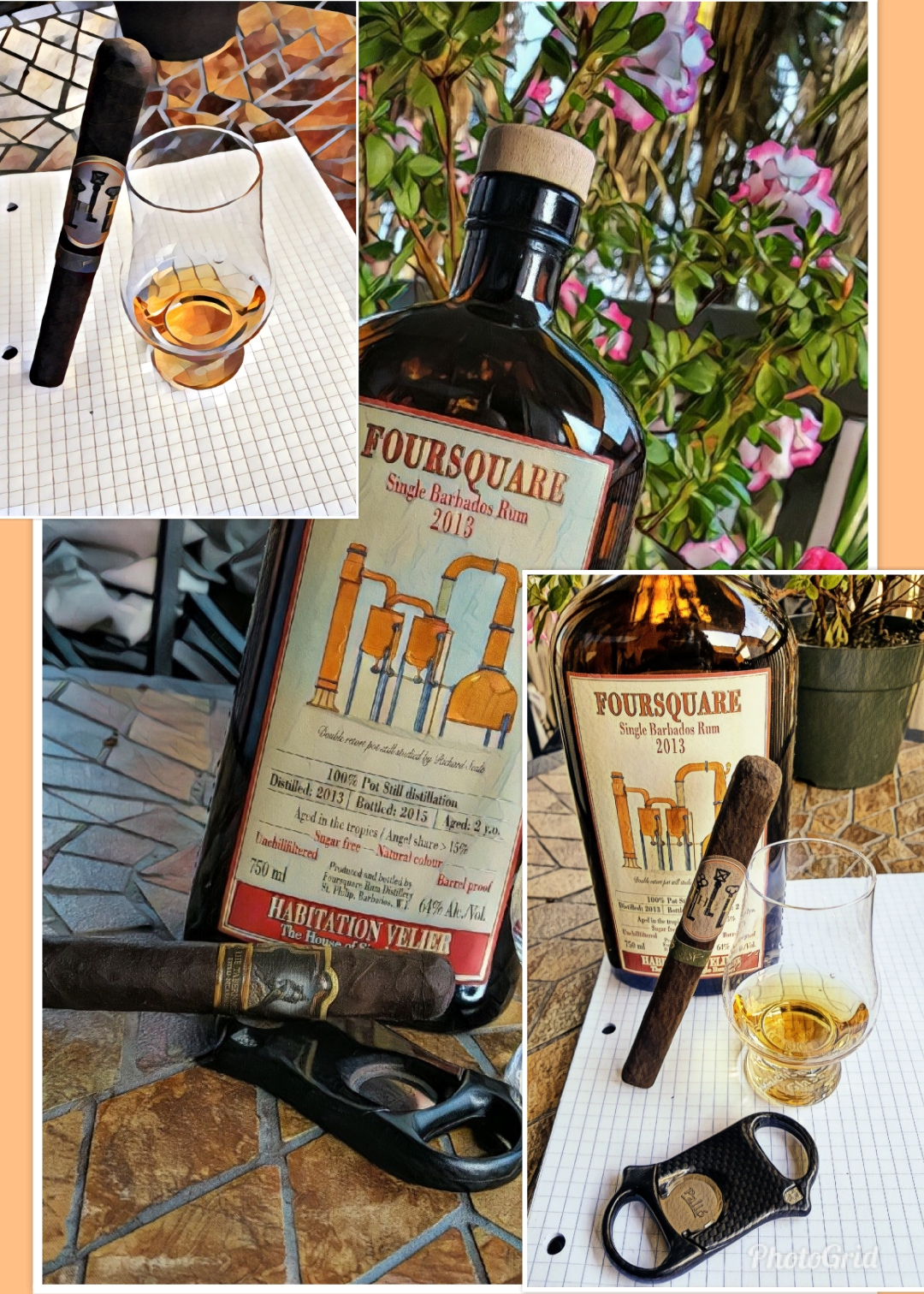
There is one down side to drinking these. They do tend to be pricey. This Worthy Park was $60, a little steep for me, but it did come highly recommended, I can see why. As goes cigar pairing (the cigar pictured is the last of my Padilla San Andres Reserva, I haven’t found any combination yet as good as everything seems to be with the Premise. But this is a great rum and a great counterpoint to sweeter offerings if you are in the mood for a change.

Book Review: Fear: Trump in the White House by Bob Woodward

I haven’t much additional commentary to add here except perhaps to expand a little on my comparison between Wolff’s “Fire and Fury” and Woodward’s Fear. Wolff’s published much earlier covers a shorter time, about 200 days compared to Woodward’s 760+. As mentioned in my review, Wolff focuses on the ring of people immediately surrounding Trump (of course he brings in the next outer band) while Woodward expands his focus to that next outer band while the characters in the inner most group (other than Bannon) receive somewhat less scrutiny. This approach makes perfect sense given the expanded time frame of Woodward’s book.

Woodward is more sympathetic to all concerned (even Trump) than Wolff. Wolff’s picture is one of conflicting and shifting groups running around like chickens with severed heads while doing their best to increase their political influence and personal wealth. Woodward reveals the same self-interested politics in the inner circle while many of those in the wider circle, and even a few in the inner one, are trying sincerely to keep Trump from destroying the nation at every impetuous turn. Sincerity here has a mixed result as many of these people have incompatible political views concerning what constitutes a rational course in the first place. Both books paint a terrifying picture. Wolff’s is more terrifying, but Woodward’s is more frustrating because he highlights many opportunities (never taken) to bring parties together.

Fear: Trump in the White House by Bob Woodward 2018

My first observation is that this book is not as long as it seems. The first 63% (my Kindle tells me that) is the body of the book followed by a long chapter of acknowledgements, a detailed listing, chapter by chapter, of sources with lots of online links (including many of Trump’s infamous tweets), and a long index. Trump assumed the presidency on Jan 20, 2016. The last date mentioned in the book is March 21 2018 so about 760 days into the present (Sept. 2018) administration.

One cannot help but compare Woodward to Wolff’s “Fire and Fury” (also reviewed). Wolff’s focus is the shifting cabals immediately surrounding the president in his first (roughly 200) days. Woodward hits all the same characters and follows them as well but more through the lens of national and international incidents and issues occurring at the time, some precipitated by Trump himself. The characters are painted almost sympathetically, even Trump, relatively speaking. The unifying issue throughout is how the staff, principal cabinet secretaries, and members of Congress struggled to prevent the ever impetuous Trump from wrecking the economy or starting world war III, while a few were eager to egg him on in support of his most destructive instincts. The influence goes both ways. Trump appears to have supported DACA recipients specifically (though he never liked any of the rest of U.S. immigration policy) but was turned away from even DACA support by congressional hard liners.

There are lots of missing pieces. I suppose it would be impossible to include everything. Sean Spicer is mentioned, as is the hiring of Anthony Scaramucci but there is no word about their departure. Of course many characters do come and go. Like Wolff, Woodward focuses early on Bannon, but he hardly touches (of course they are present in the story) Jarad and Ivanka. Like Wolff, Woodward paints a picture of a man whose comprehension of the world’s complexity rises to the level of an elementary school graduate, a man mercurial and impulsive with uneven check on his actions by the adults in the room, often because they themselves are conflicted over every issue.

Washington Post publisher Phillip Graham seems to be credited with the observation that “Journalism is the ‘first rough draft of history'”. That rough draft is unfolding before us in books like Wolff’s and this one from Bob Woodward. I expect there will be a few more before this presidential term is over. Historians of the future (if there is a future) will not lack for sources. If like me you are a news junkie, this book will be an enjoyable, if frightening and possibly frustrating (so many opportunities lost) ride.

Book Review: The Attack of the 50 Foot Women

I try to read on subjects outside my mainstream interests. This is one of those books, broadly feminist. Not philosophy, but rather a clear statement of what inclusiveness in terms of the politics of sex means, how an ideal tolerance would come out in social institutions political and otherwise. Besides this, the book is a catalog of some ten years of investigation into the status of this ideal in various parts of the world. Finally, it threads in the history of one such attempt (still going on I hope), literally a political party focused on these issues, in the United Kingdom.

Philosophically there are two issues she fails to develop. One more minor she mentions but does not explore; the impact of present diversity (racially, sexually as it stands in different cultures) on the trajectory of political attempts at realizing the ideal. The more major issue is that of history. From the outset of human existence women have labored (literally and figuratively), the only member of the species that bears children. In fact this goes back far deeper into the past, to the earliest mammals at least, but in human society the distinction matters more and has always mattered more. Primitive hunter-gatherers were not egalitarian (Mayer appears to believe they were) but highly specialized along sexual lines. Men hunted, stood guard, and fought (until there were no more men and the women had to fight). Women gathered, bore, and mostly raised children; girls for their whole lives, and boys until they were old enough to hunt, stand guard, and fight. There are a few, but very few counter examples in Earth’s history.

There is literally a million years of such history behind us and this differential has had social-psychological consequences in the form of inate bias on both sides, male bias and female bias manifesting quite differently conditioned by the still considerable difference in physical size and strength of [most] men compared to [most] women. Should we, now in this “civilized age”, be attempting to erase this bias? I think yes, we should. Will we be entirely successful even in the next thousand years? Likely not. I address this further in the review below.

So was it a good book? Sure, why not! If nothing else, philosophically, Ms. Mayer has deliniated for us what sexual-identity-tolerance means and at least one example of its political expression. I wish her well!

Attack of the 50 Ft. Women: From man-made mess to a better future – the truth about global inequality and how to unleash female potential by Catherine Mayer 2017

I thought I might take a little side trip in to the political and social philosophy of feminism, but this book really isn’t that. Ms Mayer is more about a historical review and international survey. There is a chapter on just about every possible arena in which women and men either compete, cooperate, and frequently do both at the same time. She highlights both the common threads and differences between issues of gender and those of race and economic status across all races and genders. Throughout her intellectual and geographic wanderings (traveling widely interviewing people of many perspectives) Mayer weaves in a thread about the beginnings and organization of a United Kingdom political party (The Women’s Equality Party) that she and a few others launched but a few years ago.

Historically Mayer covers four generations of feminist movements, the suffragets of the late 19th and early 20th centuries (in some nations extending as on down to today), changes brought about by the demands of World War II, the movement in the U.S. and Europe of the 1970s, and of course the situation in the 21st Century. Pay differentials, political representation (government and corporate), violence against women, the situation in education, the real (nuanced) nature of physical and psychological gender differences, the role of institutional religion, and how all of this plays out in various parts of the world are given consideration.

On the whole Mayer does a good job of surveying the historically recent (last few hundred years) and present scope of issues and how these might be adjusted. On the whole her view cannot help but be colored by modern “identity politics”, but she does not call for absolute equality in the economic sphere. She does not expect that half the fire fighters or soldiers in the world will be women, nor half the nurses men. But she does think that we can do much better than we are in the political, and overall in the economic, sphere. She insists that a world in which women are genuinely respected, genuinely recognized to be the equals of (if not the “same as”) men in the process of building a society, will be more productive and peaceful. I am sure she is right about this because a society, such as ours, where respect is lacking is distorted socially, economically, and psychologically. It cannot help but be worse for all concerned (generally, the super-rich will always get by).

So her survey is good and her points well made, but in this reviewer’s opinion she is mistaken as concerns the roots of the problem. There is no excuse, in our modern world, for the gender (or for that matter racial) disparities that presently exist. But she never asks the counterfactual question that sets up the difference that really made a difference through 99% of human history: why aren’t men having more babies? Every social, economic, and political difference between men and women on this planet is rooted in that inconvenient biological fact; only women can bear children.

This is a handicap that men, and not merely women (as Mayer well notes) should be striving to mitigate, and while it might be overcome in the social sphere, violence against women must cease, it will never be quite overcome in the economic or political spheres because whether men have “paternity leave” or not, women, most women, MUST drop out of the economic and political spheres for a time or there won’t be any future economy or politics to worry about. In modern society there is no real excuse for any inequity between the sexes. We can COMPENSATE for the child handicap. But it is a compensation and not merely an acknowledgement of women’s equal importance. The devil is in those details.

Review: Foursquare Premise Rum

Review: Foursquare Premise Rum

Another offering from Richard Seale. Premise is one of those special barrel bottlings released in the last few years by Foursquare Rum and available in American brick and mortar stores (with good rum collections) for about $55. A tad more than the earlier “Port Cask” and “Zinfandel Finish” releases. Although it isn’t in the name I’m told to think of this as a “sherry cask” rum. As in all the other releases, these are supposed to be dry ex-sherry casks, and the rum contains no additives.

The rum is a medium amber, not pale, but by no means dark. More brass than copper colored. When swirled in the glass it forms medium thick legs that flow pretty fast. Bottled at 46% ABV a good down the middle strength given the present fashion for “naval strength” rums. Smooth and delicious as it is, it had enough fire going down to convince you there is real alcohol present. The rum is aged 3 years in ex-bourbon wood and then 7 more in ex-sherry wood. More detail can be found here at the fatrumpirate site.

On the nose there is intense Caramel, toffee, brown sugar, raisin, even apple or green grape, and maybe light ripe pineapple. Also enough alcohol to push it all out, I don’t get any petrol or varnish notes. This is one sweet and slightly bright-fruity aroma with a little oak thrown in.

The flavor is surprisingly sweet maybe sweeter than the port and zinfandel bottlings. Lots of brown sugar, light caramel, maybe a little tobacco, sherried oak. The sweetness is a little less up front on subsequent sips. Finish is long and sweet, there is no bitterness here. Not a lot of fruit in the flavor for me, but what there is isn’t dark but light. The body is distinctly creamy, a little thick.

You know I always drink rum paired with a cigar. It so happens that the only wine I really like paired with cigars is sherry. Needless to say a “sherry cask” finished rum from foursquare was going to hit the spot. It does. Goes well with every stick I’ve tried, 5 of them at this point. A little expensive yes, but if you have developed a palate for unadulterated rums lately you’re going to want to try this one.

Happy sipping!

The Mistake in Theological Fatalism

“God knows everything you’ve done and loves you. God knows everything you are going to do and still loves you” Vern Benom Grimsley

There is a present fashion among intellectuals, a belief they are not free willed in the libertarian sense, that libertarian free will is impossible in a universe of randomness (quantum mechanics) and determinism (everything else). Although this present fashion is rationalized by modern physics, the idea is as old as the Greeks. Democritus (of atom fame) was one of those who believed this, and so the debate has gone on for some 2400 years.

I make no secret of my scorn for this fashion (see “Arguing with Automatons” and “The Nonsensical Notion of Compatibilism”). It is the philosophical equivalent of adolescent obsession with self-mutilation. Philosophers, even atheist philosophers like John Searle (“MIND” 2005 and “Making the Social World” 2010), Nicholas Rescher (“Free Will: A Philosophical Reappraisal” 2009), and Edward Lowe (“Personal Agency” 2006), address the absurdity of this position, though Searle admits he cannot reconcile his epistemological conviction that free will must be genuine with his equally strong metaphysical conviction (grounded in physics) that it is impossible.

In this context, the term ‘libertarian’ is not a political ideology but refers to the idea that some agency, my “I”, is volitional; “at liberty” to cause (in Rescher’s term “initiate” [atemporal cause]) some sorts of neurological activity in my brain. Some entity (often called mind) is the starting point of actions instantiated in the physical world by my body. In effect a subjective agent, I, and not merely neurological activity (which I am not aware of directly) am in command/control of my body, and this I, while resting on neuro-physiology, has some independence from physics; there is a gap between that which chooses, and the physiology the choice precipitates. For this reason, the term “contra-causal will” is associated with libertarianism.

The idea here is that this “I” in command (mind?) does not appear to be a physical entity and so libertarian free will commits to the added idea there is in the universe a “cause of the physical” that is not physical. This idea violates a central principle of physics known as the Causal Closure Principle (see “Fantasy Physics and the Genisis of Mind”). The two ideas, libertarian will and contra-causal will, are therefore associated, but the connection rests on the assumption the “I” is not a physical object. ‘Libertarian’ refers to phenomenology, first person experience, while ‘contra-causal’ cause is a metaphysical idea. “Theological Fatalism” addresses the former and is not necessarily committed to the latter should the “I” happen to be physical (see “I Am a Strange Loop” 2004 by Douglas Hofstadter and Lowe referenced above).

THE PROBLEM

On the other side of the debate, philosophers of religion (also going back to the Greeks) have an escape. God, being omnipotent, knows the trick of making contra-causal (and so libertarian) free will possible in a universe whose only other causes are random or deterministic.

Logicians then framed a puzzle. If God is omniscient, he knows everything that has, is, and will happen. This has to include every choice ever made (and ever to be made) by any minded being, personal or otherwise. If that is the case, if God already knows that when you step into a taquiria you will today order pollo and tomorrow carne asada, how can those choices be free? You cannot avoid the problem by intending to order chicken and then at the last moment changing your mind; God knows you will do that too. This puzzle is called “Theological Fatalism”. Even if God is the source of a third (contra-causal) cause, and “mind causes physics” (Sean Carroll “The Big Picture” 2016, something Carroll of course denies is possible) that cause cannot be free in the libertarian sense because God already knows what the choice will be and can never be wrong about it.

The puzzle is reminiscent of Zeno’s paradox (back to the Greeks again). Zeno said that movement, change in space, is impossible because to move a mile, or a foot, or even a millimeter, one has to go first half the distance, and then half that distance and so on blocking any movement before it begins. Although it seems obvious that we can move, it took some time for philosophers, early mathematicians, to figure out where Zeno goes wrong. The distance between any two points can be divided into an infinite series of smaller distances. Mathematicians demonstrated that one can traverse or complete an infinite series in a finite time. Zeno did not account for time and in a sense the same is true of Theological Fatalism, or at least that is a part of the story.

Before I dismantle this puzzle I want to note that this argument is raised by scientists and philosophers by way of ridicule; God himself is (or would be) inconsistent with free will. Oddly, many present-day theologians and philosophers of religion have accepted the argument and decided that therefore God is either not omniscient or not omnipotent!

If a theologian does not understand that God must be able to do and experience in ways we cannot and that there are logical riddles, transparent to God, we cannot (perhaps never will) fathom, who will? Such philosophers should hang up their philosophy hats and go away. Logically probing how such qualities as omnipotence and omniscience go together and yet provide for free will is one thing. Denying this is possible because they cannot figure out how it works is ridiculous; the pinnacle of hubris!

THE SOLUTION

If God is God then he knows everything that has, is, and will happen throughout time with absolute assurance, never guessing, and never being surprised. His knowledge is immediate and atemporal, it is a knowledge of a sort we know nothing about by experience, nor can we grasp it logically. We can suppose that God’s knowledge must be infinite and perfect, but not what that is like to experience it.

I’ll go further for the sake of the conundrum. Harry Frankfurt is famous in ethics circles for coming up with a puzzle. A mad genius has learned to take over brains and can cause a person to make any decision the genius wishes. Moreover, the genius knows (here is the real genius) what decision you make as you are making it. If your decision is what the genius wants you to do anyway, she need do nothing. But if your decision is about to be what she doesn’t want, she can force you to make the one she wants and do so in such a way that you do not even realize you are being forced! The question is: is your will still free?

The short answer to the Frankfurt question is, I think, yes you are free when you make the decision the genius wants and no otherwise. My point in bringing this up is to note that God has the power (omnipotence plus omniscience) to be the supreme Frankfurt genius! While we appear to be free, we are merely compelled (having no feeling of being compelled) to follow God’s script. But this mistakenly implies a causal relation between what God knows and what we do. No one claims theological fatalism precludes freedom because it is causal . It is rather a logical problem. God does not cause, that is force, us to make a particular choice.  The matter is rather about what God knows in what seems, from our viewpoint to be “ahead of time”. But God’s foreknowledge is foreknowledge only from a human, temporal, perspective. What ever be the limits of human libertarian freedom, even the most dyed-in-the-wool libertarian does not suppose that such limits include contravention of natural law, including time.

In the comments here an interlocutor points out that what God knows amounts to fate, and for this reason we are not free. It is a viewpoint that amounts to a deduction from a universal perspective impossible for us to actually have. Since “God is one” one might argue that everything that, to us, appears differentiated about the universe is all illusion or but a shadow of the singular unified reality. This ignores the manifest, to us, reality of matter and a richly differentiated universe. Both views reflect the same singular reality, some shadow to God, differentiated reality to us. It is from this perspective that we are free even if what we choose is, from God’s universal view fated.

No libertarian claims our freedom is absolute. Just as we cannot contravene natural law, so also we cannot surprise God. So long as (and assuming) mind is a cause in time, the future is genuinely open in time! If from our perspective, always limited to the present, a choice makes a future difference, then our choice is free from within that perspective.

Of course we might still be wrong about this if God is a deceiver, if it is in fact the case (as in Frankfurt’s clever puzzle) that we are not the cause of our choices, or that we are that cause only when we choose what God has foreordained. But if we are deceived then God has to be causing our choices and that is not the crux of theological fatalism.

There is every reason to believe that God (should he exist) cannot be a deceiver (see Prolegomena to a Future Theology). It does seem to experience that our will itself, the subjective mind exercising it, is (provided we are of normal brain) sovereign over choice no matter what choice we make. That God knows what that choice will be does not abrogate its freedom from within the view of our temporally constrained, to the present, perspective.

From our viewpoint, future possibilities from among which we choose (God knows these also) are in fact genuinely open to us because we do not know what God knows. We do, subjectively, choose from among alternatives and “which choice” we make makes a future difference to us and others whom the choice may entangle. This is all a robust libertarian free will needs. The strongest advocates of libertarian will do not demand that no power in the universe knows what you will decide.  Being unable to “surprise God” does not equate to fate from our perspective.

Libertarianism requires only that we cannot know what that power knows and as concerns God’s viewpoint this is surely true.  To say then: “well our freedom is purely perspectival, or stems merely from our limited perspective” is trivially true, but over-simplified. All freedom short of God stems from or exists within some perspective. It is freedom nevertheless because from within any perspective it bears causal responsibility for the particular choice made.

All that libertarianism requires is that subjective agency, the self-aware subject, and not deterministic neurophysiology nor God causally, initiates action from within its perspective and this requirement is fully satisfied in the human experience of willing. We are free in our experience and if “mind can cause physics”, if contra-causal cause is real (possible if God is real), and God is not a deceiver, then we are free in the libertarian sense, from within our perspective, despite what God knows. God knows what we will choose, but so long as his knowledge is not a cause of our choice our will is free within its constrained perspective. Theological fatalism is a false doctrine.