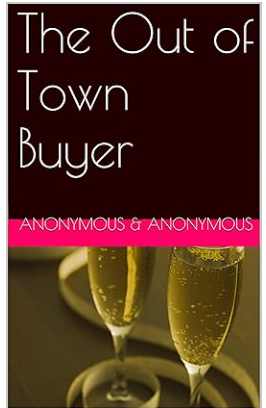
To keep the entire corpus of Matthew Rapaport’s work together, I cannot fail to mention this book attributed to Anonymous & Anonymous. Make no mistake. Mr. Rapaport is one of its authors. Yes, only one of them.
In the mid-2000s, Matthew had an affair with a married woman whose real name and location still cannot be revealed. Known only as J., he discovered she was a good writer of erotica and they conspired to co-create an experimental novella in which each party uses a paragraph or two to describe some part of a scene, the paragraphs alternating between Matthew (M) and J as they proceed through the story. To separate the two voices, each author’s part is written in a different font and signaled with an M or J.
The story concept is simple: a man travels from the West Coast to the Midwest to buy a house for his family because his job is to be transferred there. His realtor, J, meets him at the airport and they go off together looking at houses. Each finds the other attractive, and back in his hotel room, Matthew seduces J. As it turns out, J, married for 25 years, does not have a great sex life in her marriage and lustfully craves the orgasms Matthew’s tongue delivers. What follows is a weekend of house hunting punctuated by a lot of over-the-top explicit sex.
Unlike Matthew’s other novels, The Out of Town Buyer is not a story mixed with a lot of sex. Rather, the sex is the story! As an experiment, it works well. Matthew did all the editing, but J’s voice comes through nicely, the two complimenting one another well. The story, written in 2005 wasn’t published until 2012 when Amazon publishing came to Matthew’s attention.
As of December 2024 there are four novels (five counting an anonymous novella) published on Amazon. All but the novella are published in Kindle (recommended) and paperback form. There are also reviews published here by guest author Wehttam Tropapar. I will link to Mr. Tropapar’s reviews below. There are links to the books on Amazon in each review.
Foreign Agent was conceived while I was taking a shower, having just finished joking with my girlfriend about Chinese technology (his television, Alexa, phones, etc.) monitoring our sex. I joked that I should invoice the Chinese. As I go off to my shower, I say to her: “The only fantasy in all of this is that the Chinese would pay me.” In the shower, I had an epiphany! “I could,” I said to myself, “simply make believe the Chinese would pay me”—not for sex, but for my geopolitical opinion! Sex was an added bonus. And so Foreign Agent was born.
Foreign Agent was to be a stand-alone novel. I had no thought to write another. But some months after the publication, in another shower, I had another epiphany. There was an element of the first novel, the aliens mentioned only in its last chapter, that could be the basis of a second novel, and so Foreign Agent the Last Chapter was born! This novel is closely tied to the first. The locale and characters are the same; only time has passed.
Once again, in the shower, I wistfully realize that my two novels are not selling very well—a few copies a year, maybe! But what might happen, I wonder, if the Cult of Aten (conceived in the second novel) were made real and took off? That became the basis of the third novel, the Cult and the first two books becoming wildly successful! But while the first two novels are ostensibly drafted by Francis Nash in Bangkok, this one is written by me-as-myself. The setting and characters—except for introductory mentions establishing context for the reader—are entirely different. If Foreign Agent and Foreign Agent the Last Chapter are brothers, Cult of Aten is more of a distant cousin and can be read as a stand-alone novel.
My fourth novel, LoveMe Inc., is entirely independent of the other novels. Narrated by a 38-year-old Matthew (who is not supposed to be me), the novel takes place near Washington, D.C., in 2027-9 and is something of a political thriller. There are a dozen or so main characters, but the central trio includes a libido-charged artificial intelligence conspiring to take control of U.S. and international politics based on ideas found in its training documents—which happen to include—surprise, surprise—the three prior novels of Matthew Rapaport!
The Out of Town Buyer is a co-authored novella, my first non-short-story piece of literature, written in 2005-6 but not published until 2012. The authors are listed as Anonymous & Anonymous to reflect the joint authorship and also hide themselves as both were married (one still is) at the time of the writing. Discovering that J (the co-author) was herself a stimulating erotica writer, I proposed that we write a story together. She proposed that we get together to “do some research.”
The story idea was that each scene (the sex and what happens before and in between the sex) would be crafted in detail and that each author would take a paragraph or two to describe that part of the scene in first person from their own viewpoint, the shifting voices being signaled by a change in font. Together (sometimes in bed), they mapped out the story paragraph by paragraph.
Unlike the later novels, part story and part sex, the novella is, except for an introductory few pages where we meet, all about the sex. My primary aim was to coax J into describing her orgasms. The reader will have to judge my degree of success.
***
Sex in the novels: Through the 1980s, 90s, and into the early 2000s, I wrote a half dozen pornographic short stories published on the Usenet (it was one of these stories, published in 2005 on Literotica, that brought J and me together to write The Out of Town Buyer). In those stories, excessively erotic explicitness is the backbone of the writing’s humor. This practice is only a little smoothed out in the novella, and sex remains over-described in the first two novels. When I wrote Cult of Aten, I decided it was too much of a good thing. In the longer form, the over-description got tiring. As a result, most of the over-description and even some, but by no means all, of the explicitness is removed in Cult of Aten, and this process advances in LoveMe Inc., where even more of the sex, but not all, is closer to soft-core.
LoveMe Inc. is Matthew Rapaport’s fourth novel, a new story in a new place, with new characters, including the narrator (also Matthew), who is but thirty-eight years old. Ah to be young again… And yet, despite it’s narrative separation from the person of the author, Matthew manages to contrive some marketing for himself and his particular skills.
The story begins ambiguously in the summer/fall of 2027. Matthew, a programmer and statistical analyst, is contacted by a libido-endowed artificial intelligence (AI) and leads him into the employ of Dr. Pamela Parker (who researches psycho-sexual pathologies in women) and her post-grad student Lakshmi Tripathi. When the book opens, Matthew has already seduced and fucked six of Dr. Parker’s patients—I’m drifting into spoiler country here! No sex is portrayed in this part of the narrative, but his “bad boy” behavior comes back to bite him (and not in the good way).
Together the three of them, along with the AI, discover that certain women can be politically liberalized by orgasms. Between them, and soon more characters come into play, plots are hatched to help sway the national election of 2028, which the Republicans—having, as we know, won in 2024 by disinformation-appeal to an undereducated electorate—plan to fix so that electoral politics in America is ended once and for all.
There are multiple twists in this plot. AI is at the center of most of them. To tell you anything would commit major spoilers. Here is a minor one: how does Matthew Rapaport market himself? The full answer has two parts, but I’m only going to reveal one. His three novels (Foreign Agent, Foreign Agent the Last Chapter, and Cult of Aten) are the last three novels in the training corpus of the libidinous AI! Of the second, I will only say that it is one of the novel’s tragedies.
Mr. Rapaport is surely honing his craft. This is the most complex of his novels thus far, and except for a limited amount of gratuitous sex—90% of all the sex being softcore—the action all connects up sensibly. Moreover, there are no hanging threads needing resolution in epilogs. Mr. Rapaport ends this one properly!
Liberalism combined with modern democratic government is the only socio-political philosophy that builds and maintains a happy society in the long run. The basic idea is that the locus of cultural and political choice lies with the individual, not the group. Fukuyama makes clear that this freedom of the individual cannot become license. There must be some commonly accepted behavioral boundaries, roughly captured by the notion that I am free to swing my fist until it makes contact with your nose.
Fukuyama uses most of the book to explore alternatives to liberalism: Communism, Fascism, neo-liberalism, pointing at Libertarianism, and identity politics. One by one, he shows how these alternatives (combined with human nature) always lead to political and economic unfairness greater than that of democratic liberalism, democracy–the vote–adding the dimension of political choice.
He then explores criticisms of “true liberalism” itself, for example, its insistence on tolerance of widely diverging cultural norms and possible violation of religious or nationalistic prescriptions or proscriptions. These might help establish cultural norms of behavior but may just as easily discourage tolerance of differences. Without something to be shared—Fukuyama cites nationalism as one, albeit dangerous, possibility—the polity is ultimately pulled in so many directions that policy gridlock ensues.
Of course, all of this is theoretical. The U.S. is no longer entirely “democratic,” and what aspired to be reasonably liberal in the post-WWII generation is now divided, socially, culturally, politically, and even economically, into blocks that see competition between themselves and others as a zero-sum game.
Neither liberalism nor democracy can persist in the face of an insufficiently educated public. If the education system permits a generation to forget the horrors perpetrated by attempts at systems other than liberal democracies, the next generation—dissatisfied with the difficult choices liberalism forces on the individual—will think to attempt them again. Even worse, an education system that leaves basic facts (scientific and historical) in doubt breaks apart the last atoms of common ground the polity possesses.
I have said elsewhere that a fully tolerant society cannot tolerate intolerance at the risk of its tolerance being politically undercut. The U.S.’s tolerance of intolerance had led us down the populist path thanks to education’s failure noted above. Fukuyama’s apology for classical liberalism is right on the mark as far as I am concerned, but then, I’m an educated individualist who gets along with his fellow man! Too many now fail at one test or the other.
In the not-to-distant past, we were, perhaps, a bit closer to the educated-liberal polity ideal. Of course, we were never entirely there—the “good old days” were never wholly good. Distortions have always existed—selfish individuals who would leverage the non-liberal to their own political or economic advantage, further distorting the system—and under those conditions, when society tolerates outright intolerance of others for political, racial, or sexual reasons and historical education fails, the liberal order is quickly eroded. We are living the process now.
Author’s note: As of December 2024, I am no longer posting reviews of my non-fiction reading on Amazon (see this for more information). I will continue to post reviews here, and in addition, instead of posting the original [Amazon] review preceded by my extra comments, I will review with integrated extra comments.
A superb review not only of conspiracy theories but also of the psychological and now political phenomenon of conspiracism, the inclination to believe broadly in conspiracies. Belief in broad fantastical conspiracies has been around for a long time. Dr. Konda takes us through some history, starting in Europe but then quickly moving to the U.S., which has, it seems, been conspiracy-addled since its founding.
Konda takes us through the broad conspirational ideas, the hidden hand conspiracies of the Illuminati, Jews, bankers (often Jewish bankers), and so on, down to more modern variations, like the anti-vaccine crowd, climate change denialism, Kennedy assassination conspiracies, the “9-11 truther movement,” and so on. Some of these ideas—fake moon landings, flat Earth—are harmless in themselves, while others—mistrust and misunderstanding of science in general or the illegitimacy of the Federal Government—are potentially very dangerous—psychologically, socially, and politically.
Konda leaves us embedded in the modern problem. Despite conspiracism’s long U.S. history, it is surprising that so little government economic and social policy was impacted by it—until the present century. The rise of social media—cheap international communications direct to the individual—has greatly increased the reach and danger of the conspiracist landscape.
How have we come to this sorry state? The bottom line seems to be a failure of American education, a crucial lack of civics and critical thinking. Ironically, the present educational environment is reinforced by a generation of conspiracists who now comprise a large part of the government. Civics is “socialism”, and critical thinking is “wokeism,” and so on.
I make only one small critical point. The book was published in 2019, and there is no mention of QAnon, a conspiracy consolidator and clearing house—capturing everyone’s social media attention—appearing on the scene in 2017. Konda is too thorough to have missed this. The book was likely finished before QAnon’s emergence, and the publisher responsible for the two-year delay.
An excellent and frankly frightening read not nearly as long as it appears—almost half of it is end notes: hundreds of books, articles, and websites. If you are looking for the roots of present-day conspiracism or have concerns about its present political implications and force, this is a good source.
I believe I have written something around 150+ book reviews for Amazon, but I have posted my last. Why? Over the years, Amazon has rejected three of my reviews for words they didn’t like.
The first two rejections were pretty illogical. In a book titled “On Bullshit” (the book title and link laid out by Amazon at the top of the review), I used the word ‘bullshit.’ In a book titled “Assholes, a Theory,” you can guess the rest. I didn’t make changes to satisfy Amazon’s absurd demands. I simply didn’t post those reviews—the very short Assholes review is here.
The third rejection went differently. In a book titled “Conspiracies of Conspiracies” (history and content of conspirational thinking), the author notes that from the mid-nineteenth to the mid-twentieth century, most political and economic conspiracy theories blamed (among many others) ‘Jews,’ or ‘Jewish bankers’ for the world’s troubles. It seemed to me it must be the words derived from ‘Jew’ that was Amazon’s problem.
This time, I tried an experiment. I re-submitted the review, substituting underscores ‘____’ for the words ‘Jews’ and ‘Jewish.’ The result was not merely another rejection but a warningletter telling me I had “violatedcommunityguidelines.” (Is there a guideline pertaining to underscores in reviews?), and I should consider the letter a “first warning.” Amazon would, they said, ban me from posting reviews should I continue my unsocial behavior.
That email was the last straw for me. The “first warning” will be my last. I will post no more reviews of non-fiction books on Amazon. I will make an exception for fiction writing by authors I know on social media, especially if they also review one of my books (novels or non-fiction). I will continue to read non-fiction purchased from Amazon (via bookbub.com), and if interesting enough, I will continue to review them here as I have done now with my conspiracies review.


 Ruminations